Betty A. Laird – författare
Visar alla böcker från författaren Betty A. Laird. Handla med fri frakt och snabb leverans.
5 produkter
5 produkter
Inbunden, Engelska, 2020
2 244 kr
Skickas inom 10-15 vardagar
In the 1970s Eastern Europe and the Soviet Union have changed from being net grain exporters to major grain importers. Clearly, unfavorable weather has played a key role in this dramatic reversal. However, as several of the authors of this book argue, bad policies have played a key role. In the authors’ analyses of the new five-year plans, a serious question is raised as to whether the nations involved can meet their ambitious goals. Indeed, a strong case is made that the U.S.S.R. will not only continue to be an importer of grains, but that it will increase such imports over the years. Although the CMEA nations have made increases in food output in the last two decades, a point of diminishing returns seems to have been reached. Future demand for food imports may have an enormous impact on international affairs. Even if the nations involved were to collectively meet their ambitious production plans, which the authors doubt, there is no possibility that the area will be able to make any significant contribution to mounting world food demand in the foreseeable future. This fact alone is of great significance in a world facing a mounting food crisis.
Häftad, Engelska, 2022
613 kr
Skickas inom 10-15 vardagar
In the 1970s Eastern Europe and the Soviet Union have changed from being net grain exporters to major grain importers. Clearly, unfavorable weather has played a key role in this dramatic reversal. However, as several of the authors of this book argue, bad policies have played a key role. In the authors’ analyses of the new five-year plans, a serious question is raised as to whether the nations involved can meet their ambitious goals. Indeed, a strong case is made that the U.S.S.R. will not only continue to be an importer of grains, but that it will increase such imports over the years. Although the CMEA nations have made increases in food output in the last two decades, a point of diminishing returns seems to have been reached. Future demand for food imports may have an enormous impact on international affairs. Even if the nations involved were to collectively meet their ambitious production plans, which the authors doubt, there is no possibility that the area will be able to make any significant contribution to mounting world food demand in the foreseeable future. This fact alone is of great significance in a world facing a mounting food crisis.
E-bok
PDF, Engelska, 2019702 kr
Läs direkt efter köp
In the 1970s Eastern Europe and the Soviet Union have changed from being net grain exporters to major grain importers. Clearly, unfavorable weather has played a key role in this dramatic reversal. However, as several of the authors of this book argue, bad policies have played a key role. In the authors’ analyses of the new five-year plans, a serious question is raised as to whether the nations involved can meet their ambitious goals. Indeed, a strong case is made that the U.S.S.R. will not only continue to be an importer of grains, but that it will increase such imports over the years. Although the CMEA nations have made increases in food output in the last two decades, a point of diminishing returns seems to have been reached. Future demand for food imports may have an enormous impact on international affairs. Even if the nations involved were to collectively meet their ambitious production plans, which the authors doubt, there is no possibility that the area will be able to make any significant contribution to mounting world food demand in the foreseeable future. This fact alone is of great significance in a world facing a mounting food crisis.
E-bok
Engelska, 2019702 kr
Läs direkt efter köp
In the 1970s Eastern Europe and the Soviet Union have changed from being net grain exporters to major grain importers. Clearly, unfavorable weather has played a key role in this dramatic reversal. However, as several of the authors of this book argue, bad policies have played a key role. In the authors’ analyses of the new five-year plans, a serious question is raised as to whether the nations involved can meet their ambitious goals. Indeed, a strong case is made that the U.S.S.R. will not only continue to be an importer of grains, but that it will increase such imports over the years. Although the CMEA nations have made increases in food output in the last two decades, a point of diminishing returns seems to have been reached. Future demand for food imports may have an enormous impact on international affairs. Even if the nations involved were to collectively meet their ambitious production plans, which the authors doubt, there is no possibility that the area will be able to make any significant contribution to mounting world food demand in the foreseeable future. This fact alone is of great significance in a world facing a mounting food crisis.
E-bok
PDF, Engelska, 2013763 kr
Läs direkt efter köp
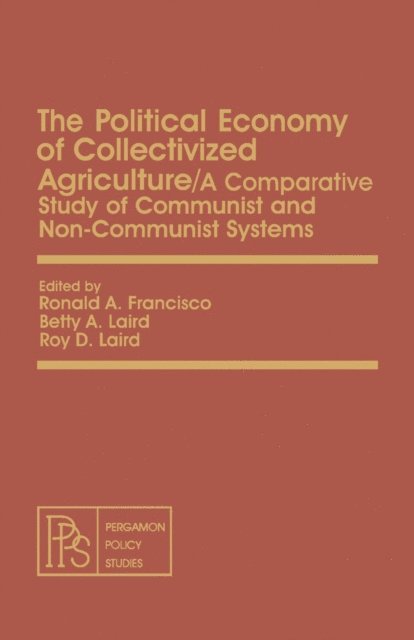
The Political Economy of Collectivized Agriculture/A Comparative Study of Communist and Non-Communist Systems assesses the political and economic impact of collectivization by surveying the experience of several nations with different forms of collective or state farming. Focusing primarily on the Council for Mutual Economic Assistance (CMEA) nations, this book addresses a number of questions, such as whether collectivized agriculture is more or less efficient than private agriculture; whether the manner in which collectivization is implemented affects its success; and whether there are social and political motivations that override economic considerations. This monograph is comprised of nine chapters and opens with a discussion on the advantages and disadvantages of state agriculture in the USSR, followed by an analysis of collectivized agriculture in Romania, Hungary, Czechoslovakia, German Democratic Republic, and Poland. The impact and politics of agricultural collectivization on productivity in China are then examined, paying particular attention to its advantages and drawbacks as well as the factors driving the growth of Chinese agriculture. The experience of Israel with collectivized agriculture is also considered, along with the impact of industrialization and modernization on the kibbutz and the problems associated with embourgeoisement. This text will be of interest to economists, political scientists, and policymakers concerned with agriculture.