Bhanwar Vishvendra Raj Singh – författare
Visar alla böcker från författaren Bhanwar Vishvendra Raj Singh. Handla med fri frakt och snabb leverans.
4 produkter
4 produkter
Inbunden, Engelska, 2026
1 503 kr
Kommande
From Ainu knowledge in Japan and Adivasi foodways in India, to Maasai pastoral systems in East Africa, Iñupiat climate resilience in Arctic Alaska, and Wet'suwet'en forest governance in Canada, Indigenous Knowledge systems are essential to sustainable futures. This volume explores how Indigenous Knowledge operates in diverse contexts, highlighting its adaptability and potential for addressing pressing environmental challenges. Interweaving theory, global case studies, and governance debates across five continents, the book engages critically with rights-of-nature frameworks, ecological sovereignty, carbon markets, and water governance. It also examines the challenges Indigenous communities face in preserving their knowledge systems and ways of life amidst land encroachment, climate change, industrialization, and other pressures. Bridging multidisciplinary scholarship and lived experience, this book positions Indigenous Knowledge as central - not peripheral - to sustainability science and policy transformation. It will be particularly valuable for students, researchers, and policymakers in environmental science, Indigenous studies, sustainable development, and political ecology.
Del 11 - Human-Environment Interactions
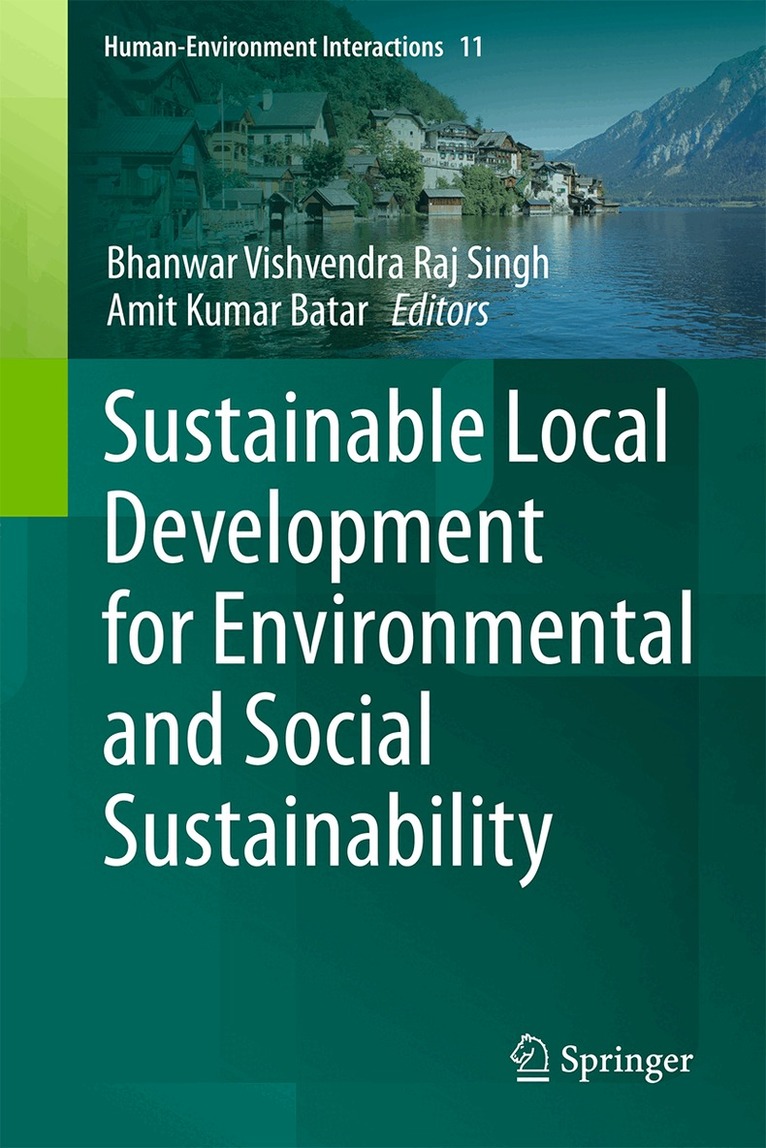
Sustainable Local Development for Environmental and Social Sustainability
Inbunden, Engelska, 2024
1 738 kr
Skickas inom 10-15 vardagar
The world organizations, including national governments, have already recognized the importance of the Aichi Biodiversity Target, the Paris Agreement, Sustainable Development Goals (SDGs), Ecosystem-based Disaster Risk Reduction (Eco-DRR), Low Carbon Society. Therefore, there is an urgent need to act locally to tackle socio-economic, socio-ecological, socio-hydrological, and environmental conservation concerns in changing environments on a local to global scale and need to promote scientific solutions and common knowledge to achieve harmony between nature and humans under the threat of global climate change and the post-Covid-19 pandemic situation. For this purpose, the SLD approach is needed towards environmental and social sustainability. However, the SLD approach is challenging in terms of supply and demand of natural resources, resource depletion, socio-economic inequality, biodiversity loss, and climate change risk from local to the global scale, which vary based on different socio-economic, political, geographical, and cultural factors. Therefore, this book will highlight the environmental and social sustainability research by taking the local/regional case study. This book would also highlights the importance of policy interface at a local to global scale for environmental and social sustainability (ESS) in changing environments.
E-bok
Engelska, 20242 149 kr
Läs direkt efter köp
The world organizations, including national governments, have already recognized the importance of the Aichi Biodiversity Target, the Paris Agreement, Sustainable Development Goals (SDGs), Ecosystem-based Disaster Risk Reduction (Eco-DRR), Low Carbon Society. Therefore, there is an urgent need to act locally to tackle socio-economic, socio-ecological, socio-hydrological, and environmental conservation concerns in changing environments on a local to global scale and need to promote scientific solutions and common knowledge to achieve harmony between nature and humans under the threat of global climate change and the post-Covid-19 pandemic situation. For this purpose, the SLD approach is needed towards environmental and social sustainability. However, the SLD approach is challenging in terms of supply and demand of natural resources, resource depletion, socio-economic inequality, biodiversity loss, and climate change risk from local to the global scale, which vary based on different socio-economic, political, geographical, and cultural factors. Therefore, this book will highlight the environmental and social sustainability research by taking the local/regional case study. This book would also highlights the importance of policy interface at a local to global scale for environmental and social sustainability (ESS) in changing environments.
Inbunden, Engelska, 2027
1 541 kr
Kommande
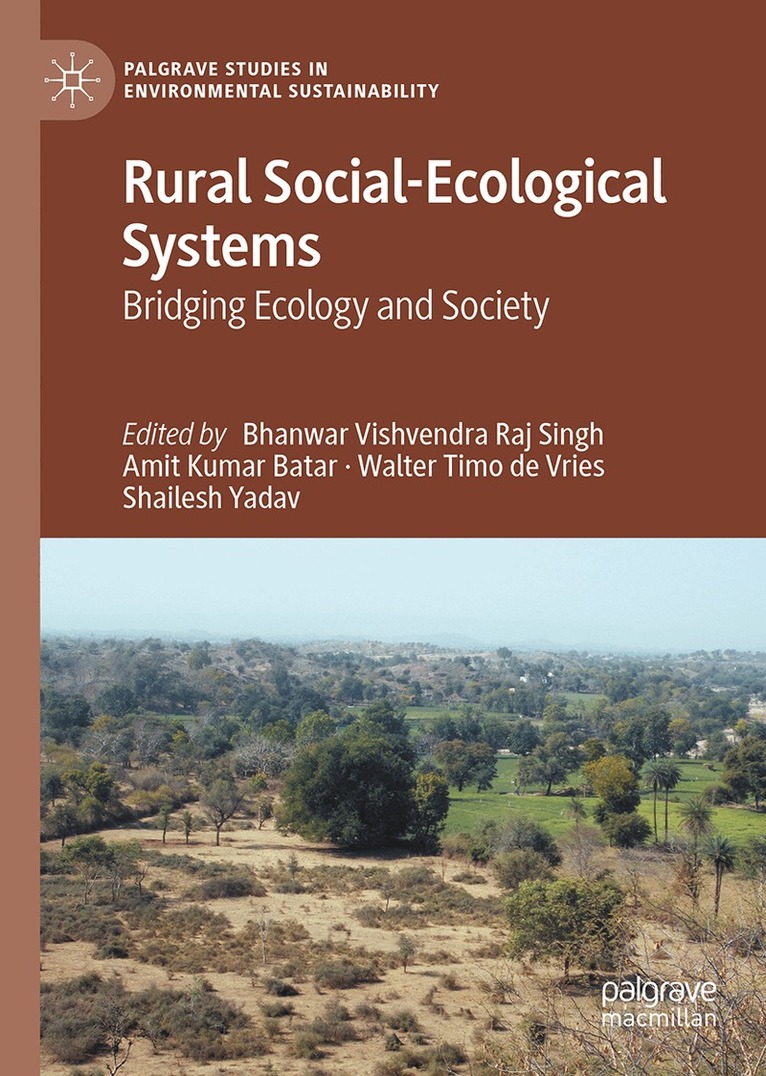
This book explores rural landscapes as dynamic social-ecological systems shaped by environmental change, shifting livelihoods, and evolving governance. It reveals how rural regions function through the interplay of ecology, society, culture, and policy.Moving from core conceptual frameworks—including integrated social-ecological models—to empirical studies, the volume spans Indigenous knowledge systems, land abandonment, pastoralism, sacred groves, climate vulnerability, geo-hazards, gendered livelihoods, biodiversity conservation, infrastructure expansion, and environmental law. These cases illuminate the diverse pressures and adaptive strategies defining contemporary rural environments.Further chapters address governance, resilience building, and adaptation pathways toward more just and sustainable rural futures. The book underscores the need to pursue ecological integrity and social equity together to strengthen resilience, support climate adaptation, and sustain both biodiversity and livelihoods.This volume offers integrative frameworks and actionable insights for an era of global transformation, designed for researchers across ecology, geography, environmental social science, sustainability studies, and rural development.