Blanford Parker - Böcker
Visar alla böcker från författaren Blanford Parker. Handla med fri frakt och snabb leverans.
2 produkter
2 produkter
Del 36 - Cambridge Studies in Eighteenth-Century English Literature and Thought
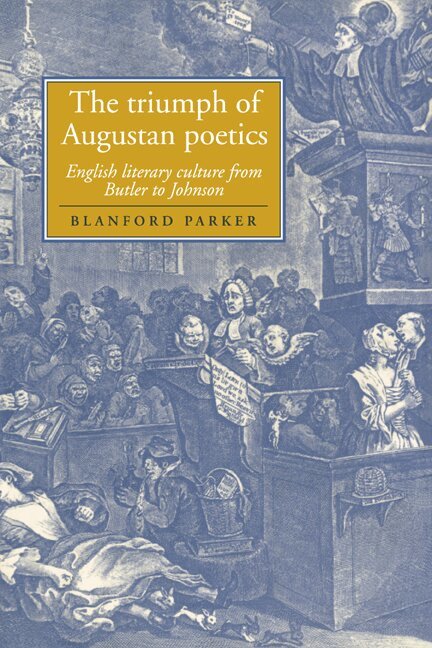
The Triumph of Augustan Poetics
English Literary Culture from Butler to Johnson
Häftad, Engelska, 2006
614 kr
Skickas inom 7-10 vardagar
The Triumph of Augustan Poetics offers an important re-evaluation of the transition from Baroque to Augustan in English literature. Starting with Butler's Hudibras, Blanford Parker describes Augustan satire as a movement away from the 'controversial disputation' of the seventeenth century to a general satire which ridicules Protestant, Anglican and Catholic in equal measure, as well as the poetic traditions that supported them. Once the dominant forms of late medieval and Baroque thought - analogical and fideist, a fully symbolic world and an empty wilderness - were erased, a novel space for the imagination was created. Here a 'literalism' new to European thought can be seen to have replaced the general satire, and at this moment Pope and Thomson create a new art of natural and quotidian description, in parallel with the rise of the novel. Parker's account concludes with the ambiguous or hostile reaction to this new mode seen in the works of Samuel Johnson and others.
Del 36 - Cambridge Studies in Eighteenth-Century English Literature and Thought
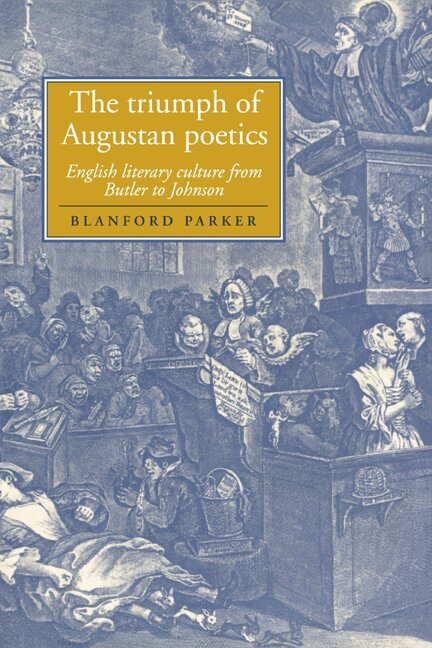
The Triumph of Augustan Poetics
English Literary Culture from Butler to Johnson
Inbunden, Engelska, 1998
1 371 kr
Skickas inom 7-10 vardagar
The Triumph of Augustan Poetics offers an important re-evaluation of the transition from Baroque to Augustan in English literature. Starting with Butler's Hudibras, Blanford Parker describes Augustan satire as a movement away from the 'controversial disputation' of the seventeenth century to a general satire which ridicules Protestant, Anglican and Catholic in equal measure, as well as the poetic traditions that supported them. Once the dominant forms of late medieval and Baroque thought - analogical and fideist, a fully symbolic world and an empty wilderness - were erased, a novel space for the imagination was created. Here a 'literalism' new to European thought can be seen to have replaced the general satire, and at this moment Pope and Thomson create a new art of natural and quotidian description, in parallel with the rise of the novel. Parker's account concludes with the ambiguous or hostile reaction to this new mode seen in the works of Samuel Johnson and others.