Brandy Nalani McDougall - Böcker
Visar alla böcker från författaren Brandy Nalani McDougall. Handla med fri frakt och snabb leverans.
5 produkter
5 produkter
371 kr
Skickas inom 7-10 vardagar
Winner of the Native American Literature Symposium's Beatrice Medicine Award for Published MonographIn this first extensive study of contemporary Hawaiian literature, Brandy Nalani McDougall examines a vibrant selection of fiction, poetry, and drama by emerging and established Hawaiian authors, including Haunani-Kay Trask, John Dominis Holt, Imaikalani Kalahele, and Victoria Nalani Kneubuhl. At the center of the analysis is a hallmark of Hawaiian aesthetics—kaona, the intellectual practice of hiding and finding meaning that encompasses the allegorical, the symbolic, the allusive, and the figurative.With a poet’s attention to detail, McDougall interprets examples of kaona, guiding readers through olelo no'eau (proverbs), mo‘olelo (literature and histories), and mooku'auhau (genealogies) alongside their contemporary literary descendants, unveiling complex layers of Hawaiian identity, culture, history, politics, and ecology.Throughout, McDougall asserts that “kaona connectivity” not only carries bright possibilities for connecting the present to the past, but it may also ignite a decolonial future. Ultimately, Finding Meaning affirms the tremendous power of Indigenous stories and genealogies to give activism and decolonization movements lasting meaning.
220 kr
Skickas inom 7-10 vardagar
‘Āina Hānau / Birth Land is a powerful collection of new poems by Kanaka ʻŌiwi (Native Hawaiian) poet Brandy Nālani McDougall. ‘Āina hānau—or the land of one’s birth—signifies identity through intimate and familial connections to place and creates a profound bond between the people in a community. McDougall’s poems flow seamlessly between ‘Ōlelo Hawai‘i and English, forming rhythms and patterns that impress on the reader a deep understanding of the land. Tracing flows from the mountains to the ocean, from the sky to the earth, and from ancestor to mother to child, these poems are rooted in the rich ancestral and contemporary literature of Hawaiʻi —moʻolelo, moʻokūʻauhau, and mele —honoring Hawaiian ʻāina, culture, language, histories, aesthetics, and futures.The poems in Āina Hānau / Birth Land cycle through sacred and personal narratives while exposing and fighting ongoing American imperialism, settler colonialism, militarism, and social and environmental injustice to protect the ʻāina and its people. The ongoing environmental crisis in Hawaiʻi, inextricably linked to colonialism and tourism, is captured with stark intensity as McDougall writes, Violence is what we settle for / because we’ve been led to believe / green paper can feed us / more than green land. The experiences of birth, motherhood, miscarriage, and the power of Native Hawaiian traditions and self-advocacy in an often dismissive medical system is powerfully narrated by the speaker of the titular poem, written for McDougall’s daughters.‘Āina Hānau reflects on what it means to be from and belong to an ʻāina hānau, as well as what it means to be an ‘āina hānau, as all mothers serve as the first birth lands for their children.
431 kr
Skickas inom 7-10 vardagar
An Ocean of Wonder: The Fantastic in the Pacific brings together fifty writers and artists from across Moananuiākea working in myriad genres across media, ranging from oral narratives and traditional wonder tales to creative writing as well as visual artwork and scholarly essays. Collectively, this anthology features the fantastic as present-day Indigenous Pacific world-building that looks to the past in creating alternative futures, and in so doing reimagines relationships between peoples, environments, deities, nonhuman relatives, history, dreams, and storytelling. Wonder is activated by curiosity, humility in the face of mystery, and engagement with possibilities. We see wonder and the fantastic as general modes of expression that arenot confined to realism. As such, the fantastic encompasses fantasy, science fiction, magic realism, fabulation, horror, fairy tale, utopia, dystopia, and speculative fiction. We include Black, feminist, and queer futurisms, Indigenous wonderworks, Hawaiian moʻolelo kamahaʻo and moʻolelo āiwaiwa, Sāmoan fāgogo, and other non-mimetic genres from specific cultures, because we recognize that their refusal to adopt restrictive Euro-American definitions of reality is whatinspires and enables the fantastic to flourish.As artistic, intellectual, and culturally based expressions that encode and embody Indigenous knowledge, the multimodal moʻolelo in this collection upend monolithic, often exoticizing, and demeaning stereotypes of the Pacific and situate themselves in conversation with critical understandings of the global fantastic, Indigenous futurities, social justice, and decolonial and activist storytelling.In this collection, Oceanic ideas and images surround and connect to Hawaiʻi, which is for the three coeditors, a piko (center); at the same time, navigating both juxtaposition and association, the collection seeks to articulate pilina (relationships) across genres, locations, time, and media and to celebrate the multiplicity and relationality of the fantastic in Oceania.
256 kr
Skickas inom 3-6 vardagar
157 kr
Skickas inom 5-8 vardagar
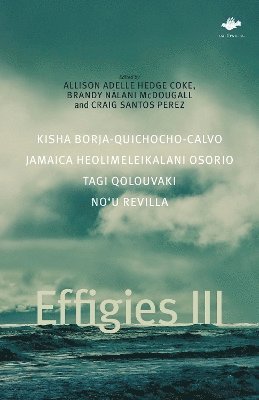
The Effigies series has woven a vibrant tapestry of indigenous poets from Native North America and the Pacific. As the third in this series, this anthology continues this weaving with the work of four emerging Pacific islander women poets from Guam, Hawai’i, and Fiji. Despite their distant origins, all these writers explore culture, history, politics, genealogy, feminism, and the environment. They each have their own unique style, ranging from the lyric to the avant-garde. Overall, they represent the next resurgent wave of empowered and decolonial Pacific writers.No‘u Revilla (Kanaka ‘Ōiwi), Jamaica Heolimeleikalani Osorio (Kanaka ‘Ōiwi), Kisha Borja-Quichocho-Calvo (Chamoru), and Tagi Quolouvaki (Fijian, Tongan) take readers into the vast Pacific ocean to swim beyond the reef in high tide, out to where the water meets the sky, only to circle back to the islands to taste the tears and sweat in coconut and guava, the smell of frangipani on the wind. Amidst such beauty, these poets also carry us into darkness with tremendous power and vulnerability, laying bare the ravages of colonialism—the brutal occupation of country, the violence waged against Native women and girls, the erosion of language and ancestral memory, and the forced disconnections from land, ocean, and other healing lifeways. Effigies III features four debut books that fearlessly journey through these home-islands in ways that will transform and empower.