Brian Halweil - Böcker
Visar alla böcker från författaren Brian Halweil. Handla med fri frakt och snabb leverans.
6 produkter
6 produkter
239 kr
Skickas inom 5-8 vardagar
Human demands are pressing up against more and more of the Earth's limits. This book from the Worldwatch Institute examines the impacts of population growth on global resources and services, including food, fresh water, fisheries, jobs, education, income, and health. Despite the current hype of a "birth dearth" in parts of Europe and Japan, the fact remains that human numbers are projected to increase by over 3 billion by 2050. Rapidly growing nations are likely to outstrip the carrying capacity of their natural support systems. Governments worn down by several decades of rapid population growth often cannot mobilize the resources necessary to cope with emerging threats such as new diseases, food and water shortages, and mass unemployment. Already, in several African nations, hunger, disease, and social disintegration are leading to rising death rates, checking the rapid growth of population. Either nations with surging populations will quickly shift to smaller families or nature will impose its own, less humane limits to growth. As the world enters the new millennium, no challenge is perhaps so urgent as the need to quickly reduce population growth. Pakistan's population is projected to increase from 148 million to 357 million, surpassing that of the United States before 2050. Zimbabwe, Botswana, Zambia, Namibia, and Swaziland, where over one-fifth of the adult population is infected with HIV, will likely reach population stability shortly after the year 2000, as AIDS-related deaths offset soaring birth rates. A Worldwatch Environmental Alert book. Newsmaking press conference on publication National press and television coverage
272 kr
Skickas inom 5-8 vardagar
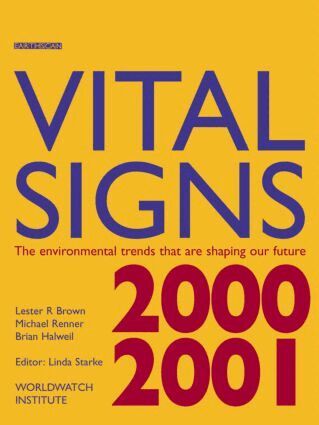
This annual volume from the Worldwatch Institute shows in graphic form key trends that often escape the attention of the news media, world leaders, and economic experts, but should be integrated into their plans as they map out our global future. Written by the staff of the award-winning Worldwatch Institute, this book allows readers to track key indicators that show social, economic, and environmental progress, or the lack of it. These authoritative data have been distilled from thousands of documents obtained from government, industry, scientists, and international organizations into forty-five "vital signs" of our times. Vital Signs 2000 presents up-to-the-minute information on environmental and sustainable development topics such as global temperature, population growth, HIV/AIDS, fossil fuel consumption, Internet use, income inequalities, grain production, and fish catch. Each trend is presented in both text and graphics, providing a thorough, well-documented, and very accessible overview.
238 kr
Skickas inom 3-6 vardagar
Everyone everywhere depends increasingly on long-distance food. Since 1961 the tonnage of food shipped between nations has grown fourfold. In the United States, food typically travels between 1,500 and 2,500 miles from farm to plate—as much as 25 percent farther than in 1980. For some, the long-distance food system offers unparalleled choice. But it often runs roughshod over local cuisines, varieties, and agriculture, while consuming staggering amounts of fuel, generating greenhouse gases, eroding the pleasures of face-to-face interactions, and compromising food security. Fortunately, the long-distance food habit is beginning to weaken under the influence of a young, but surging, local-foods movement. From peanut-butter makers in Zimbabwe to pork producers in Germany and rooftop gardeners in Vancouver, entrepreneurial farmers, start-up food businesses, restaurants, supermarkets, and concerned consumers are propelling a revolution that can help restore rural areas, enrich poor nations, and return fresh, delicious, and wholesome food to cities.
2 088 kr
Skickas inom 10-15 vardagar
On the bicentennial of Malthus' legendary essay on the tendency of population to grow more rapidly than the food supply, this book examines the impacts of population growth on 19 global resources and services, including food, fresh water, fisheries, jobs, education, income and health. Despite current hype of a 'birth dearth' in parts of Europe and Japan, the fact remains that human numbers are projected to increase by over 3 billion by 2050. Populations in rapidly growing nations are in danger of outstripping the carrying capacity of their natural support systems and governments in such situations will find it increasingly hard to respond to crises such as AIDS, food and water shortages and mass unemployment. Beyond Malthus examines methods such as the expansion of international family planning, investment in educating young people in the developing world and promotion of a shift towards smaller families which will represent the most humane response to the possible ravages of the population explosion.
576 kr
Skickas inom 10-15 vardagar
On the bicentennial of Malthus' legendary essay on the tendency of population to grow more rapidly than the food supply, this book examines the impacts of population growth on 19 global resources and services, including food, fresh water, fisheries, jobs, education, income and health. Despite current hype of a 'birth dearth' in parts of Europe and Japan, the fact remains that human numbers are projected to increase by over 3 billion by 2050. Populations in rapidly growing nations are in danger of outstripping the carrying capacity of their natural support systems and governments in such situations will find it increasingly hard to respond to crises such as AIDS, food and water shortages and mass unemployment. Beyond Malthus examines methods such as the expansion of international family planning, investment in educating young people in the developing world and promotion of a shift towards smaller families which will represent the most humane response to the possible ravages of the population explosion.
283 kr
Tillfälligt slut
This ninth annual edition of Vital Signs takes the world's pulse by compiling a wide-ranging collection of trends that identify both problems and progress in the quest for a sustainable society. It highlights both alarming situations and encouraging developments. Part One is a comprehensive presentation of the key indicators in areas such as food, agriculture, energy, atmosphere, economics, transport and the military. Part Two provides in-depth special feature articles on: environmental features, such as transgenic crops and paper recycling; economic features, such as environmental taxes and corporate mergers; and social features, such as tuberculosis, prisons and women in politics.