Britta Nestler – författare
Visar alla böcker från författaren Britta Nestler. Handla med fri frakt och snabb leverans.
4 produkter
4 produkter
E-bok
PDF, Engelska, 20101 202 kr
Läs direkt efter köp
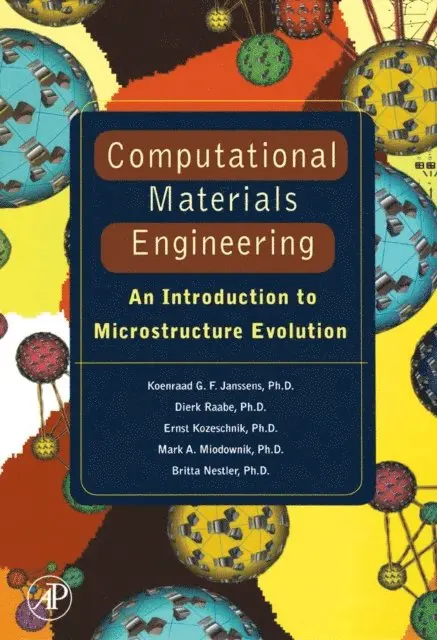
Computational Materials Engineering is an advanced introduction to the computer-aided modeling of essential material properties and behavior, including the physical, thermal and chemical parameters, as well as the mathematical tools used to perform simulations. Its emphasis will be on crystalline materials, which includes all metals. The basis of Computational Materials Engineering allows scientists and engineers to create virtual simulations of material behavior and properties, to better understand how a particular material works and performs and then use that knowledge to design improvements for particular material applications. The text displays knowledge of software designers, materials scientists and engineers, and those involved in materials applications like mechanical engineers, civil engineers, electrical engineers, and chemical engineers. Readers from students to practicing engineers to materials research scientists will find in this book a single source of the major elements that make up contemporary computer modeling of materials characteristics and behavior. The reader will gain an understanding of the underlying statistical and analytical tools that are the basis for modeling complex material interactions, including an understanding of computational thermodynamics and molecular kinetics; as well as various modeling systems. Finally, the book will offer the reader a variety of algorithms to use in solving typical modeling problems so that the theory presented herein can be put to real-world use.- Balanced coverage of fundamentals of materials modeling, as well as more advanced aspects of modeling, such as modeling at all scales from the atomic to the molecular to the macro-material- Concise, yet rigorous mathematical coverage of such analytical tools as the Potts type Monte Carlo method, cellular automata, phase field, dislocation dynamics and Finite Element Analysis in statistical and analytical modeling
Del 32 - Lecture Notes in Computational Science and Engineering
Interface and Transport Dynamics
Computational Modelling
Inbunden, Engelska, 2003
1 684 kr
Skickas inom 10-15 vardagar
The workshop on "computational physics of transport and interfacial dynam ics" was held in Dresden, Germany from February 25 to March 8,2002. The Max Planck Institute for the Physics of Complex Systems has sponsored the workshop and the preliminary lecture-based seminar. The workshop has closely pursued the recent progress of research in com putational physics and materials science, particularly in modelling both traf fic fiow phenomena and complex multi-scale solidification. These branches of science have become topics of considerable diversity linking disciplines as different as physics, mathematical and computational modelling, nonlinear dynamics, materials sciences, statistical mechanics and foundry technique. The international workshop brought together experts from different fields in order to enhance the exchange of knowledge, to assess common interests and to provide closer cooperation between different communities of researchers. The workshop intended to create a comprehensive and coherent image of the current research status and to formulate various possible perspectives for joint future activities. Special emphases laid on exchanging experiences concerning numerical tools and on the bridging of the scales as necessary in a variety of scientific and engineering applications. An interesting possibility along this line was the coupling of different computational approaches leading to hybrid simulations. In this sense, we explicitly addressed researchers working with different numerical schemes as diverse as cellular automata, coupled maps, fi nite difference and finite element algorithms for partial differential equations (e. g. phase-field computations).
Del 32 - Lecture Notes in Computational Science and Engineering
Interface and Transport Dynamics
Computational Modelling
Häftad, Engelska, 2010
1 635 kr
Skickas inom 10-15 vardagar
The workshop on "computational physics of transport and interfacial dynam ics" was held in Dresden, Germany from February 25 to March 8,2002. The Max Planck Institute for the Physics of Complex Systems has sponsored the workshop and the preliminary lecture-based seminar. The workshop has closely pursued the recent progress of research in com putational physics and materials science, particularly in modelling both traf fic fiow phenomena and complex multi-scale solidification. These branches of science have become topics of considerable diversity linking disciplines as different as physics, mathematical and computational modelling, nonlinear dynamics, materials sciences, statistical mechanics and foundry technique. The international workshop brought together experts from different fields in order to enhance the exchange of knowledge, to assess common interests and to provide closer cooperation between different communities of researchers. The workshop intended to create a comprehensive and coherent image of the current research status and to formulate various possible perspectives for joint future activities. Special emphases laid on exchanging experiences concerning numerical tools and on the bridging of the scales as necessary in a variety of scientific and engineering applications. An interesting possibility along this line was the coupling of different computational approaches leading to hybrid simulations. In this sense, we explicitly addressed researchers working with different numerical schemes as diverse as cellular automata, coupled maps, fi nite difference and finite element algorithms for partial differential equations (e. g. phase-field computations).
E-bok
PDF, Engelska, 20132 049 kr
Läs direkt efter köp
The workshop on "computational physics of transport and interfacial dynam ics" was held in Dresden, Germany from February 25 to March 8,2002. The Max Planck Institute for the Physics of Complex Systems has sponsored the workshop and the preliminary lecture-based seminar. The workshop has closely pursued the recent progress of research in com putational physics and materials science, particularly in modelling both traf fic fiow phenomena and complex multi-scale solidification. These branches of science have become topics of considerable diversity linking disciplines as different as physics, mathematical and computational modelling, nonlinear dynamics, materials sciences, statistical mechanics and foundry technique. The international workshop brought together experts from different fields in order to enhance the exchange of knowledge, to assess common interests and to provide closer cooperation between different communities of researchers. The workshop intended to create a comprehensive and coherent image of the current research status and to formulate various possible perspectives for joint future activities. Special emphases laid on exchanging experiences concerning numerical tools and on the bridging of the scales as necessary in a variety of scientific and engineering applications. An interesting possibility along this line was the coupling of different computational approaches leading to hybrid simulations. In this sense, we explicitly addressed researchers working with different numerical schemes as diverse as cellular automata, coupled maps, fi nite difference and finite element algorithms for partial differential equations (e. g. phase-field computations).