Bruce Aune - Böcker
Visar alla böcker från författaren Bruce Aune. Handla med fri frakt och snabb leverans.
8 produkter
8 produkter
1 953 kr
Skickas inom 10-15 vardagar
Many philosophers believe that the traditional problem of our knowledge of the external world was dissolved by Wittgestein and others. They argue that it was not really a problem - just a linguistic `confusion' that did not actually require a solution. Bruce Aune argues that they are wrong. He casts doubt on the generally accepted reasons for putting the problem aside and proposes an entirely new approach. By considering the history of the problem from Descartes to Kant, Aune shows that analogous arguments create difficulties for the contemporary philosophical consensus. He makes it clear that the problem remains acute, particualarly for our understanding of scientific evidence. The solution he proposes draws upon contemporary philosophy of science and probability theory.

807 kr
Skickas inom 10-15 vardagar
Many philosophers believe that the traditional problem of our knowledge of the external world was dissolved by Wittgestein and others. They argue that it was not really a problem - just a linguistic `confusion' that did not actually require a solution. Bruce Aune argues that they are wrong. He casts doubt on the generally accepted reasons for putting the problem aside and proposes an entirely new approach. By considering the history of the problem from Descartes to Kant, Aune shows that analogous arguments create difficulties for the contemporary philosophical consensus. He makes it clear that the problem remains acute, particualarly for our understanding of scientific evidence. The solution he proposes draws upon contemporary philosophy of science and probability theory.
330 kr
Skickas inom 7-10 vardagar
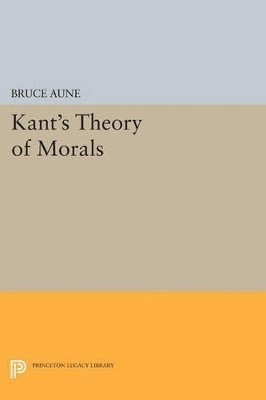
Written for the general reader and the student of moral philosophy, this book provides a clear and unified treatment of Kant's theory of morals. Bruce Aune takes into account all of Kant's principal writings on morality and presents them in a contemporary idiom. Originally published in 1980. The Princeton Legacy Library uses the latest print-on-demand technology to again make available previously out-of-print books from the distinguished backlist of Princeton University Press. These editions preserve the original texts of these important books while presenting them in durable paperback and hardcover editions. The goal of the Princeton Legacy Library is to vastly increase access to the rich scholarly heritage found in the thousands of books published by Princeton University Press since its founding in 1905.
1 497 kr
Skickas inom 3-6 vardagar
Written for the general reader and the student of moral philosophy, this book provides a clear and unified treatment of Kant's theory of morals. Bruce Aune takes into account all of Kant's principal writings on morality and presents them in a contemporary idiom. Originally published in 1980. The Princeton Legacy Library uses the latest print-on-demand technology to again make available previously out-of-print books from the distinguished backlist of Princeton University Press. These editions preserve the original texts of these important books while presenting them in durable paperback and hardcover editions. The goal of the Princeton Legacy Library is to vastly increase access to the rich scholarly heritage found in the thousands of books published by Princeton University Press since its founding in 1905.
271 kr
Skickas inom 11-20 vardagar
Comprehensive introductory survey of the key concepts and problems in traditional and contemporary metaphysics.A comprehensive introductory study of the key concepts and problems in traditional and contemporary metaphysics. Aune presents and defends a point of view that is naturalistic, nominalistic and pragmatic-an approach that has the overall advantage of providing a coherent, structured view of the topics he discusses.
267 kr
Skickas inom 3-6 vardagar
1 064 kr
Skickas inom 10-15 vardagar
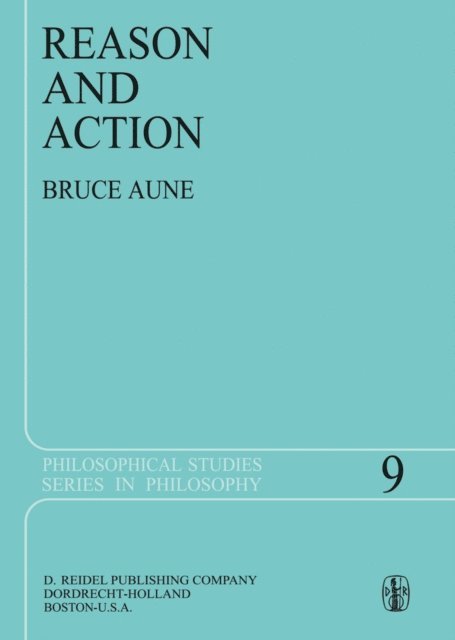
Philosophers writing on the subject of human action have found it tempting to introduce their subject by raising Wittgenstein's question, 'What is left over if you subtract the fact that my arm goes up from the fact that I raise my arm?' The presumption is that something of particular interest is involved in an action of raising an arm that is not present in a mere bodily movement, and the philosopher's task is to specify just what this is. Unfortunately, such an approach does not take us very far, since a person could properly be said to raise his (or her) arm while asleep or hypnotized even though he (or she) would not be performing an action in the sense of 'action' with which philosophers are particularly concerned. To avoid this kind of difficulty I shall approach the subject of human action is a more academic way: I shall expound some important rival theories of human action, and introduce the relevant issues by commenting critically on those theories. One of the issues I eventually introduce is a metaphysical one. A theory of action makes sense, I contend, only on the assumption that there are such 'things' as actions (or events). After considering some key arguments bearing on the issue I conclude that, as matters currently stand in philosophy, a metaphysically noncommittal attitude toward actions and events seems justified.
1 064 kr
Skickas inom 10-15 vardagar
Philosophers writing on the subject of human action have found it tempting to introduce their subject by raising Wittgenstein's question, 'What is left over if you subtract the fact that my arm goes up from the fact that I raise my arm?' The presumption is that something of particular interest is involved in an action of raising an arm that is not present in a mere bodily movement, and the philosopher's task is to specify just what this is. Unfortunately, such an approach does not take us very far, since a person could properly be said to raise his (or her) arm while asleep or hypnotized even though he (or she) would not be performing an action in the sense of 'action' with which philosophers are particularly concerned. To avoid this kind of difficulty I shall approach the subject of human action is a more academic way: I shall expound some important rival theories of human action, and introduce the relevant issues by commenting critically on those theories. One of the issues I eventually introduce is a metaphysical one. A theory of action makes sense, I contend, only on the assumption that there are such 'things' as actions (or events). After considering some key arguments bearing on the issue I conclude that, as matters currently stand in philosophy, a metaphysically noncommittal attitude toward actions and events seems justified.