C. Cercignani - Böcker
Visar alla böcker från författaren C. Cercignani. Handla med fri frakt och snabb leverans.
6 produkter
6 produkter
1 064 kr
Skickas inom 10-15 vardagar
1 064 kr
Skickas inom 10-15 vardagar
This work is devoted to the evolution of infinite systems interacting via a short range potential. The Hamilton dynamics is defined through its evolution semigroup and the corresponding Bogolubov-Born-Green-Kirkwood-Yvon (BBGKY) hierarchy is constructed. The existence of global in time solutions of the BBGKY hierarchy for hard spheres interacting via a short range potential is proved in the Boltzmann-Grad limit and by Bogolubov's and Cohen's methods. This volume should be of interest to graduate students and researchers whose work involves mathematical and theoretical physics, functional analysis and probability theory.
1 064 kr
Skickas inom 10-15 vardagar
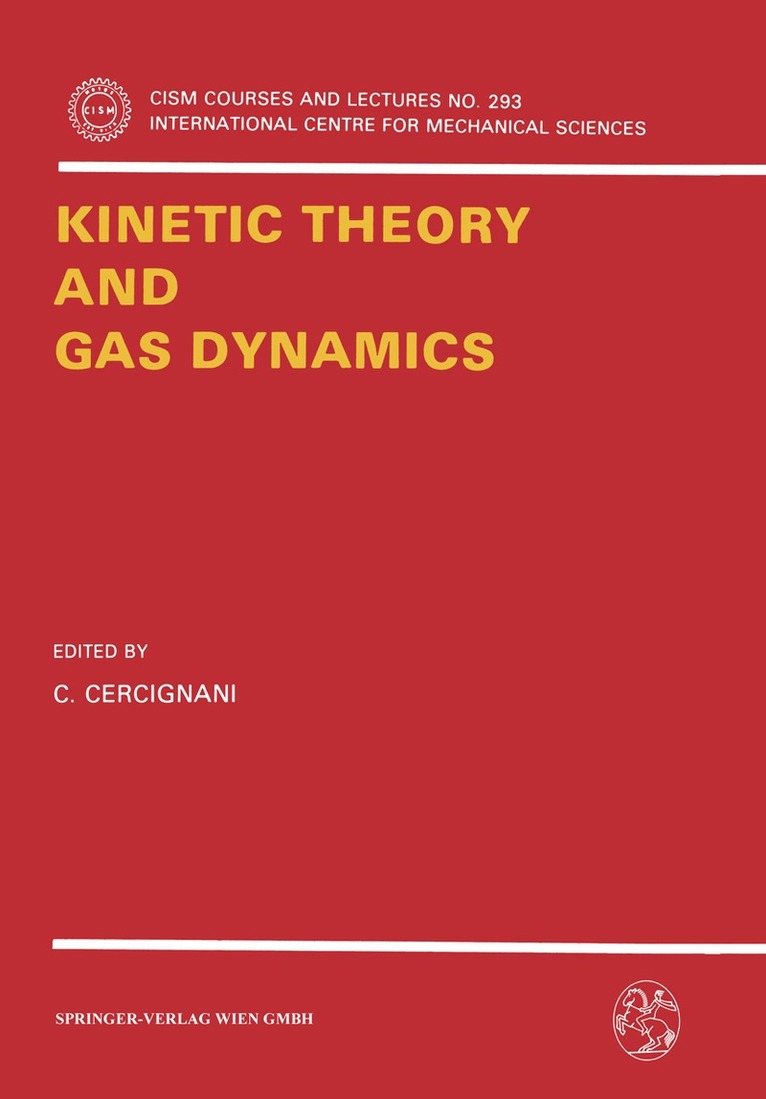
Del 293 - CISM International Centre for Mechanical Sciences
Kinetic Theory and Gas Dynamics
Häftad, Engelska, 1988
536 kr
Skickas inom 10-15 vardagar
Del 1048 - Lecture Notes in Mathematics
Kinetic Theories and the Boltzmann Equation
Lectures given at the 1st 1981 Session of the Centro Internazionale Matematico Estivo (C.I.M.E.) Held at Montecatini, Italy, June 10-18, 1981
Häftad, Engelska, 1984
377 kr
Skickas inom 10-15 vardagar
1 064 kr
Skickas inom 10-15 vardagar
As our title suggests, there are two aspects in the subject of this book. The first is the mathematical investigation of the dynamics of infinite systems of in teracting particles and the description of the time evolution of their states. The second is the rigorous derivation of kinetic equations starting from the results of the aforementioned investigation. As is well known, statistical mechanics started in the last century with some papers written by Maxwell and Boltzmann. Although some of their statements seemed statistically obvious, we must prove that they do not contradict what me chanics predicts. In some cases, in particular for equilibrium states, it turns out that mechanics easily provides the required justification. However things are not so easy, if we take a step forward and consider a gas is not in equilibrium, as is, e.g., the case for air around a flying vehicle. Questions of this kind have been asked since the dawn of the kinetic theory of gases, especially when certain results appeared to lead to paradoxical conclu sions. Today this matter is rather well understood and a rigorous kinetic theory is emerging. The importance of these developments stems not only from the need of providing a careful foundation of such a basic physical theory, but also to exhibit a prototype of a mathematical construct central to the theory of non-equilibrium phenomena of macroscopic size.