C. Edwin Baker – författare
Visar alla böcker från författaren C. Edwin Baker. Handla med fri frakt och snabb leverans.
9 produkter
Human Liberty and Freedom of Speech
Häftad, 1993
1253 kr
Lägg i varukorg
This is a paperback reprint of an OUP/USA hardcover published in September 1989. To date the predominant rationale for freedom of speech has been the "marketplace of ideas" theory, which holds that the truth will be discovered only through debate free from government interference. In Human Liberty …
Human Liberty and Freedom of Speech
E-bok, 1992
585 kr
Lägg i varukorg
Although an inchoate liberty theory of freedom of speech has deep roots in Supreme Court decisions and political history, it has been overshadowed in judicial decisions and scholarly commentary by the marketplace of ideas theory. In this book, Baker critiques the assumptions required by the …
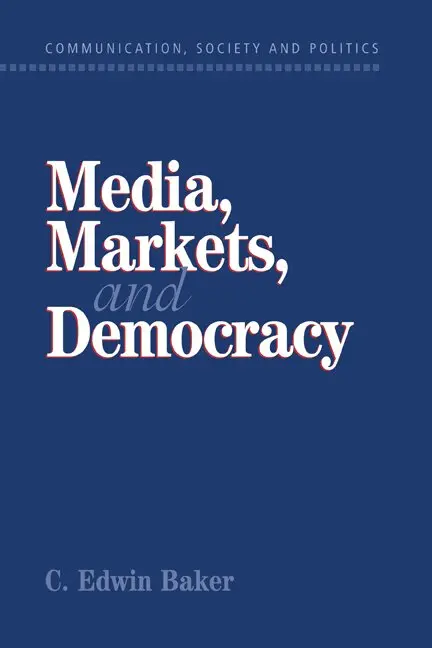
Media, Markets, and Democracy
Av C. Edwin Baker, W. Lance Bennett m. fl.
Häftad, 2001
553 kr
Lägg i varukorg
Government interventions in media markets are often criticized for preventing audiences from getting the media products they want. A free press is often asserted to be essential for democracy. The first point is incorrect and the second is inadequate as a policy guide. Part I of this book shows …
Media Concentration and Democracy
Why Ownership Matters
Häftad, 2006
432 kr
Lägg i varukorg
Firmly rooting its argument in democratic and economic theory, the book argues that a more democratic distribution of communicative power within the public sphere and a structure that provides safeguards against abuse of media power provide two of three primary arguments for ownership dispersal. It …
Media, Markets, and Democracy
Av C. Edwin Baker, W. Lance Bennett m. fl.
Inbunden, 2001
1514 kr
Lägg i varukorg
Government interventions in media markets are often criticized for preventing audiences from getting the media products they want. A free press is often asserted to be essential for democracy. The first point is incorrect and the second is inadequate as a policy guide. Part I of this book shows …
Media Concentration and Democracy
Why Ownership Matters
Inbunden, 2006
838 kr
Lägg i varukorg
Firmly rooting its argument in democratic and economic theory, the book argues that a more democratic distribution of communicative power within the public sphere and a structure that provides safeguards against abuse of media power provide two of three primary arguments for ownership dispersal. It …
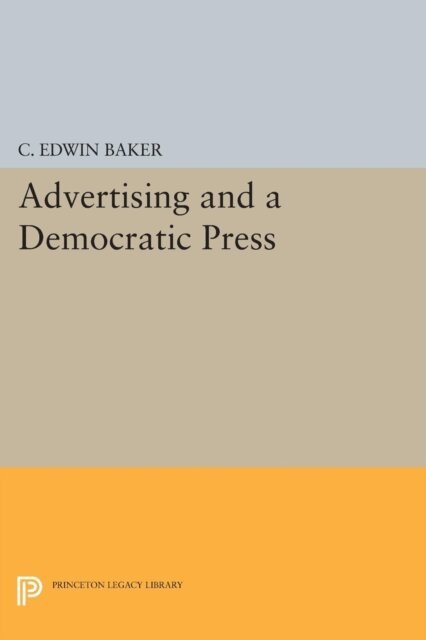
Advertising and a Democratic Press
Häftad, 2014
381 kr
Lägg i varukorg
In this provocative book, C. Edwin Baker argues that print advertising seriously distorts the flow of news by creating a powerfully corrupting incentive: the more newspapers depend financially on advertising, the more they favor the interests of advertisers over those of readers. Advertising …
Advertising and a Democratic Press
Inbunden, 2016
1566 kr
Lägg i varukorg
In this provocative book, C. Edwin Baker argues that print advertising seriously distorts the flow of news by creating a powerfully corrupting incentive: the more newspapers depend financially on advertising, the more they favor the interests of advertisers over those of readers. Advertising …
Advertising and a Democratic Press
E-bok, 2014
503 kr
Lägg i varukorg
In this provocative book, C. Edwin Baker argues that print advertising seriously distorts the flow of news by creating a powerfully corrupting incentive: the more newspapers depend financially on advertising, the more they favor the interests of advertisers over those of readers. Advertising …