C. Lévêque - Böcker
Visar alla böcker från författaren C. Lévêque. Handla med fri frakt och snabb leverans.
3 produkter
3 produkter
2 101 kr
Skickas inom 10-15 vardagar
such as ?oodplains and temporary ponds) challenge this de?nition. Our decision has been to include such The term 'aquatic macrophytes' refers to a diverse species as "aquatic macrophytes", only if their group of aquatic photosynthetic organisms, all large environmental survival is clearly dependent upon enough to see with the naked eye. It includes regular re?lling of their aquatic habitat with a source macroalgae of the divisions Chlorophyta (green of fresh to brackish water. algae), Xanthophyta (yellow-green algae) and Rho- The freshwater macroalgae are primarily rep- dophyta (red algae) and the "blue-green algae" (more sented by the green algae, especially the Charales, correctly known as Cyanobacteria), Bryophyta commonly known as the stoneworts or brittleworts (mosses and liverworts), Pteridophyta (ferns) and (e.g., Chara and Nitella spp.).The Charales are often Spermatophyta (seed-bearing plants), the vegetative mistaken for higher plants because they have erect parts of which actively grow either permanently or central stalks that are divided into short nodes and periodically (for at least several weeks each year) long internodes of elongated multinucleate cells, with submerged below, ?oating on, or growing up through a whorl of "branchlets" at each node (Fig. 1).
2 101 kr
Skickas inom 10-15 vardagar
such as ?oodplains and temporary ponds) challenge this de?nition. Our decision has been to include such The term 'aquatic macrophytes' refers to a diverse species as "aquatic macrophytes", only if their group of aquatic photosynthetic organisms, all large environmental survival is clearly dependent upon enough to see with the naked eye. It includes regular re?lling of their aquatic habitat with a source macroalgae of the divisions Chlorophyta (green of fresh to brackish water. algae), Xanthophyta (yellow-green algae) and Rho- The freshwater macroalgae are primarily rep- dophyta (red algae) and the "blue-green algae" (more sented by the green algae, especially the Charales, correctly known as Cyanobacteria), Bryophyta commonly known as the stoneworts or brittleworts (mosses and liverworts), Pteridophyta (ferns) and (e.g., Chara and Nitella spp.).The Charales are often Spermatophyta (seed-bearing plants), the vegetative mistaken for higher plants because they have erect parts of which actively grow either permanently or central stalks that are divided into short nodes and periodically (for at least several weeks each year) long internodes of elongated multinucleate cells, with submerged below, ?oating on, or growing up through a whorl of "branchlets" at each node (Fig. 1).
536 kr
Skickas inom 10-15 vardagar
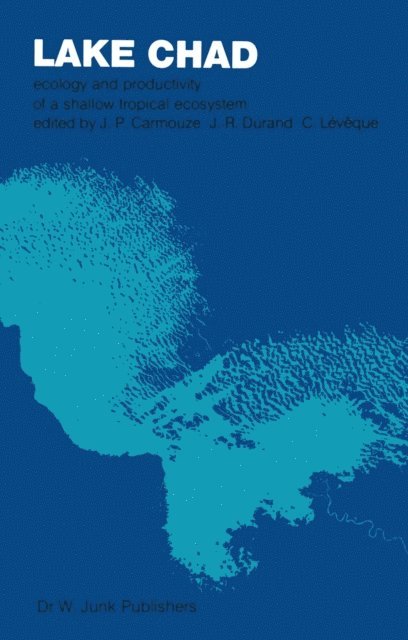
In 1963 the director general of the 'Office de la Recherche Scientifique et Technique Outre-Mer' (ORSTOM) asked me to form a well structured team of hydrobiologists based at Fort-Lamy (now N'Djamena) where a laboratory could be built as a branch of the already existing ORSTOM Center. The International Biological Program, IBP, had at this time recommended an integrated study of ecosystems selected in proportion to their representation of a particular zone or ecological conditions. I took this opportunity to propose Lake Chad as the model of a tropicallake in a semi-arid c1imate as part of the activity of the section Productivity of freshwater communities (PF). With the efficient help ofDr B. Dussart a research program was established involving the establishment of a permanent team of ten researchers in Chad. Apart from myself, ORSTOM only had three hydrobiologists: Mr R. Gras, Mr G. Loubens and Mr A. Iltis. These valuable researchers who had been working for the 'Centre Technique et Forestier Tropical' and had acquired considerable experience in African freshwaters, unhesitatingly accepted to join me at Fort-Lamy.It was necessary to enlarge this team with so me young and enthusiastic collaborators, namely, Mr C. Leveque, Mr C. Dejoux, Miss S. Duwat, Mr L. Lauzanne and Mr. J. R. Durand, later joined by Mr J. P. Carmouze and Mr J. Lemoalle.