C.A. Middelburg – författare
Visar alla böcker från författaren C.A. Middelburg. Handla med fri frakt och snabb leverans.
5 produkter
5 produkter
E-bok
PDF, Engelska, 2012708 kr
Läs direkt efter köp
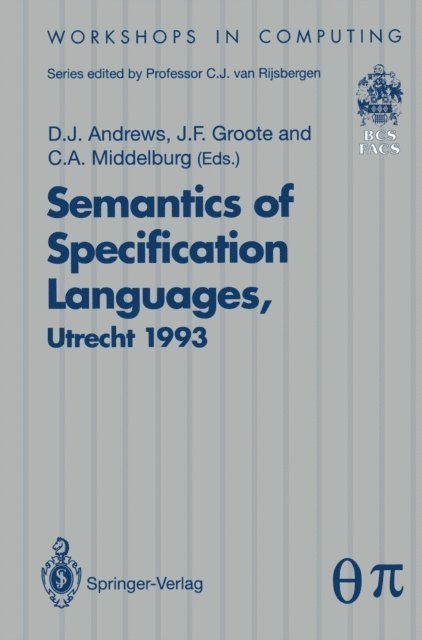
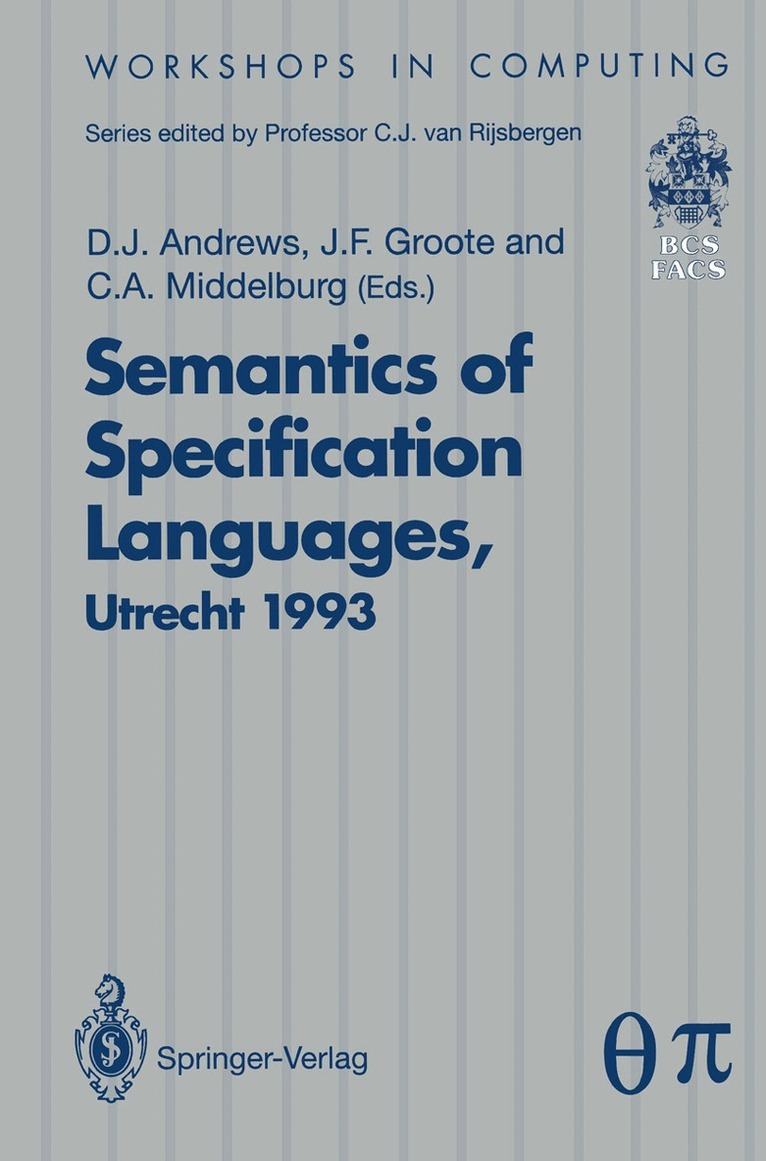
SoSL was the first International Workshop on Semantics of Specification Languages, held from 25-27 October 1993 in Utrecht, the Netherlands. The workshop was organized by the Department of Philosophy of Utrecht University with financial support from the Nationale Faciliteit Informatica of the Nederlandse Organisatie voor Wetenschappelijk Onderzoek (NWO), and under the auspices of the British Computer Society''S specialist group in Formal Aspects of Computing Science (BCS FACS). The concern of the workshop was the semantics of specification languages, and the issues closely related to this area, such as type checking and the justification of proof rules and proof obligations. Its aim was the exchange of problems and ideas in this field of formal methods, and the identification of common programs of work for further investigation. The program of SoSL consisted of 3 invited lectures presenting the developments of the semantics of 3 major specification languages. Furthermore, there were 16 presentations of submitted papers. This volume provides a direct account of the workshop. It contains 3 papers that match the invited lectures and the 16 selected papers. The editors want to thank all those who have contributed to the workshop; the Program Committee and the referees for selecting the contributed papers, the invited speakers for their interesting talks, the Organizing Committee for all their efforts, and of course the participants. We have the feeling that the workshop was worthwhile and should be repeated.
Häftad, Engelska, 1994
565 kr
Skickas inom 10-15 vardagar
SoSL was the first International Workshop on Semantics of Specification Languages, held from 25-27 October 1993 in Utrecht, the Netherlands. The workshop was organized by the Department of Philosophy of Utrecht University with financial support from the Nationale Faciliteit Informatica of the Nederlandse Organisatie voor Wetenschappelijk Onderzoek (NWO), and under the auspices of the British Computer Society'S specialist group in Formal Aspects of Computing Science (BCS FACS). The concern of the workshop was the semantics of specification languages, and the issues closely related to this area, such as type checking and the justification of proof rules and proof obligations. Its aim was the exchange of problems and ideas in this field of formal methods, and the identification of common programs of work for further investigation. The program of SoSL consisted of 3 invited lectures presenting the developments of the semantics of 3 major specification languages. Furthermore, there were 16 presentations of submitted papers. This volume provides a direct account of the workshop. It contains 3 papers that match the invited lectures and the 16 selected papers. The editors want to thank all those who have contributed to the workshop; the Program Committee and the referees for selecting the contributed papers, the invited speakers for their interesting talks, the Organizing Committee for all their efforts, and of course the participants. We have the feeling that the workshop was worthwhile and should be repeated.
Inbunden, Engelska, 2002
565 kr
Skickas inom 10-15 vardagar
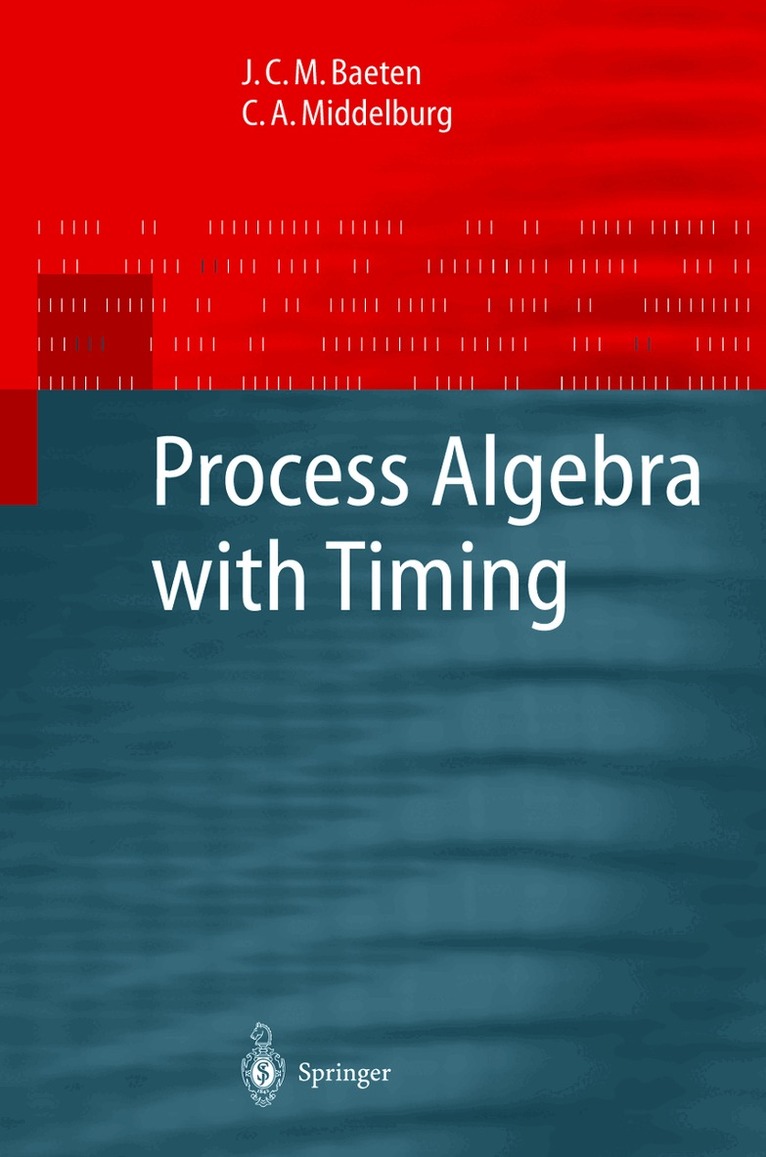
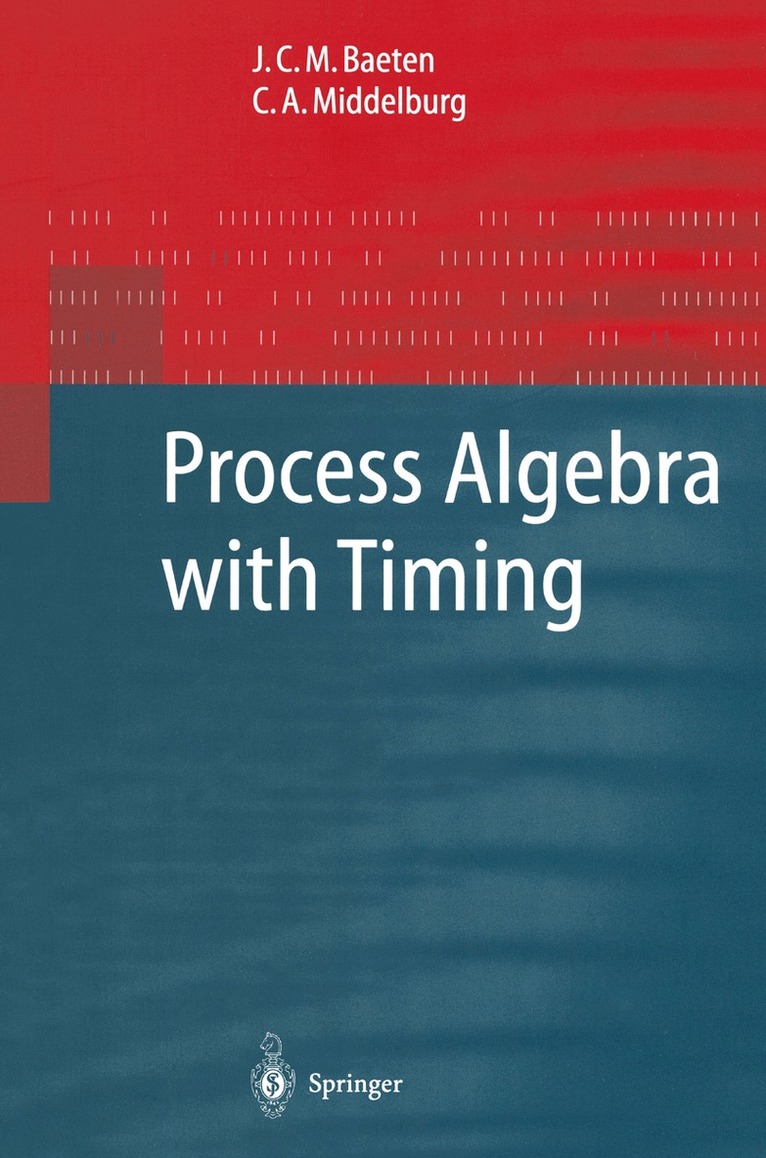
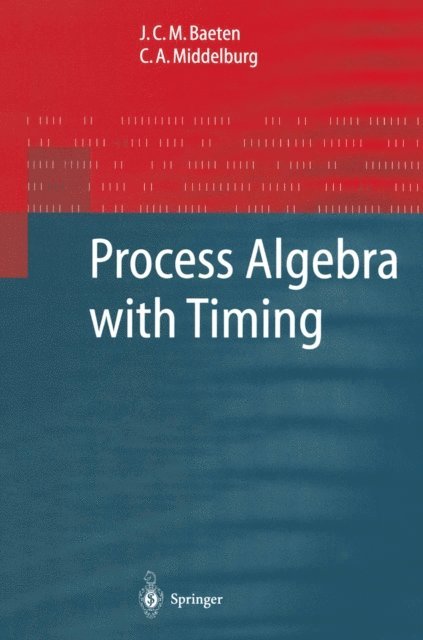
This book is concerned with a number of theories that can be used for describ ing and analyzing systems of interacting components in case it is desirable or necessary to regard their time-dependent behavior. Society is becoming increasingly more dependent on complex computer based systems that are composed of several components that act concurrently and interact - to synchronize and communicate with each other. The com plexity of these systems arises to a great extent from the many ways in which their components can interact. The need that these components act and in teract on time as well adds considerably to the complexity. In developing such a system, it is important to be able to acquire a better understanding of the relevant issues at the conceptual level, to describe the system in a precise way at various levels of detail, and to analyze it on the basis of the descriptions. When the early algebraic theories about processes, such as ACP [16, 17, 20], CCS [49, 50] and CSP [27, 39], were developed for that purpose, the established opinion was still that timing is a concern that can more often than not be treated independently. It is therefore not surprising that timing is deliberately ignored in those theories. They have now all been extended to deal with timing.
Häftad, Engelska, 2010
565 kr
Skickas inom 10-15 vardagar
This book is concerned with a number of theories that can be used for describ ing and analyzing systems of interacting components in case it is desirable or necessary to regard their time-dependent behavior. Society is becoming increasingly more dependent on complex computer based systems that are composed of several components that act concurrently and interact - to synchronize and communicate with each other. The com plexity of these systems arises to a great extent from the many ways in which their components can interact. The need that these components act and in teract on time as well adds considerably to the complexity. In developing such a system, it is important to be able to acquire a better understanding of the relevant issues at the conceptual level, to describe the system in a precise way at various levels of detail, and to analyze it on the basis of the descriptions. When the early algebraic theories about processes, such as ACP [16, 17, 20], CCS [49, 50] and CSP [27, 39], were developed for that purpose, the established opinion was still that timing is a concern that can more often than not be treated independently. It is therefore not surprising that timing is deliberately ignored in those theories. They have now all been extended to deal with timing.
E-bok
PDF, Engelska, 2013693 kr
Läs direkt efter köp
This book is concerned with a number of theories that can be used for describ ing and analyzing systems of interacting components in case it is desirable or necessary to regard their time-dependent behavior. Society is becoming increasingly more dependent on complex computer based systems that are composed of several components that act concurrently and interact - to synchronize and communicate with each other. The com plexity of these systems arises to a great extent from the many ways in which their components can interact. The need that these components act and in teract on time as well adds considerably to the complexity. In developing such a system, it is important to be able to acquire a better understanding of the relevant issues at the conceptual level, to describe the system in a precise way at various levels of detail, and to analyze it on the basis of the descriptions. When the early algebraic theories about processes, such as ACP [16, 17, 20], CCS [49, 50] and CSP [27, 39], were developed for that purpose, the established opinion was still that timing is a concern that can more often than not be treated independently. It is therefore not surprising that timing is deliberately ignored in those theories. They have now all been extended to deal with timing.