Carl G. Rosberg - Böcker
Visar alla böcker från författaren Carl G. Rosberg. Handla med fri frakt och snabb leverans.
5 produkter
5 produkter
1 177 kr
Skickas inom 3-6 vardagar
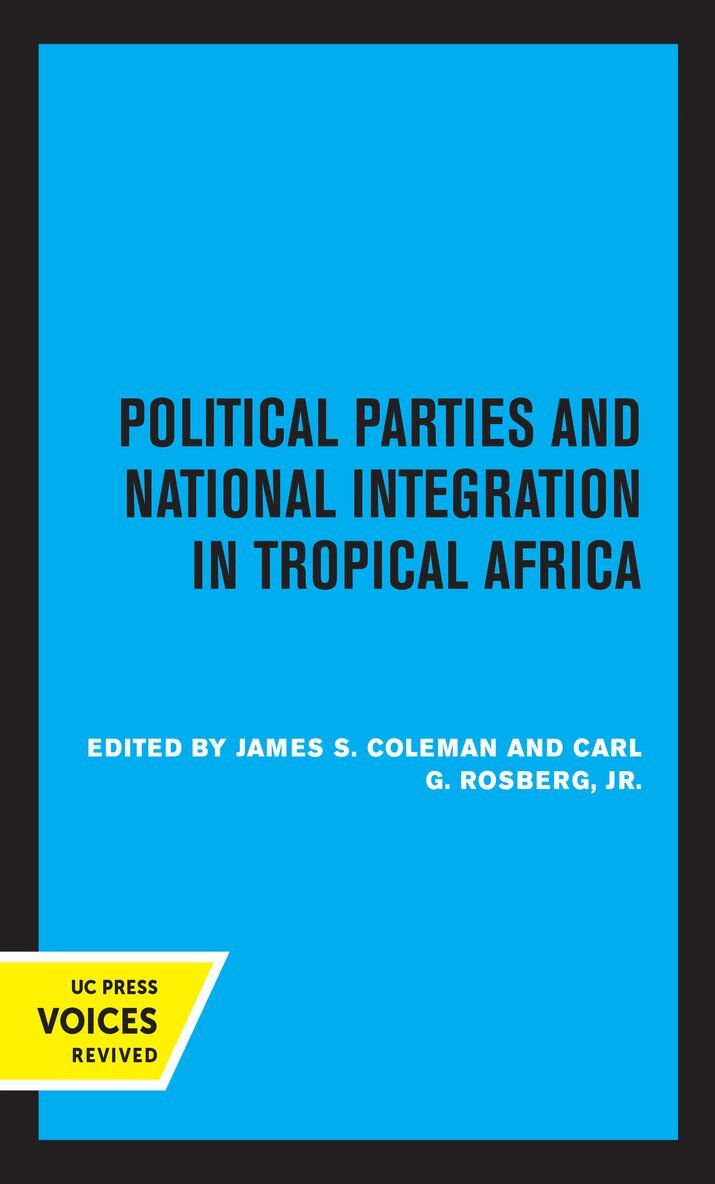
The essays in this book focus attention on the role of political groups in the new functioning and development of the new African societies and the political systems of which they are a part. The authors, all recognized authorities, have sought to identify and compare the manifestations of the general tendency among the new states of Tropical Africa toward the establishment and consolidation of one-party political systems, and to examine, in the light of this general trend, the different dimensions of the problem of integration. This title is part of UC Press's Voices Revived program, which commemorates University of California Press's mission to seek out and cultivate the brightest minds and give them voice, reach, and impact. Drawing on a backlist dating to 1893, Voices Revived makes high-quality, peer-reviewed scholarship accessible once again using print-on-demand technology. This title was originally published in 1964.
835 kr
Skickas inom 3-6 vardagar
Personal Rule in Black Africa: The Dynamics and Challenges of Institutionless Governance offers an in-depth exploration of governance systems across Black African states, focusing on the pervasive model of personal rule. This study contends that political authority in much of Black Africa operates outside the frameworks of institutionalized governance, relying instead on personal influence, informal agreements, and factional power dynamics. Such systems are marked by a distinct absence of enforceable rules, leading to heightened political risks and instability, yet also fostering a form of political order that defies classical theories predicting chaos in the absence of institutionalized systems.The book delves into the historical and sociopolitical underpinnings of personal rule, comparing it to similar transitional governance systems in early modern Europe. It emphasizes the role of rulers' political acumen and adaptability in maintaining order in the face of limited institutional support. Through a typological approach, the study categorizes various forms of personal rule and evaluates their implications for political stability, governance quality, and the provision of essential "political goods" such as peace and security. With insights drawn from classical political theory, sociological frameworks, and comparative politics, the book sheds light on the successes and limitations of this governance model, offering a nuanced perspective on African statecraft and its future trajectory.This title is part of UC Press's Voices Revived program, which commemorates University of California Press’s mission to seek out and cultivate the brightest minds and give them voice, reach, and impact. Drawing on a backlist dating to 1893, Voices Revived makes high-quality, peer-reviewed scholarship accessible once again using print-on-demand technology. This title was originally published in 1982.
912 kr
Skickas inom 7-10 vardagar
The essays in this book focus attention on the role of political groups in the new functioning and development of the new African societies and the political systems of which they are a part. The authors, all recognized authorities, have sought to identify and compare the manifestations of the general tendency among the new states of Tropical Africa toward the establishment and consolidation of one-party political systems, and to examine, in the light of this general trend, the different dimensions of the problem of integration. This title is part of UC Press's Voices Revived program, which commemorates University of California Press's mission to seek out and cultivate the brightest minds and give them voice, reach, and impact. Drawing on a backlist dating to 1893, Voices Revived makes high-quality, peer-reviewed scholarship accessible once again using print-on-demand technology. This title was originally published in 1964.
1 513 kr
Skickas inom 3-6 vardagar
Personal Rule in Black Africa: The Dynamics and Challenges of Institutionless Governance offers an in-depth exploration of governance systems across Black African states, focusing on the pervasive model of personal rule. This study contends that political authority in much of Black Africa operates outside the frameworks of institutionalized governance, relying instead on personal influence, informal agreements, and factional power dynamics. Such systems are marked by a distinct absence of enforceable rules, leading to heightened political risks and instability, yet also fostering a form of political order that defies classical theories predicting chaos in the absence of institutionalized systems.The book delves into the historical and sociopolitical underpinnings of personal rule, comparing it to similar transitional governance systems in early modern Europe. It emphasizes the role of rulers' political acumen and adaptability in maintaining order in the face of limited institutional support. Through a typological approach, the study categorizes various forms of personal rule and evaluates their implications for political stability, governance quality, and the provision of essential "political goods" such as peace and security. With insights drawn from classical political theory, sociological frameworks, and comparative politics, the book sheds light on the successes and limitations of this governance model, offering a nuanced perspective on African statecraft and its future trajectory.This title is part of UC Press's Voices Revived program, which commemorates University of California Press’s mission to seek out and cultivate the brightest minds and give them voice, reach, and impact. Drawing on a backlist dating to 1893, Voices Revived makes high-quality, peer-reviewed scholarship accessible once again using print-on-demand technology. This title was originally published in 1982.
541 kr
Skickas inom 10-15 vardagar
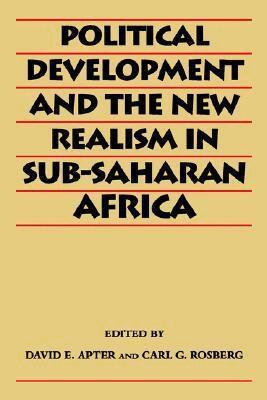
Since the 1950s David Apter and Carl Rosberg have been among the leading American scholars in African studies. In this volume they, along with other specialists in the field, explore the new configurations of African politics. With tentative efforts at a revival of democracy now taking place, it seems appropriate to reassess the theoretical debates and empirical themes that have characterised postwar Sub-Saharan African politics. Focusing on a ""new realism"" which has emerged among Africanists since the dismantling of colonial rule, the essays are presented as a corrective both to the initial euphoria informing African studies and to the later tendency to place blame for all of Africa's political and economic difficulties on the receding spectre of colonial oppression. In the introductory chapter, Apter and Rosberg point out that Sub-Saharan African has been particularly vulnerable to fluctuating truths and flights of interpretive fancy. No other continent has attracted such multiple layers of power and prejudice from the outside. Judgments and speculations about the very nature of Africanness have been common. Today everything is subject to controversy - race, ethnicity, language, religion, ideology - and all the debates are heated up by severe economic decline and the long-standing, unresolved difficulties of state formation. Crawford Young (University of Wisconsin) examines the role of nationalism in the political awakening of the area and looks at ethnicity as a possible resource rather than an obstacle to state formation. Joel D. Barkan (University of Iowa) identifies the new and emerging issues in civil society and the revival of modernisation theory in a context of accountability, Richard L. Sklar (University of California, Los Angeles) works through the inadequacies of conventional notions of markets and of bourgeoisie and proletariat and shows that neither capitalism nor socialism can be looked to for definitive solutions. Michael F. Lofchie (University of California, Los Angeles) examines the reassertion of neoclassical economic theory and evaluates new policy alternatives designed to correct distortions in African economies. The analysis by Thomas M. Callaghy (University of Pennsylvania) advocates a new balance between the needs of the state for stability and the development need for a market-driven economy. Colin Leys (Queen's University, Kingston, Canada) reviews the arguments for dependency and classical Marxism in the context of Kenya and is concerned with whether or not, however defined, the Kenyan bourgeoisie can engender capitalist growth. Michael Chege (Programme Officer in Governance and International Affairs for the Ford Foundation in Harare, Zimbabwe) examines the contrasting patterns of capitalist and socialist orientations in development in both Kenya and Tanzania under their respective presidents, and Robert M. Jackson (University of British Columbia, Vancouver) and Carl G. Rosberg conclude with an examination of how the political dyseconomy of personal rule, with its tolerance of corruption and clientelism, has undermined the viability of most new African states.