Casey Dué - Böcker
Visar alla böcker från författaren Casey Dué. Handla med fri frakt och snabb leverans.
4 produkter
4 produkter
239 kr
Skickas inom 10-15 vardagar
The laments of captive women found in extant Athenian tragedy constitute a fundamentally subversive aspect of Greek drama. In performances supported by and intended for the male citizens of Athens, the songs of the captive women at the Dionysia gave a voice to classes who otherwise would have been marginalized and silenced in Athenian society: women, foreigners, and the enslaved. The Captive Woman's Lament in Greek Tragedy addresses the possible meanings ancient audiences might have attached to these songs. Casey DuÉ challenges long-held assumptions about the opposition between Greeks and barbarians in Greek thought by suggesting that, in viewing the plight of the captive women, Athenian audiences extended pity to those least like themselves. DuÉ asserts that tragic playwrights often used the lament to create an empathetic link that blurred the line between Greek and barbarian. After a brief overview of the role of lamentation in both modern and classical traditions, DuÉ focuses on the dramatic portrayal of women captured in the Trojan War, tracing their portrayal through time from the Homeric epics to Euripides' Athenian stage. The author shows how these laments evolved in their significance with the growth of the Athenian Empire. She concludes that while the Athenian polis may have created a merciless empire outside the theater, inside the theater they found themselves confronted by the essential similarities between themselves and those they sought to conquer.
Del 35 - Hellenic Studies Series
Recapturing a Homeric Legacy
Images and Insights from the Venetus A Manuscript of the Iliad
Inbunden, Engelska, 2009
644 kr
Skickas inom 7-10 vardagar
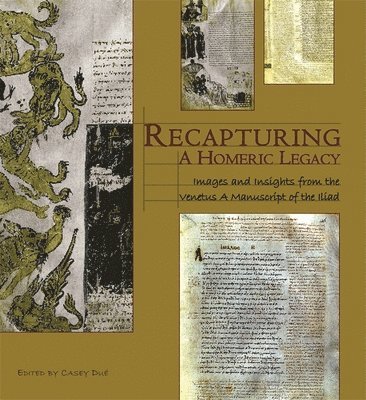
Marcianus Graecus Z. 454 [= 822], known to Homeric scholars as the Venetus A, is the oldest complete text of the Iliad in existence, meticulously crafted during the tenth century ce. An impressive thousand years old and then some, its historical reach is far greater. The Venetus A preserves in its entirety a text that was composed within an oral tradition that can be shown to go back as far as the second millennium bce, and the writings in its margins preserve the scholarship of Ptolemaic scholars working in the second century bce and in the centuries following. Two thousand years later, technology offers a new opportunity to rediscover this scholarship and better understand the epic that is the foundation of Western literature. The high-resolution images of the manuscript that accompany these essays were acquired by a multinational team of scholars and conservators in May 2007.
Del 39 - Hellenic Studies Series
Iliad 10 and the Poetics of Ambush
A Multitext Edition with Essays and Commentary
Häftad, Engelska, 2010
235 kr
Skickas inom 7-10 vardagar
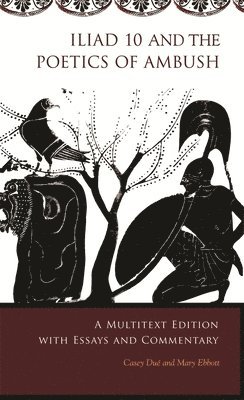
This edition, commentary, and accompanying essays focus on the tenth book of the Iliad, which has been doubted, ignored, and even scorned. Casey Dué and Mary Ebbott use approaches based on oral traditional poetics to illuminate many of the interpretive questions that strictly literary approaches find unsolvable. The introductory essays explain their textual and interpretive approaches and explicate the ambush theme within the whole Greek epic tradition. The critical texts (presented as a sequence of witnesses, including the tenth-century Venetus A manuscript and select papyri) highlight the individual witnesses and the variations they offer. The commentary demonstrates how the unconventional Iliad 10 shares in the oral traditional nature of the whole epic, even though its poetics are specific to its nocturnal ambush plot.
Del 81 - Hellenic Studies Series
Achilles Unbound
Multiformity and Tradition in the Homeric Epics
Häftad, Engelska, 2019
258 kr
Skickas inom 7-10 vardagar
Though Achilles the character is bound by fate and by narrative tradition, Achilles’s poem, the Iliad, was never fixed and monolithic in antiquity—it was multiform. And the wider epic tradition, from which the Iliad emerged, was yet more multiform. In Achilles Unbound, Casey Dué, building on nearly twenty years of work as coeditor of the Homer Multitext (www.homermultitext.org), explores both the traditionality and multiformity of the Iliad in a way that gives us a greater appreciation of the epic that has been handed down to us.Dué argues that the attested multiforms of the Iliad—in ancient quotations, on papyrus, and in the scholia of medieval manuscripts—give us glimpses of the very long history of the text, access to even earlier Iliads, and a greater awareness of the mechanisms by which such a remarkable poem could be composed in performance. Using methodologies grounded in an understanding of Homeric poetry as a system, Achilles Unbound argues for nothing short of a paradigm shift in our approach to the Homeric epics, one that embraces their long evolution and the totality of the world of epic song, in which each performance was newly composed and received by its audience.