Cecilia Heyes - Böcker
Visar alla böcker från författaren Cecilia Heyes. Handla med fri frakt och snabb leverans.
2 produkter
2 produkter
323 kr
Skickas inom 10-15 vardagar
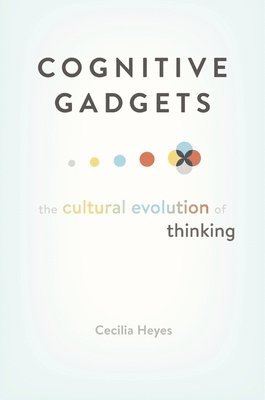
“This is an important book and likely the most thoughtful of the year in the social sciences… Highly recommended, it is likely to prove one of the most thought-provoking books of the year.”—Tyler Cowen, Marginal RevolutionHow did human minds become so different from those of other animals? What accounts for our capacity to understand the way the physical world works, to think ourselves into the minds of others, to gossip, read, tell stories about the past, and imagine the future? These questions are not new: they have been debated by philosophers, psychologists, anthropologists, evolutionists, and neurobiologists over the course of centuries. One explanation widely accepted today is that humans have special cognitive instincts. Unlike other living animal species, we are born with complicated mechanisms for reasoning about causation, reading the minds of others, copying behaviors, and using language.Cecilia Heyes agrees that adult humans have impressive pieces of cognitive equipment. In her framing, however, these cognitive gadgets are not instincts programmed in the genes but are constructed in the course of childhood through social interaction. Cognitive gadgets are products of cultural evolution, rather than genetic evolution. At birth, the minds of human babies are only subtly different from the minds of newborn chimpanzees. We are friendlier, our attention is drawn to different things, and we have a capacity to learn and remember that outstrips the abilities of newborn chimpanzees. Yet when these subtle differences are exposed to culture-soaked human environments, they have enormous effects. They enable us to upload distinctively human ways of thinking from the social world around us.As Cognitive Gadgets makes clear, from birth our malleable human minds can learn through culture not only what to think but how to think it.
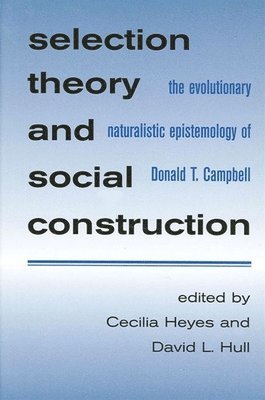
Selection Theory and Social Construction
The Evolutionary Naturalistic Epistemology of Donald T. Campbell
Häftad, Engelska, 2001
382 kr
Tillfälligt slut
Top scholars examine the work of Donald T. Campbell, one of the first to emphasize the social structure of science.In his long career, Donald T. Campbell made important contributions to social psychology, anthropology, sociology, education, science studies, and epistemology. In this anthology, the authors concentrate on his epistemology, in particular his evolutionary, naturalistic epistemology. The four philosophers, two psychologists, a sociologist, and specialists in science studies and education discuss Campbell's contributions, explaining and criticizing them in a comprehensive way. Campbell and his ideas are treated in a strikingly new light-Campbell enters the new millennium.