Cedric Johnson - Böcker
Visar alla böcker från författaren Cedric Johnson. Handla med fri frakt och snabb leverans.
7 produkter
7 produkter
875 kr
Skickas inom 10-15 vardagar
Compiled in this volume is the most significant accumulation of works on the subject of African American leadership to date. As the field of leadership studies continues to grow, this timely work contributes to an understanding of the activities of those people and organizations that have been leaders of people of African descent and have contributed to the cultural and political affairs of the black community, as well as the representation of the black community in mainstream American life. The annotated entries cover a variety of works on subjects such as dedicated black leadership studies, local descriptions and analyses, biographies, leadership organizations, and audio-visual materials. This reference is an important contribution to the field of leadership studies in general, and African American leadership in particular, and will serve as a valuable research tool for educators and practitioners alike.The entries are organized into six sections, which offer a broad overview of the various aspects of African American leadership. Part I, Critical Studies and Appraisals, focuses on the history of works dedicated to both national and local leaders and their politically relevant activities. The next section, Local Leadership Studies, is organized around black leaders who served local communities and the various issues they addressed. Part III looks at relevant social movements and ideologies that have highlighted the activities of black leaders. Individual leaders who have made contributions to the political life of the black community are included in Part IV, while leadership organizations are highlighted in Part V. The concluding section of the volume looks at available audio-visual materials. A thorough index rounds out the bibliography.
Revolutionaries to Race Leaders
Black Power and the Making of African American Politics
Häftad, Engelska, 2007
230 kr
Skickas inom 7-10 vardagar
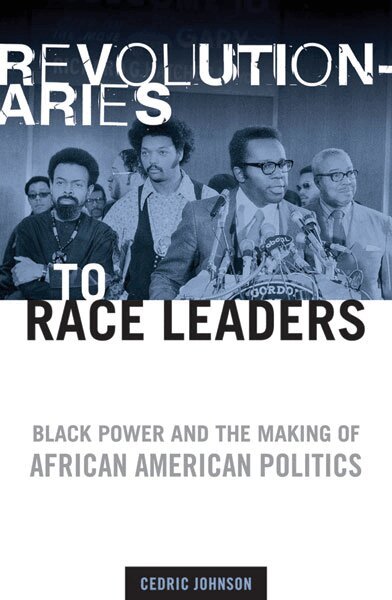
The Black Power movement represented a key turning point in American politics. Disenchanted by the hollow progress of federal desegregation during the 1960s, many black citizens and leaders across the United States demanded meaningful self-determination. The popular movement they created was marked by a vigorous artistic renaissance, militant political action, and fierce ideological debate. Exploring the major political and intellectual currents from the Black Power era to the present, Cedric Johnson reveals how black political life gradually conformed to liberal democratic capitalism and how the movement’s most radical aims-the rejection of white aesthetic standards, redefinition of black identity, solidarity with the Third World, and anticapitalist revolution-were gradually eclipsed by more moderate aspirations. Although Black Power activists transformed the face of American government, Johnson contends that the evolution of the movement as a form of ethnic politics restricted the struggle for social justice to the world of formal politics. Johnson offers a compelling and theoretically sophisticated critique of the rhetoric and strategies that emerged in this period. Drawing on extensive archival research, he reinterprets the place of key intellectual figures, such as Harold Cruse and Amiri Baraka, and influential organizations, including the African Liberation Support Committee, the National Black Political Assembly, and the National Black Independent Political Party in postsegregation black politics, while at the same time identifying the contradictions of Black Power radicalism itself. Documenting the historical retreat from radical, democratic struggle, Revolutionaries to Race Leaders ultimately calls for the renewal of popular struggle and class-conscious politics. Cedric Johnson is assistant professor of political science at Hobart and William Smith Colleges.
Neoliberal Deluge
Hurricane Katrina, Late Capitalism, and the Remaking of New Orleans
Häftad, Engelska, 2011
286 kr
Skickas inom 10-15 vardagar
Katrina was not just a hurricane. The death, destruction, and misery wreaked on New Orleans cannot be blamed on nature’s fury alone. This volume of essays locates the root causes of the 2005 disaster squarely in neoliberal restructuring and examines how pro-market reforms are reshaping life, politics, economy, and the built environment in New Orleans.The authors-a diverse group writing from the disciplines of sociology, political science, education, public policy, and media theory-argue that human agency and public policy choices were more at fault for the devastation and mass suffering experienced along the Gulf Coast than were sheer forces of nature. The harrowing images of flattened homes, citizens stranded on rooftops, patients dying in makeshift hospitals, and dead bodies floating in floodwaters exposed the moral and political contradictions of neoliberalism-the ideological rejection of the planner state and the active promotion of a new order of market rule.Many of these essays offer critical insights on the saga of postdisaster reconstruction. Challenging triumphal narratives of civic resiliency and universal recovery, the authors bring to the fore pitched battles over labor rights, gender and racial justice, gentrification, the development of city master plans, the demolition of public housing, policing, the privatization of public schools, and roiling tensions between tourism-based economic growth and neighborhood interests. The contributors also expand and deepen more conventional critiques of “disaster capitalism” to consider how the corporate mobilization of philanthropy and public good will are remaking New Orleans in profound and pernicious ways. Contributors: Barbara L. Allen, Virginia Polytechnic U; John Arena, CUNY College of Staten Island; Adrienne Dixson, Ohio State U; Eric Ishiwata, Colorado State U; Avis Jones-Deweever, National Council of Negro Women; Chad Lavin, Virginia Polytechnic U; Paul Passavant, Hobart and William Smith Colleges; Linda Robertson, Hobart and William Smith Colleges; Chris Russill, Carleton U; Kanchana Ruwanpura, U of Southampton; Nicole Trujillo-PagÁn, Wayne State U; Geoffrey Whitehall, Acadia U.
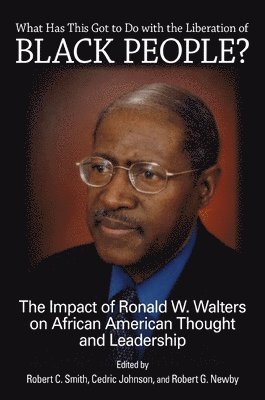
What Has This Got to Do with the Liberation of Black People?
The Impact of Ronald W. Walters on African American Thought and Leadership
Inbunden, Engelska, 2014
1 088 kr
Tillfälligt slut
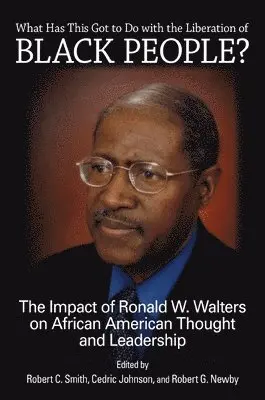
A compelling intellectual and political study of a leading post–civil rights era African American political theorist and strategist.It is rare that a major leader of a protest movement also becomes an accomplished scholar who provides valuable insight into the movement in which he participated. Yet this was precisely what Ronald W. Walters (1938–2010) did. Born in Wichita, Kansas, the young Walters led the first modern sit-in protest during the summer of 1958, nearly two years before the more famous Greensboro sit-in of 1960. After receiving a doctorate from American University, Walters embarked on an extraordinary career of scholarship and activism. Shaped by the civil rights and black power movements and the African and Caribbean liberation struggles, Walters was a pioneer in the development of black studies and "black science" in political science. A public intellectual, as well as advisor and strategist to African American leaders, Walters founded numerous organizations that shaped the post–civil rights era. A must read for scholars, students, pundits, political leaders, and activists, What Has This Got to Do with the Liberation of Black People? is a major contribution to the historiography of the civil rights and black power movements, African American intellectual history, political science, and black studies.
What Has This Got to Do with the Liberation of Black People?
The Impact of Ronald W. Walters on African American Thought and Leadership
Häftad, Engelska, 2015
381 kr
Tillfälligt slut
A compelling intellectual and political study of a leading post–civil rights era African American political theorist and strategist.It is rare that a major leader of a protest movement also becomes an accomplished scholar who provides valuable insight into the movement in which he participated. Yet this was precisely what Ronald W. Walters (1938–2010) did. Born in Wichita, Kansas, the young Walters led the first modern sit-in protest during the summer of 1958, nearly two years before the more famous Greensboro sit-in of 1960. After receiving a doctorate from American University, Walters embarked on an extraordinary career of scholarship and activism. Shaped by the civil rights and black power movements and the African and Caribbean liberation struggles, Walters was a pioneer in the development of black studies and "black science" in political science. A public intellectual, as well as advisor and strategist to African American leaders, Walters founded numerous organizations that shaped the post–civil rights era. A must read for scholars, students, pundits, political leaders, and activists, What Has This Got to Do with the Liberation of Black People? is a major contribution to the historiography of the civil rights and black power movements, African American intellectual history, political science, and black studies.
277 kr
Skickas inom 3-6 vardagar
121 kr
Skickas inom 5-8 vardagar