Ching-Li Chai - Böcker
Visar alla böcker från författaren Ching-Li Chai. Handla med fri frakt och snabb leverans.
4 produkter
4 produkter
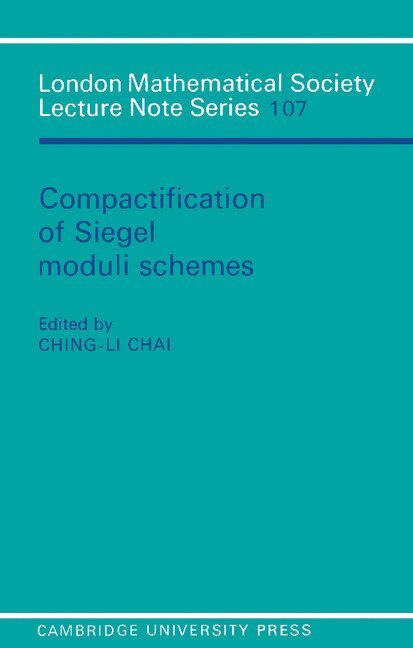
Del 107 - London Mathematical Society Lecture Note Series
Compactification of Siegel Moduli Schemes
Häftad, Engelska, 1985
1 008 kr
Skickas inom 7-10 vardagar
The Siegel moduli scheme classifies principally polarised abelian varieties and its compactification is an important result in arithmetic algebraic geometry. The main result of this monograph is to prove the existence of the toroidal compactification over Z (1/2). This result should have further applications and is presented here with sufficient background material to make the book suitable for seminar courses in algebraic geometry, algebraic number theory or automorphic forms.
1 453 kr
Skickas inom 7-10 vardagar
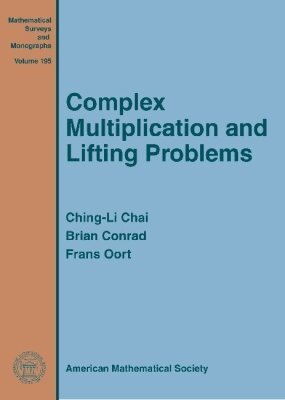
Abelian varieties with complex multiplication lie at the origins of class field theory, and they play a central role in the contemporary theory of Shimura varieties. They are special in characteristic 0 and ubiquitous over finite fields. This book explores the relationship between such abelian varieties over finite fields and over arithmetically interesting fields of characteristic 0 via the study of several natural CM lifting problems which had previously been solved only in special cases. In addition to giving complete solutions to such questions, the authors provide numerous examples to illustrate the general theory and present a detailed treatment of many fundamental results and concepts in the arithmetic of abelian varieties, such as the Main Theorem of Complex Multiplication and its generalisations, the finer aspects of Tate's work on abelian varieties over finite fields, and deformation theory. This book provides an ideal illustration of how modern techniques in arithmetic geometry (such as descent theory, crystalline methods, and group schemes) can be fruitfully combined with class field theory to answer concrete questions about abelian varieties. It will be a useful reference for researchers and advanced graduate students at the interface of number theory and algebraic geometry.
1 473 kr
Skickas inom 10-15 vardagar
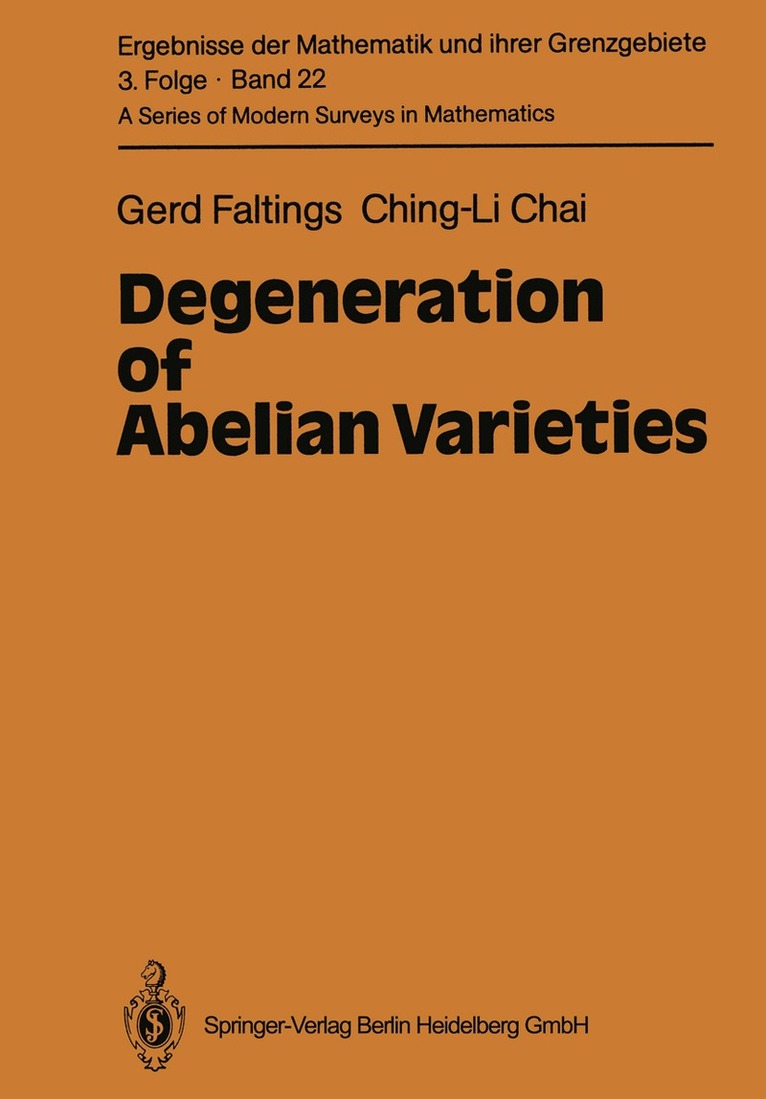
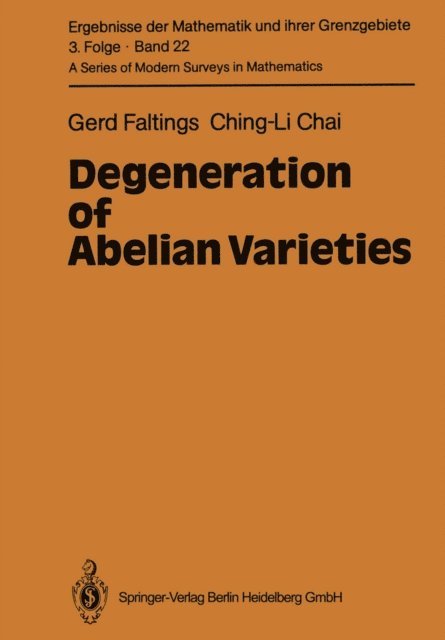
The topic of this book is the theory of degenerations of abelian varieties and its application to the construction of compactifications of moduli spaces of abelian varieties. These compactifications have applications to diophantine problems and, of course, are also interesting in their own right. Degenerations of abelian varieties are given by maps G - S with S an irre ducible scheme and G a group variety whose generic fibre is an abelian variety. One would like to classify such objects, which, however, is a hopeless task in this generality. But for more specialized families we can obtain more: The most important theorem about degenerations is the stable reduction theorem, which gives some evidence that for questions of compactification it suffices to study semi-abelian families; that is, we may assume that G is smooth and flat over S, with fibres which are connected extensions of abelian varieties by tori. A further assumption will be that the base S is normal, which makes such semi-abelian families extremely well behaved. In these circumstances, we give a rather com plete classification in case S is the spectrum of a complete local ring, and for general S we can still say a good deal. For a complete base S = Spec(R) (R a complete and normal local domain) the main result about degenerations says roughly that G is (in some sense) a quotient of a covering G by a group of periods.
1 473 kr
Skickas inom 10-15 vardagar
The topic of this book is the theory of degenerations of abelian varieties and its application to the construction of compactifications of moduli spaces of abelian varieties. These compactifications have applications to diophantine problems and, of course, are also interesting in their own right. Degenerations of abelian varieties are given by maps G - S with S an irre ducible scheme and G a group variety whose generic fibre is an abelian variety. One would like to classify such objects, which, however, is a hopeless task in this generality. But for more specialized families we can obtain more: The most important theorem about degenerations is the stable reduction theorem, which gives some evidence that for questions of compactification it suffices to study semi-abelian families; that is, we may assume that G is smooth and flat over S, with fibres which are connected extensions of abelian varieties by tori. A further assumption will be that the base S is normal, which makes such semi-abelian families extremely well behaved. In these circumstances, we give a rather com plete classification in case S is the spectrum of a complete local ring, and for general S we can still say a good deal. For a complete base S = Spec(R) (R a complete and normal local domain) the main result about degenerations says roughly that G is (in some sense) a quotient of a covering G by a group of periods.