Chris Benner - Böcker
Visar alla böcker från författaren Chris Benner. Handla med fri frakt och snabb leverans.
9 produkter
9 produkter
482 kr
Skickas inom 10-15 vardagar
Breaking new ground in its innovative blend of quantitative and qualitative methods, the book essentially argues that another sort of growth is indeed possible. While offering specific insights for regional leaders and analysts of metropolitan areas, the authors also draw a broader – and quite timely – set of conclusions about how to scale up these efforts to address a U.S. economy still seeking to recover from economic crisis and ameliorate distributional divisions.
2 219 kr
Skickas inom 10-15 vardagar
Breaking new ground in its innovative blend of quantitative and qualitative methods, the book essentially argues that another sort of growth is indeed possible. While offering specific insights for regional leaders and analysts of metropolitan areas, the authors also draw a broader – and quite timely – set of conclusions about how to scale up these efforts to address a U.S. economy still seeking to recover from economic crisis and ameliorate distributional divisions.
Equity, Growth, and Community
What the Nation Can Learn from America's Metro Areas
Häftad, Engelska, 2015
190 kr
Skickas
In the last several years, much has been written about growing economic challenges, increasing income inequality, and political polarization in the United States. This book argues that lessons for addressing these national challenges are emerging from a new set of realities in America's metropolitan regions: first, that inequity is, in fact, bad for economic growth; second, that bringing together the concerns of equity and growth requires concerted local action; and, third, that the fundamental building block for doing this is the creation of diverse and dynamic epistemic (or knowledge) communities, which help to overcome political polarization and help regions address the challenges of economic restructuring and social divides.
490 kr
Tillfälligt slut
This Could Be the Start of Something Big
How Social Movements for Regional Equity Are Reshaping Metropolitan America
Inbunden, Engelska, 2009
1 518 kr
Skickas inom 10-15 vardagar
Economic justice has long been the core goal of community organizing. In the past decade, often below the radar screen of national politics, effective movements have emerged within neighborhoods and, more importantly, at the regional level. This Could Be The Start of Something Big provides a vivid account of some of these efforts and is an important contribution to new thinking about progressive politics.― Paul Osterman, NTU Professor of Human Resources and Management, MIT Sloan SchoolFor nearly two decades, progressives have been dismayed by the steady rise of the right in U.S. politics. Often lost in the gloom and doom about American politics is a striking and sometimes underanalyzed phenomenon: the resurgence of progressive politics and movements at a local level. Across the country, urban coalitions, including labor, faith groups, and community-based organizations, have come together to support living wage laws and fight for transit policies that can move the needle on issues of working poverty. Just as striking as the rise of this progressive resurgence has been its reception among unlikely allies. In places as diverse as Chicago, Atlanta, and San Jose, the usual business resistance to pro-equity policies has changed, particularly when it comes to issues like affordable housing and more efficient transportation systems. To see this change and its possibilities requires that we recognize a new thread running through many local efforts: a perspective and politics that emphasizes "regional equity."Manuel Pastor Jr., Chris Benner, and Martha Matsuoka offer their analysis with an eye toward evaluating what has and has not worked in various campaigns to achieve regional equity. The authors show how momentum is building as new policies addressing regional infrastructure, housing, and workforce development bring together business and community groups who share a common desire to see their city and region succeed. Drawing on a wealth of case studies as well as their own experience in the field, Pastor, Benner, and Matsuoka point out the promise and pitfalls of this new approach, concluding that what they term social movement regionalism might offer an important contribution to the revitalization of progressive politics in America.
This Could Be the Start of Something Big
How Social Movements for Regional Equity Are Reshaping Metropolitan America
Häftad, Engelska, 2009
234 kr
Skickas inom 10-15 vardagar
Economic justice has long been the core goal of community organizing. In the past decade, often below the radar screen of national politics, effective movements have emerged within neighborhoods and, more importantly, at the regional level. This Could Be The Start of Something Big provides a vivid account of some of these efforts and is an important contribution to new thinking about progressive politics.― Paul Osterman, NTU Professor of Human Resources and Management, MIT Sloan SchoolFor nearly two decades, progressives have been dismayed by the steady rise of the right in U.S. politics. Often lost in the gloom and doom about American politics is a striking and sometimes underanalyzed phenomenon: the resurgence of progressive politics and movements at a local level. Across the country, urban coalitions, including labor, faith groups, and community-based organizations, have come together to support living wage laws and fight for transit policies that can move the needle on issues of working poverty. Just as striking as the rise of this progressive resurgence has been its reception among unlikely allies. In places as diverse as Chicago, Atlanta, and San Jose, the usual business resistance to pro-equity policies has changed, particularly when it comes to issues like affordable housing and more efficient transportation systems. To see this change and its possibilities requires that we recognize a new thread running through many local efforts: a perspective and politics that emphasizes "regional equity."Manuel Pastor Jr., Chris Benner, and Martha Matsuoka offer their analysis with an eye toward evaluating what has and has not worked in various campaigns to achieve regional equity. The authors show how momentum is building as new policies addressing regional infrastructure, housing, and workforce development bring together business and community groups who share a common desire to see their city and region succeed. Drawing on a wealth of case studies as well as their own experience in the field, Pastor, Benner, and Matsuoka point out the promise and pitfalls of this new approach, concluding that what they term social movement regionalism might offer an important contribution to the revitalization of progressive politics in America.
640 kr
Skickas inom 7-10 vardagar
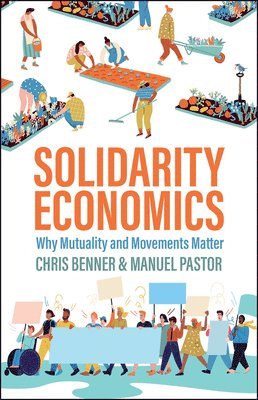
Traditional economics is built on the assumption of self-interested individuals seeking to maximize personal gain, but that is far from the whole story. Sharing, caring, and a desire to uphold the collective good are also powerful motives. In a world wracked by inequality, social divisions, and ecological destruction, can we build an alternative economics based on cooperation?In this book Chris Benner and Manuel Pastor invite us to imagine a new sort of solidarity economics – an approach grounded in our instincts for connection and community – and in so doing, actually build a more robust and sustainable economy. They argue that our current economy is already deeply dependent on mutuality, but that the inequality and fragmentation created by the status quo undermine this mutuality and with it our economic well-being. They outline the theoretical framing, policy agenda, and social movements that we need to revive solidarity and apply it to whole societies.Solidarity Economics is an essential read for anyone who longs for a fairer economy that can generate prosperity and preserve the planet.
217 kr
Skickas inom 7-10 vardagar
Traditional economics is built on the assumption of self-interested individuals seeking to maximize personal gain, but that is far from the whole story. Sharing, caring, and a desire to uphold the collective good are also powerful motives. In a world wracked by inequality, social divisions, and ecological destruction, can we build an alternative economics based on cooperation?In this book Chris Benner and Manuel Pastor invite us to imagine a new sort of solidarity economics – an approach grounded in our instincts for connection and community – and in so doing, actually build a more robust and sustainable economy. They argue that our current economy is already deeply dependent on mutuality, but that the inequality and fragmentation created by the status quo undermine this mutuality and with it our economic well-being. They outline the theoretical framing, policy agenda, and social movements that we need to revive solidarity and apply it to whole societies.Solidarity Economics is an essential read for anyone who longs for a fairer economy that can generate prosperity and preserve the planet.
235 kr
Skickas inom 5-8 vardagar
A clarion call for justice in the quest for clean energyCalifornia’s Salton Sea region is home to some of the worst environmental health conditions in the country. It is also ground zero for a new “lithium gold rush”—a race to extract a mineral critical to the rapidly expanding electric vehicle and renewable energy storage markets. With enough lithium lurking beneath the surface to provide a third of global demand, who will benefit from the development of this precious resource? A work of stunning analysis and reporting, Charging Forward shows that the questions raised by Lithium Valley lie at the heart of the “green transition.” Weaving together movement politics, federal policy, and global supply chains, noted experts Chris Benner and Manuel Pastor stress that extracting lithium is just a first step: the real question is whether the region and the nation will address and overcome the environmental degradation, labor exploitation, and racial injustice that have been as much a part of the landscape as the Salton Sea itself.What happens in Lithium Valley, the authors argue, will not stay there. This tiny patch of California is a microcosm of the broad climate challenges we face; understanding Lithium Valley today is the key to grasping the future of our economy and our planet.