Christina Ljungberg – författare
Visar alla böcker från författaren Christina Ljungberg. Handla med fri frakt och snabb leverans.
2 produkter
2 produkter
Del 17 - Semiotics, Communication and Cognition [SCC]
Thinking with Diagrams
The Semiotic Basis of Human Cognition
Inbunden, Engelska, 2016
1 646 kr
Skickas inom 5-8 vardagar
Diagrammatic reasoning is crucial for human cognition. It is hard to think of any forms of science or knowledge without the "intermediary world" of diagrams and diagrammatic representation in thought experiments and/or processes, manifested in forms as divers as notes, tables, schemata, graphs, drawings and maps. Despite their phenomenological and structural-functional differences, these forms of representation share a number of important attributes and epistemic functions. Combining aspects of linguistic and pictorial symbolism, diagrams go beyond the traditional distinction between language and image. They do not only represent, yet intervene in what is represented. Their spatiality, materiality and operativity establish a dynamic tool to exteriorize thinking, thus contributing to the idea of the extended mind. They foster imagination and problem solving, facilitate orientation in knowledge spaces and the discovery of unsuspected relationships. How can the diagrammatic nature of cognitive and knowledge practices be theorized historically as well as systematically? This is what this volume explores by investigating the semiotic dimension of diagrams as to knowledge, information and reasoning, e.g., the 'thing-ness' of diagrams in the history of art, the range of diagrammatic reasoning in logic, mathematics, philosophy and the sciences in general, including the knowledge function of maps.
2 016 kr
Kommande
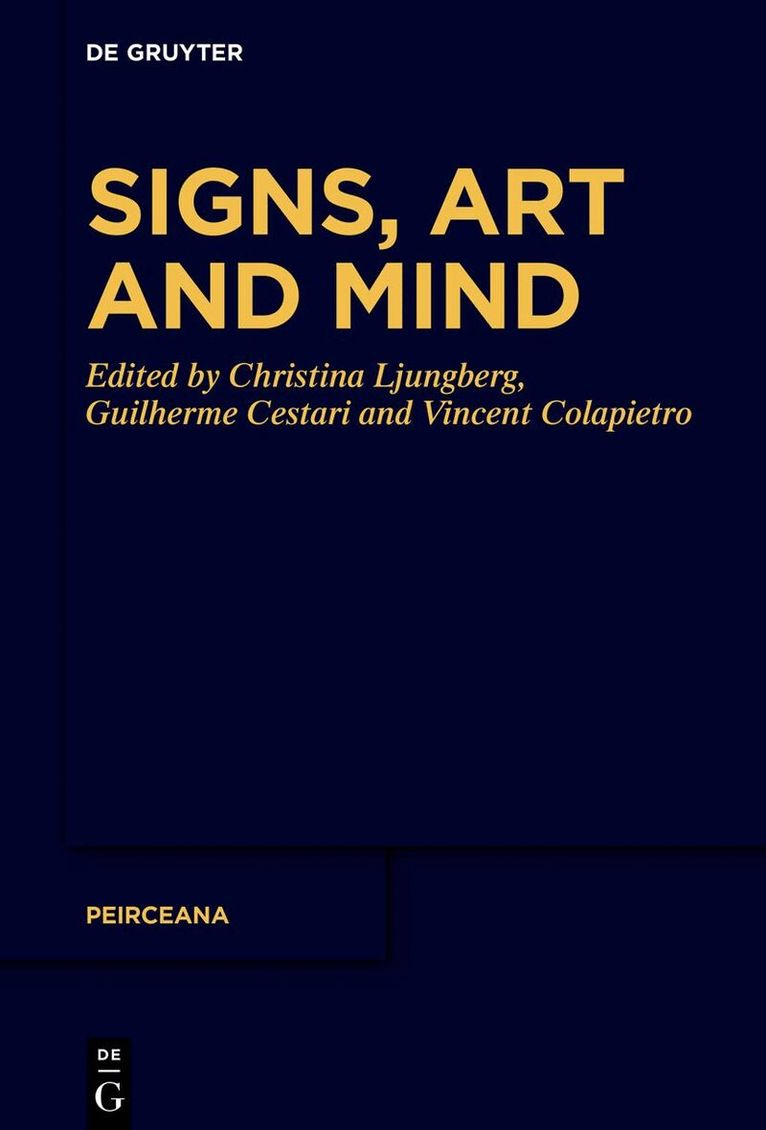
This volume presents contributions from renowned semiotic scholars who wish to celebrate and honor the work of the eminent linguist and semiotician Winfried Nöth. Spanning over 50 years of innovative semiotic inquiry, primarily into the writings of C.S. Peirce, Nöth’s interdisciplinary research and publications have been pivotal in developing fecund approaches to semiotics, including the exploration of art, design, cultural politics, ecology, cognition, and artificial intelligence from an erudite and rigorous semiotic perspective. This is reflected in the contributions to Signs, Art, and Mind, which range from art and farming to cultural politics and a convincing demonstration of how Peirce’s semeiotic can facilitate medical discoveries. The book begins with a thorough investigation of Peirce’s relevance in the 21st century and proceeds with a comprehensive discussion of his theory of signs. It also covers the relevance of Peircean semiotics to art, language, and education, as well as its topicality in the fields of cognitive science, artificial intelligence, and human ingenuity. The range of the topics and the credentials of the contributors make this volume itself an exceptional and important contribution to contemporary scholarship while at the same time expressing admiration, gratitude, and indebtedness to a singular scholar and exemplary theorist.