Sybille Kramer – författare
1 673 kr
Läs direkt efter köp
Diagrammatic reasoning is crucial for human cognition. It is hard to think of any forms of science or knowledge without the "intermediary world" of diagrams and diagrammatic representation in thought experiments and/or processes, manifested in forms as divers as notes, tables, schemata, graphs, drawings and maps. Despite their phenomenological and structural-functional differences, these forms of representation share a number of important attributes and epistemic functions. Combining aspects of linguistic and pictorial symbolism, diagrams go beyond the traditional distinction between language and image. They do not only represent, yet intervene in what is represented. Their spatiality, materiality and operativity establish a dynamic tool to exteriorize thinking, thus contributing to the idea of the extended mind. They foster imagination and problem solving, facilitate orientation in knowledge spaces and the discovery of unsuspected relationships.
How can the diagrammatic nature of cognitive and knowledge practices be theorized historically as well as systematically? This is what this volume explores by investigating the semiotic dimension of diagrams as to knowledge, information and reasoning, e.g., the ''thing-ness'' of diagrams in the history of art, the range of diagrammatic reasoning in logic, mathematics, philosophy and the sciences in general, including the knowledge function of maps.
1 688 kr
Läs direkt efter köp
Diagrammatic reasoning is crucial for human cognition. It is hard to think of any forms of science or knowledge without the "intermediary world" of diagrams and diagrammatic representation in thought experiments and/or processes, manifested in forms as divers as notes, tables, schemata, graphs, drawings and maps. Despite their phenomenological and structural-functional differences, these forms of representation share a number of important attributes and epistemic functions. Combining aspects of linguistic and pictorial symbolism, diagrams go beyond the traditional distinction between language and image. They do not only represent, yet intervene in what is represented. Their spatiality, materiality and operativity establish a dynamic tool to exteriorize thinking, thus contributing to the idea of the extended mind. They foster imagination and problem solving, facilitate orientation in knowledge spaces and the discovery of unsuspected relationships.
How can the diagrammatic nature of cognitive and knowledge practices be theorized historically as well as systematically? This is what this volume explores by investigating the semiotic dimension of diagrams as to knowledge, information and reasoning, e.g., the ''thing-ness'' of diagrams in the history of art, the range of diagrammatic reasoning in logic, mathematics, philosophy and the sciences in general, including the knowledge function of maps.
1 183 kr
Läs direkt efter köp
Lange Zeit galt Schrift als aufgeschriebene mündliche Sprache. Doch was geschieht, wenn eine mathematische Gleichung gelöst und Musik mit Noten komponiert wird, wenn ein Autor an seinem Text feilt, die Konkrete Poesie ein Schriftspiel entfaltet, der genetische Code als Buchstabenfolge sequenziert wird, der Kabbalist Buchstaben permutiert oder der Informatiker ein Computerprogramm schreibt? Schriften sind mehr als Aufschreibsysteme für Gesprochenes; stets bergen sie lautsprachenneutrale Aspekte. Der Begriff "Schriftbildlichkeit" zielt auf einen Perspektivenwechsel: die Überwindung eines phonographisch reduzierten und eurozentrisch verengten Schriftkonzeptes. Jenseits der Dichotomie von Sprache und Bild vereinigen sich in Schriften diskursive und ikonische Merkmale – und das gilt für alphabetische wie nichtalphabetische Schriften. Schriften eröffnen Experimentierräume der kognitiven wie der ästhetischen Erfahrung. In den Beiträgen dieses programmatischen Eröffnungsbandes der neuen Buchreihe "Schriftbildlichkeit" werden explorative und kreative Leistungen von Schriften im Wechselverhältnis ihrer Sichtbarkeit und Handhabbarkeit in wissenschaftlichen und künstlerischen, in alltäglichen, spielerischen und religiösen Schriftpraktiken zutage gefördert.
2 446 kr
Läs direkt efter köp
In der 1970 gegründeten Reihe erscheinen Arbeiten, die philosophiehistorische Studien mit einem systematischen Ansatz oder systematische Studien mit philosophiehistorischen Rekonstruktionen verbinden. Neben deutschsprachigen werden auch englischsprachige Monographien veröffentlicht.
Gründungsherausgeber sind: Erhard Scheibe (Herausgeber bis 1991), Günther Patzig (bis 1999) und Wolfgang Wieland (bis 2003). Von 1990 bis 2007 wurde die Reihe von Jürgen Mittelstraß, von 2005 bis 2020 von Jens Halfwassen mitherausgegeben.
1 410 kr
Läs direkt efter köp
374 kr
Läs direkt efter köp
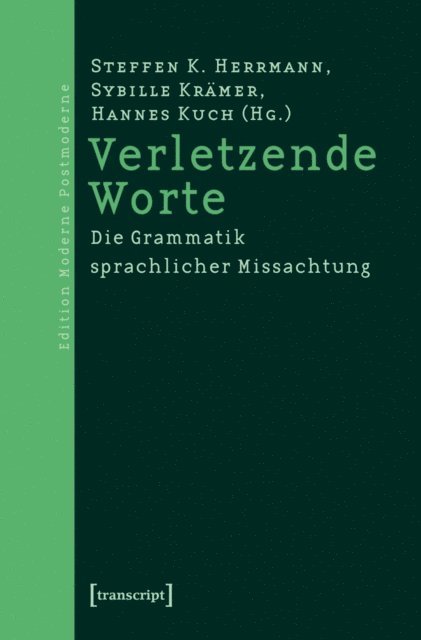
Worte verletzen und kränken. Woher aber kommt diese Verletzungsmacht? Während in der deutschsprachigen Philosophie Sprache meist als Gegenmittel zur Gewalt begriffen wird, hat die US-amerikanische Debatte um ›hate speech‹ gezeigt, dass das Sprechen Gewalt nicht nur androhen oder verhindern, sondern selbst eine Form von Gewaltausübung sein kann. Wie nun sind sprachliche Verletzung, Ausgrenzung und Missachtung zu erklären und zu verstehen? Aus der Sicht verschiedener Disziplinen untersuchen die Beiträge dieses Bandes, welcher Logik, Grammatik und Rhetorik unser verletzendes Sprechen gehorcht.Mit Beiträgen von u.a. Pierre Bourdieu, Penelope Brown/Stephen Levinson, Harold Garfinkel und Rae Langton.
Was Ist Digitale Philosophie?: Phanomene, Formen Und Methoden
923 kr
Skickas inom 3-6 vardagar