Christophe P. Gilbert - Böcker
Visar alla böcker från författaren Christophe P. Gilbert. Handla med fri frakt och snabb leverans.
2 produkter
2 produkter
809 kr
Skickas inom 10-15 vardagar
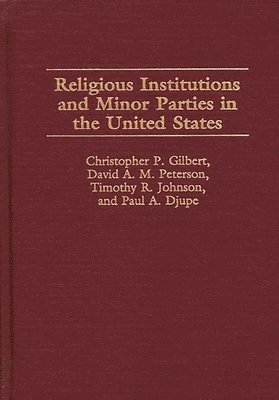
Gilbert et al. examine the impact of churches and church membership patterns on third parties and independent candidates in 20th-century U.S. politics. Candidates who choose not to run for office under the rubric of a major party face a well-known set of obstacles, yet the absence of discussion about the interconnections between religious institutions and minor parties is striking. The book presents a theoretical framework for understanding how religious institutions create, support, and sustain the political culture of local communities; by playing this role religious institutions support major parties and impede the electoral chances of political outsiders.The book's central finding is that third candidates are not privy to the ties that bind Democratic and Republican voters to their parties; one of the factors that creates and strengthens such ties is religion. Therefore, third candidates do best where church and party loyalties are weakest, or where third candidates have existing bases of support. The rare third candidate or minor party that possesses a base of support centered around a denomination or religious group can overcome such barriers. These conclusions are supported by analysis of census data, election returns, and voter surveys spanning the 20th century. Special attention is given to the 1992 and 1996 presidential candidacies of H. Ross Perot. This is an important analysis for scholars and other researchers dealing with American third parties and independent candidates and the impact of religion on politics.
1 009 kr
Skickas inom 10-15 vardagar
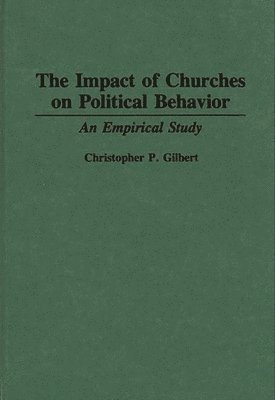
This volume applies well-known and highly regarded data in a new way and analyzes the impact of churches today on American political attitudes and behavior. These important findings measure how churches serve as political and social contexts and affect voting behavior; party identification; and the positions that local congregations and their membership take on abortion, public prayer, the economy, defense, support for minorities, and other issues. Political scientists, sociologists, and religious scholars will find these new interpretations of survey data clear, well-supported, and carefully qualified.This study of the role of religion in political decision making uses National Election study data, county-level data and the South Bend Community Study. Chapter 1 provides a general overview and introduction. Chapter 2 fills out the discussion about the nature of religious and social contexts and their relationship to churches and their members. These early chapters also define the design and research methodology and describe earlier research on the subject. Chapter 3 considers county-level data and changes relation to religious environments and individual behavior. In chapter 4, findings relating to voting and party identification are covered. Chapter 5 considers voter turnout, attitudes on public policy issues, economic expectations, views on issues relevant to the church. Chapter 6 evaluates church contexts and individual self-evaluations and perceptions about the impact of social contexts. The political influence of church discussion partners is the focus of chapter 7. The final chapter points to the political relevance of churches as contexts and summarizes some of the theoretical conclusions derived from the empirical study. Appendices provide the methodological material about variables and coding schemes needed for understanding the design of the work. A bibliography points to related studies of note.