Christopher Given-Wilson - Böcker
Visar alla böcker från författaren Christopher Given-Wilson. Handla med fri frakt och snabb leverans.
11 produkter
11 produkter
100 kr
Skickas
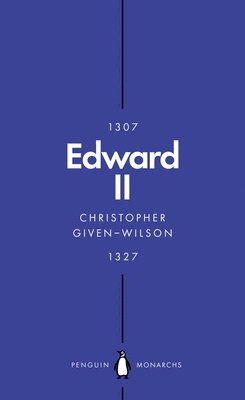
'He seems to have laboured under an almost child-like misapprehension about the size of his world. Had greatness not been thrust upon him, he might have lived a life of great harmlessness'The reign of Edward II was a succession of disasters. Inept in war, and in thrall to favourites, most notably the young nobleman Piers Gaveston, he preferred drinking, driving carts and rowing boats to the tedium of government. After twenty ruinous years, he was imprisoned and murdered. This remarkable book gives a glimpse into the abyss: the terrors of kingship.
3 245 kr
Skickas inom 5-8 vardagar
Adam Usk, the full details of whose remarkable life are here revealed for the first time, was born in Usk around the middle of the fourteenth century. Through the patronage of the Mortimer family - the earls of March - he studied law at Oxford, eventually rising to hold a chair in civil law there, before entering the service of Archbishop Arundel and, ultimately, of King Henry IV of England. He was an eye-witness to the revolution of 1399, but soon after this, having left England for Rome, he fell out with Henry IV and spent several years in exile, accused of collaborating with the Welsh rebel leader, Owain Glyn Dwr. Eventually, having returned to Wales secretly, he managed to gain a pardon from the king in 1411, and thus spent his remaining years, until his death in 1430, in relative peace.His chronicle, which is a first-hand source for the fall of Richard II, for the turbulent politics of Rome between 1402 and 1406, and for the Glyn Dwr revolt, also provides a fascinating insight - with its mixture of autobiography, political intrigue, and the supernatural - into the mind of a highly educated medieval author.
1 077 kr
Skickas inom 7-10 vardagar
This new series is to be published in alternate years with Thirteenth Century England, providing a forum for the most recent research into the political, social, economic, ecclesiastical and cultural history of the fourteenth century, one of the most turbulent and compelling periods of English history - reflected in the vitality of the current scholarship.
1 093 kr
Skickas inom 10-15 vardagar
The fruits of new research on the politics, society and culture of England in the fourteenth century.The essays collected here engage with many of the most important themes and subjects of the period. In addition to addressing matters of kingship and changing theories of power, they tackle questions concerning loyalty and rebellion at the centre of authority and on its margins; the role of law, both domestic and international; the nature of memory - legal, historical and fabricated; and the relationship between the Plantagenets and the rulers of those nations and territories over which England claimed dominion. In so doing, the collection offers important new insights into political and social developments at times of major turmoil, including Edward I's war with Scotland, the deposition of Edward II, and the Peasants' Revolt of 1381, while also exploring the mechanisms used to ensure peace and the smooth-running of a kingdom during a time of immense change. DAVID GREEN is Lecturer in British Studies and History, Harlaxton College; CHRIS GIVEN-WILSON is Professor of Late Medieval History, University of St Andrews.Contributors: James Bothwell, S.W. Dempsey, Matthew Hefferan, Samuel Lane, Cary J. Nederman, W. Mark Ormrod, Bridget Wells-Furby
21 403 kr
Tillfälligt slut
Major edition of all the surviving medieval Rolls of Parliament: an invaluable source for scholars.The rolls of parliament were the official records of the meetings of the English parliament from the reign of Edward I (1272-1307) until the reign of Henry VII (1485-1509), after which they were superseded by the journals of thelords, and, somewhat later, the commons. The rolls were first edited in the eighteenth century and published in 1767 in six folio volumes entitled Rotuli Parliamentorum, under the general editorship of the Reverend John Strachey. This new edition reproduces the rolls in their entirety, together with a few individual items published since 1783, as well as a substantial amount of material never previously published; it is complemented by a full translation of all the texts from the three languages used by the medieval clerks (Latin, Anglo-Norman and Middle English). It also includes an introduction to every parliament known to have been held by an English king (or in his name)between 1275 and 1504, whether or not the roll for that parliament survives. Where appropriate, appendices of supplementary material are also provided, and there is a General Introduction to the rolls. Contributors to the set are as follows: PAUL BRAND (1275-1307), SEYMOUR PHILLIPS (1307-1337), MARK ORMROD (1337-1377), GEOFFREY MARTIN (1377-1379), CHRIS GIVEN-WILSON (1380-1421), ANNE CURRY (1422-1453), ROSEMARY HORROX (1455-1504).
1 077 kr
Skickas inom 7-10 vardagar
Fourteenth Century England has quickly established for itself a deserved reputation for its scope and scholarship and for admirably filling a gap in the publication of medieval studies. HISTORYThe essays collected here present the fruits of the most recent research on aspects of the history, politics and culture of England during the `long' fourteenth century - roughly speaking from the reign of Edward I to the reign ofHenry V. Based on a range of primary sources, they are both original and challenging in their conclusions. Several of the articles touch in one way or another upon the subject of warfare, but the approaches which they adopt are significantly different, ranging from an analysis of the medieval theory of self-defence to an investigation of the relative utility of narrative and documentary sources for a specific campaign. Literary texts such as Barbour's Bruce are also discussed, and a re-evaluation of one particular set of records indicates that, in this case at least, the impact of the Black Death of 1348-9 may have been even more devastating than is usually thought.Chris Given-Wilson is Professor of Late Mediaeval History at the University of St Andrews. Contributors: Susan Foran, Penny Lawne, Paula Arthur, Graham E. St John, Diana Tyson, David Green, Jessica Lutkin, Rory Cox, Adrian R. Bell
The Parliament Rolls of Medieval England, 1275-1504
VI: Richard II. 1377-1384
Inbunden, Engelska, 2012
1 628 kr
Skickas inom 10-15 vardagar
A major contribution to the history of Parliament, to medieval English history, and to the study of the English constitution. ENGLISH HISTORICAL REVIEWThe rolls of parliament were the official records of the meetings of the English parliament from the reign of Edward I (1272-1307) until the reign of Henry VII (1485-1509), after which they were superseded by the journals of thelords, and, somewhat later, the commons.Chris Given-Wilson is Professor of Late Medieval History, University of St Andrews
The Parliament Rolls of Medieval England, 1275-1504
VII: Richard II. 1385-1397
Inbunden, Engelska, 2012
1 628 kr
Skickas inom 10-15 vardagar
A major contribution to the history of Parliament, to medieval English history, and to the study of the English constitution. ENGLISH HISTORICAL REVIEWThe rolls of parliament were the official records of the meetings of the English parliament from the reign of Edward I (1272-1307) until the reign of Henry VII (1485-1509), after which they were superseded by the journals of thelords, and, somewhat later, the commons.Chris Given-Wilson is Professor of Late Medieval History, University of St Andrews
The Parliament Rolls of Medieval England, 1275-1504
VIII: Henry IV. 1399-1413
Inbunden, Engelska, 2012
2 002 kr
Skickas inom 10-15 vardagar
A major contribution to the history of Parliament, to medieval English history, and to the study of the English constitution. ENGLISH HISTORICAL REVIEWThe rolls of parliament were the official records of the meetings of the English parliament from the reign of Edward I (1272-1307) until the reign of Henry VII (1485-1509), after which they were superseded by the journals of thelords, and, somewhat later, the commons.The nine parliaments held during the reign of Henry IV (1399-1413) witnessed some of the most dramatic encounters between king and commons of the middle ages, especially those of the first seven years of the reign. Principles which were to become staples of parliamentary debate, such as the demand for redress of grievances before grant of supply, insistence on the accountability to parliament of royal ministers, and the right of those who granted taxes to determine how they should be used (appropriation of supply) were openly demanded and to some extent conceded by the king. These demands reached a climax in the Long Parliament of 1406,which lasted for nine months, twice as long as any previous English parliament, and witnessed a prolonged stand-off between king and commons. The second half of the reign saw more docile parliaments, although the struggle betweenthe king and his son, the future Henry V, for control of the executive produced some dramatic parliamentary moments such as an attempt to force the king to abdicate. These early fifteenth-century parliaments also witnessed the passing of some extremely interesting social and religious legislation on matters such as heresy, law and order and the regulation of labour.The rolls from the period are reproduced in their entirely, complented by a full translation of all the texts from the three languages used by the medieval clerks (Latin, Anglo-Norman and Middle English).Chris Given-Wilson is Professor of Late Medieval History, University of St Andrews.
1 220 kr
Skickas inom 10-15 vardagar
A major contribution to the history of Parliament, to medieval English history, and to the study of the English constitution. ENGLISH HISTORICAL REVIEWThe rolls of parliament were the official records of the meetings of the English parliament from the reign of Edward I (1272-1307) until the reign of Henry VII (1485-1509), after which they were superseded by the journals of thelords, and, somewhat later, the commons.The nine parliaments held during the reign of Henry IV (1399-1413) witnessed some of the most dramatic encounters between king and commons of the middle ages, especially those of the first seven years of the reign. Principles which were to become staples of parliamentary debate, such as the demand for redress of grievances before grant of supply, insistence on the accountability to parliament of royal ministers, and the right of those who granted taxes to determine how they should be used (appropriation of supply) were openly demanded and to some extent conceded by the king. These demands reached a climax in the Long Parliament of 1406,which lasted for nine months, twice as long as any previous English parliament, and witnessed a prolonged stand-off between king and commons. The second half of the reign saw more docile parliaments, although the struggle betweenthe king and his son, the future Henry V, for control of the executive produced some dramatic parliamentary moments such as an attempt to force the king to abdicate. These early fifteenth-century parliaments also witnessed the passing of some extremely interesting social and religious legislation on matters such as heresy, law and order and the regulation of labour.The rolls from the period are reproduced in their entirely, complented by a full translation of all the texts from the three languages used by the medieval clerks (Latin, Anglo-Norman and Middle English).Chris Given-Wilson is Professor of Late Medieval History, University of St Andrews.
502 kr
Skickas inom 10-15 vardagar
The priorities of medieval chroniclers and historians were not those of the modern historian, nor was the way that they gathered, arranged and presented evidence. Yet, if we understand how they approached their task, and their assumption of God's immanence in the world, much that they wrote becomes clear. Many of them were men of high intelligence whose interpretation of events sheds clear light on what happened. Chris Given-Wilson is one of the leading authorities on medieval English historical writing. He examines how medieval writers such as William of Malmesbury and Adam of Usk treated chronology and geography, politics and warfare, heroes and villains. He looks at the ways in which chronicles were used during the middle ages, and at how the writing of history changed between the twelfth and fifteenth centuries.