Cyril O'Regan - Böcker
Visar alla böcker från författaren Cyril O'Regan. Handla med fri frakt och snabb leverans.
7 produkter
7 produkter
436 kr
Tillfälligt slut
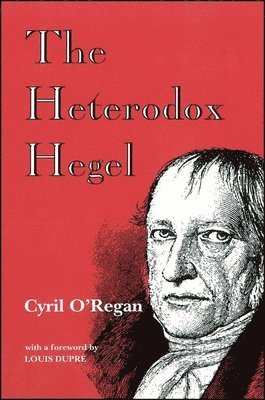
A Groundbreaking Study of Hegel’s Mystical Vision.The Heterodox Hegel opens a new horizon in the study of Hegel by uncovering the mystical and Trinitarian foundations of his thought. For the first time, readers can explore Hegel not only as a philosopher of logic and history but also as a thinker deeply engaged with the esoteric currents of Christian mysticism, a dimension long overlooked by scholarship.Through meticulous textual analysis, Cyril O'Regan traces Hegel’s intellectual journey across the epochs of the divine, from the immanent Trinity through creation, incarnation, and the kingdom of the Spirit, culminating in a comprehensive narrative of spiritual and speculative transformation. The Heterodox Hegel demonstrates how Hegel’s philosophy of religion, deeply embedded in mystical theology, continues to illuminate enduring questions of divinity, community, and metaphysical truth.Featuring an erudite foreword by Louis Dupré, extensive notes, and an exhaustive bibliography, The Heterodox Hegel is essential reading for philosophers, theologians, and scholars seeking to understand Hegel in the fullness of his mystical and metaphysical vision.
1 057 kr
Tillfälligt slut
Looks at the influence of Gnosticism in modern intellectual history, philosophy, and theology.Gnostic Return in Modernity demonstrates the possibility that Gnosticism haunts certain modern discourses. Studying Gnosticism of the first centuries of the common era and utilizing narrative analysis, the author shows how Gnosticism returns in a select band of narrative discourses that extends from the seventeenth century German mystic Jacob Boehme through Hegel and Blake down into the contemporary period. The key concept is that of narrative grammar. Unlike the hypothesis of an invariant narrative, a Gnostic narrative grammar allows room for the differences between modern and ancient forms of Gnosticism, and respects the dignity of both periods.
559 kr
Skickas inom 3-6 vardagar
Looks at the influence of Gnosticism in modern intellectual history, philosophy, and theology.Gnostic Return in Modernity demonstrates the possibility that Gnosticism haunts certain modern discourses. Studying Gnosticism of the first centuries of the common era and utilizing narrative analysis, the author shows how Gnosticism returns in a select band of narrative discourses that extends from the seventeenth century German mystic Jacob Boehme through Hegel and Blake down into the contemporary period. The key concept is that of narrative grammar. Unlike the hypothesis of an invariant narrative, a Gnostic narrative grammar allows room for the differences between modern and ancient forms of Gnosticism, and respects the dignity of both periods.
1 057 kr
Tillfälligt slut
Argues that the discourse of Jacob Boehme represents the return of Gnostic thought in modernity after a thousand year hiatus.Jacob Boehme, the seventeenth-century German speculative mystic, influenced the philosophers Hegel and Schelling and both English and German Romantics alike with his visionary thought. Gnostic Apocalypse focuses on the way Boehme's thought repeats and surpasses post-reformation Lutheran thinking, deploys and subverts the commitments of medieval mysticism, realizes the speculative thrust of Renaissance alchemy, is open to esoteric discourses such as the Kabbalah, and articulates a dynamic metaphysics. This book critically assesses the striking claim made in the nineteenth century that Boehme's visionary discourse represents within the confines of specifically Protestant thought nothing less than the return of ancient Gnosis. Although the grounds adduced on behalf of the "Gnostic return" claim in the nineteenth century are dismissed as questionable, O'Regan shows that the fundamental intuition is correct. Boehme's visionary discourse does represent a return of Gnosticism in the modern period, and in this lies its fundamental claim to our contemporary philosophical, theological, and literary attention.
594 kr
Skickas inom 3-6 vardagar
Argues that the discourse of Jacob Boehme represents the return of Gnostic thought in modernity after a thousand year hiatus.Jacob Boehme, the seventeenth-century German speculative mystic, influenced the philosophers Hegel and Schelling and both English and German Romantics alike with his visionary thought. Gnostic Apocalypse focuses on the way Boehme's thought repeats and surpasses post-reformation Lutheran thinking, deploys and subverts the commitments of medieval mysticism, realizes the speculative thrust of Renaissance alchemy, is open to esoteric discourses such as the Kabbalah, and articulates a dynamic metaphysics. This book critically assesses the striking claim made in the nineteenth century that Boehme's visionary discourse represents within the confines of specifically Protestant thought nothing less than the return of ancient Gnosis. Although the grounds adduced on behalf of the "Gnostic return" claim in the nineteenth century are dismissed as questionable, O'Regan shows that the fundamental intuition is correct. Boehme's visionary discourse does represent a return of Gnosticism in the modern period, and in this lies its fundamental claim to our contemporary philosophical, theological, and literary attention.
Anatomy of Misremembering
Von Balthasar's Response to Philosophical Modernity. Volume 1: Hegel
Häftad, Engelska, 2014
530 kr
Skickas inom 3-6 vardagar
This compelling work is the most comprehensive and sophisticated account to date of the relationship between Hans Urs von Balthasar—a Swiss theologian and Catholic priest—and the German philosopher Georg Hegel. While underscoring the depth and breadth of Balthasar’s engagement with the philosopher, author Cyril O’Regan argues that Balthasar is the most concertedly anti-Hegelian theologian of the 20th century. For him, it is essential to engage Hegel because of his corrections of sclerotic forms of premodern Christian thought, but even more importantly to resist and correct his systematic thought, which represents a comprehensive misremembering of the Christian thought, practices, and forms of life. An important and original work, this book addresses a topic that puts the possibility of an authentic postmodern theology at stake.
166 kr
Skickas inom 7-10 vardagar
O'Regan pointed to the "exile" of apocalyptic in the modern period, and its "contemporary return" in a host of theologians, including, but not limited to: Hans Urs von Balthasar, Jurgen Moltmann, Johann Baptist Metz, Sergei Bulgakov, Karl Barth, Stanley Hauerwas, Jacques Derrida, (to a limited extent) the Pope Benedict XVI, David Bentley Hart, Catherine Keller, John D. Caputo, and Gianni Vattimo. Apocalyptic is not so exotic before, especially since we find such diverse thinkers sharing the same theological "spaces" (e.g. Balthasar, the "Pope's theologian," and Derrida, share the same space - this is surprising) O'Regan finds it helpful to map out three spaces in order to distinguish these different thinkers. He has three of them: 1) Pleromatic: maximum level of content; 2) Metaxic: in-between level of content; and 3) Kenomatic: empty of content.