D. Hestenes – författare
Visar alla böcker från författaren D. Hestenes. Handla med fri frakt och snabb leverans.
11 produkter
11 produkter
E-bok
PDF, Engelska, 20054 572 kr
Läs direkt efter köp
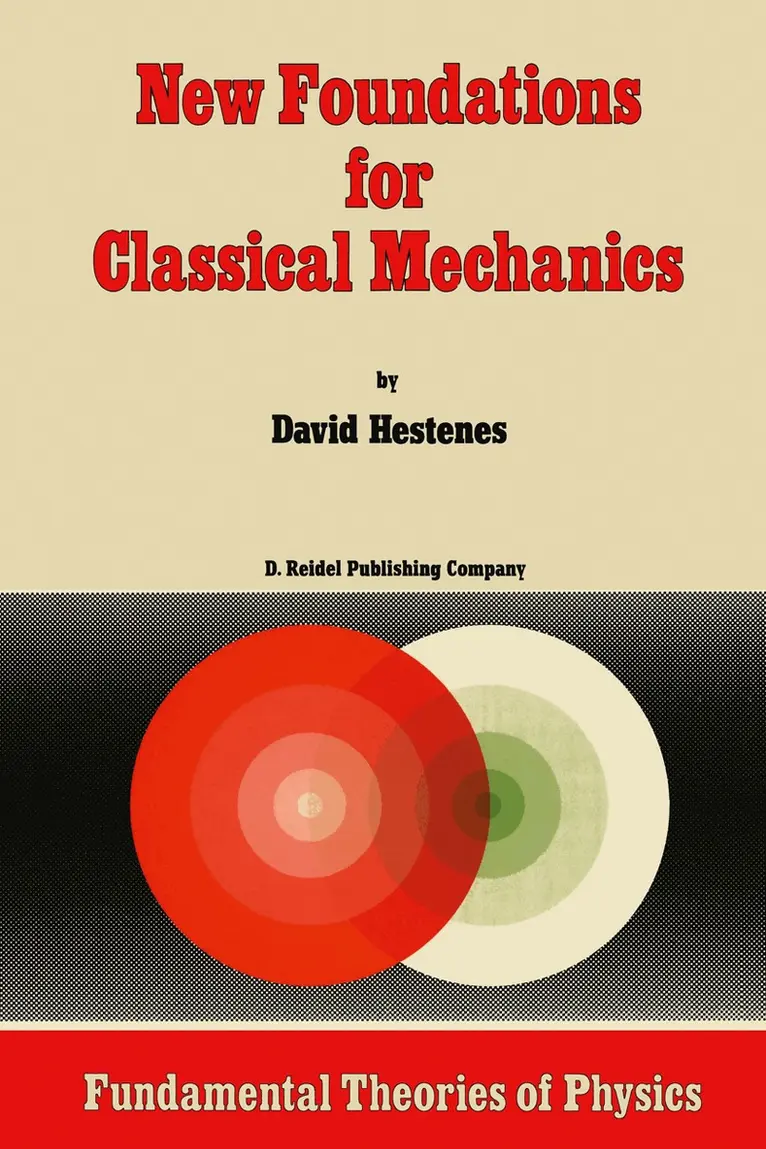
(revised) This is a textbook on classical mechanics at the intermediate level, but its main purpose is to serve as an introduction to a new mathematical language for physics called geometric algebra. Mechanics is most commonly formulated today in terms of the vector algebra developed by the American physicist J. Willard Gibbs, but for some applications of mechanics the algebra of complex numbers is more efficient than vector algebra, while in other applications matrix algebra works better. Geometric algebra integrates all these algebraic systems into a coherent mathematical language which not only retains the advantages of each special algebra but possesses powerful new capabilities. This book covers the fairly standard material for a course on the mechanics of particles and rigid bodies. However, it will be seen that geometric algebra brings new insights into the treatment of nearly every topic and produces simplifications that move the subject quickly to advanced levels. That has made it possible in this book to carry the treatment of two major topics in mechanics well beyond the level of other textbooks. A few words are in order about the unique treatment of these two topics, namely, rotational dynamics and celestial mechanics.
Del 45 - Fundamental Theories of Physics
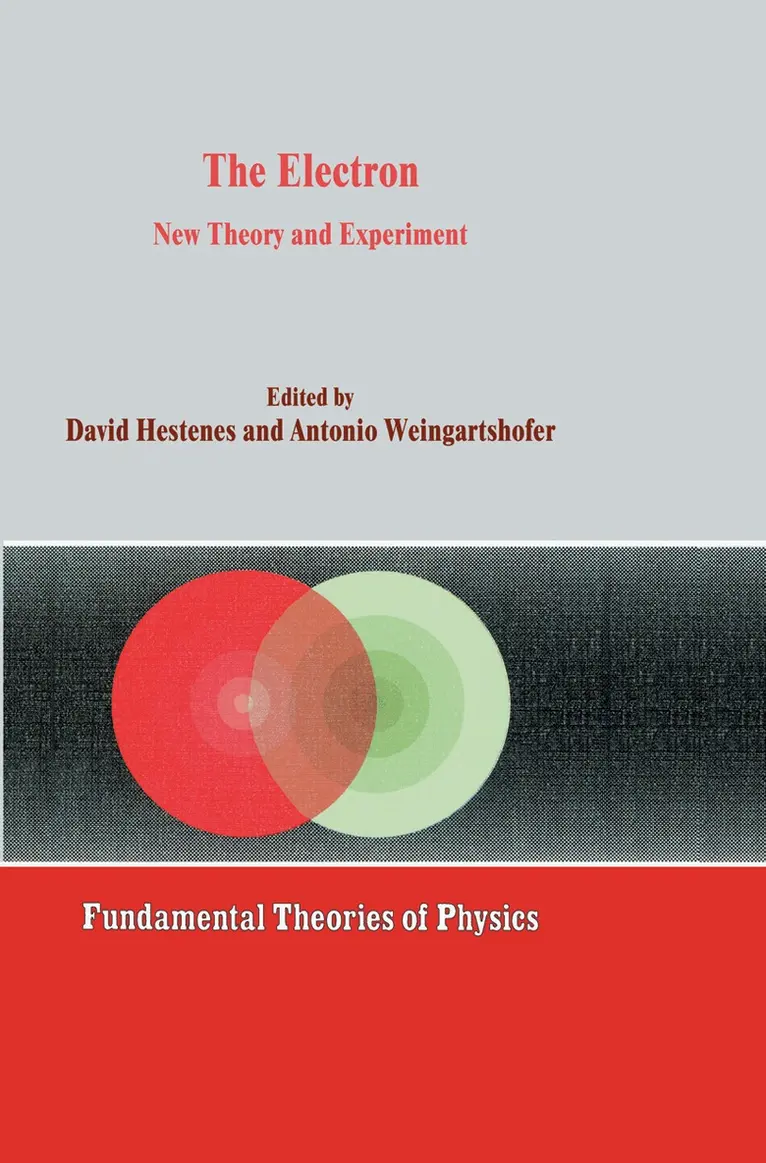
Electron
New Theory and Experiment
Inbunden, Engelska, 1991
1 616 kr
Skickas inom 10-15 vardagar
techniques, and raises new issues of physical interpretation as well as possibilities for deepening the theory. (3) Barut contributes a comprehensive review of his own ambitious program in electron theory and quantum electrodynamics. Barut's work is rich with ingenious ideas, and the interest it provokes among other theorists can be seen in the cri tique by Grandy. Cooperstock takes a much different approach to nonlinear field-electron coupling which leads him to conclusions about the size of the electron. (4) Capri and Bandrauk work within the standard framework of quantum electrodynamics. Bandrauk presents a valuable review of his theoretical approach to the striking new photoelectric phenomena in high intensity laser experiments. (5) Jung proposes a theory to merge the ideas of free-free transitions and of scattering chaos, which is becoming increasingly important in the theoretical analysis of nonlinear optical phenomena. For the last half century the properties of electrons have been probed primarily by scattering experiments at ever higher energies. Recently, however, two powerful new experimental techniques have emerged capable of giving alternative experimental views of the electron. We refer to (1) the confinement of single electrons for long term study, and (2) the interaction of electrons with high intensity laser fields. Articles by outstanding practitioners of both techniques are included in Part II of these Proceedings. The precision experiments on trapped electrons by the Washington group quoted above have already led to a Nobel prize for the most accurate measurements of the electron magnetic moment.
Inbunden, Engelska, 1999
3 546 kr
Skickas inom 10-15 vardagar
(revised) This is a textbook on classical mechanics at the intermediate level, but its main purpose is to serve as an introduction to a new mathematical language for physics called geometric algebra. Mechanics is most commonly formulated today in terms of the vector algebra developed by the American physicist J. Willard Gibbs, but for some applications of mechanics the algebra of complex numbers is more efficient than vector algebra, while in other applications matrix algebra works better. Geometric algebra integrates all these algebraic systems into a coherent mathematical language which not only retains the advantages of each special algebra but possesses powerful new capabilities. This book covers the fairly standard material for a course on the mechanics of particles and rigid bodies. However, it will be seen that geometric algebra brings new insights into the treatment of nearly every topic and produces simplifications that move the subject quickly to advanced levels. That has made it possible in this book to carry the treatment of two major topics in mechanics well beyond the level of other textbooks. A few words are in order about the unique treatment of these two topics, namely, rotational dynamics and celestial mechanics.
Del 99 - Fundamental Theories of Physics
New Foundations for Classical Mechanics
Häftad, Engelska, 1999
3 761 kr
Skickas inom 10-15 vardagar
(revised) This is a textbook on classical mechanics at the intermediate level, but its main purpose is to serve as an introduction to a new mathematical language for physics called geometric algebra. Mechanics is most commonly formulated today in terms of the vector algebra developed by the American physicist J. Willard Gibbs, but for some applications of mechanics the algebra of complex numbers is more efficient than vector algebra, while in other applications matrix algebra works better. Geometric algebra integrates all these algebraic systems into a coherent mathematical language which not only retains the advantages of each special algebra but possesses powerful new capabilities. This book covers the fairly standard material for a course on the mechanics of particles and rigid bodies. However, it will be seen that geometric algebra brings new insights into the treatment of nearly every topic and produces simplifications that move the subject quickly to advanced levels. That has made it possible in this book to carry the treatment of two major topics in mechanics well beyond the level of other textbooks. A few words are in order about the unique treatment of these two topics, namely, rotational dynamics and celestial mechanics.
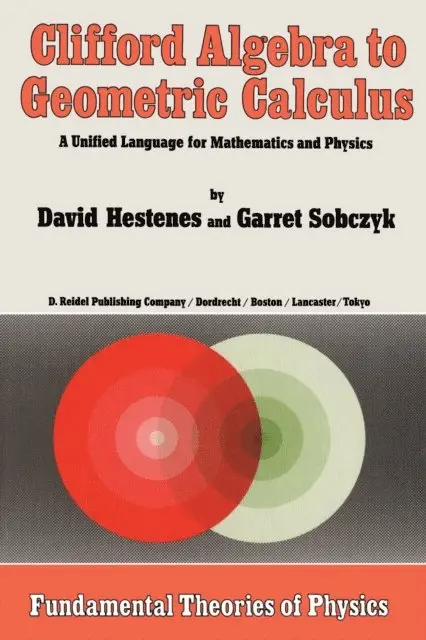
Del 5 - Fundamental Theories of Physics
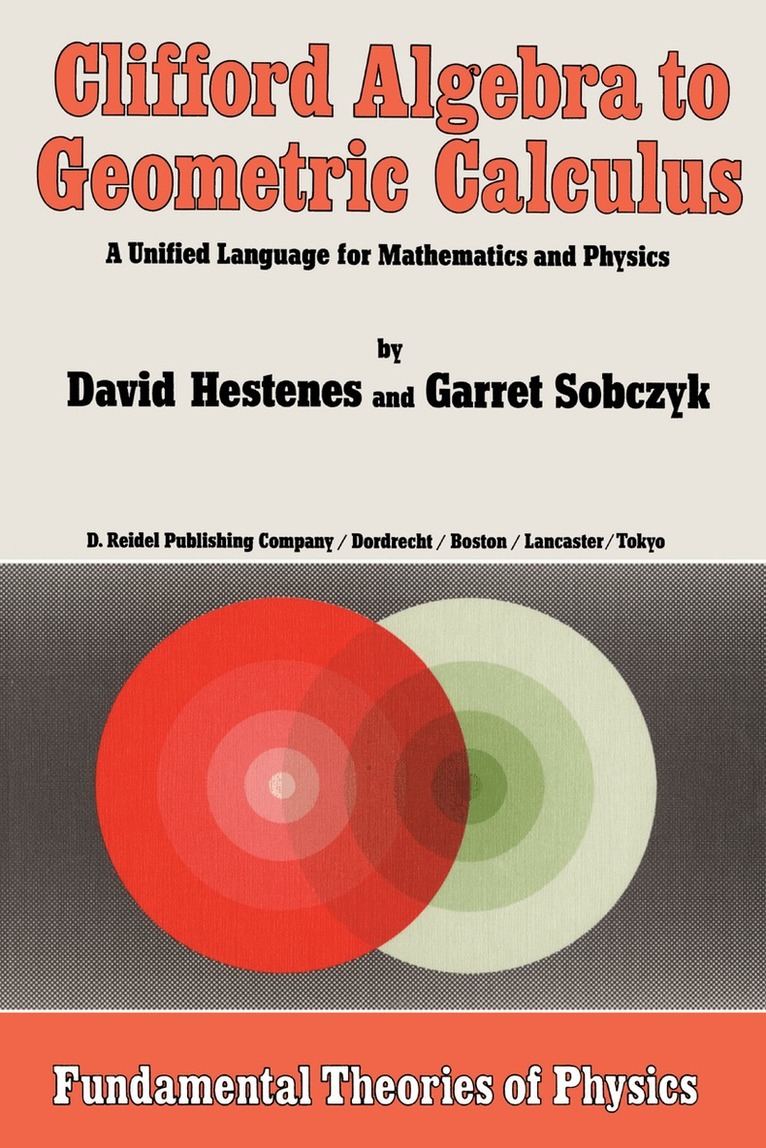
Clifford Algebra to Geometric Calculus
A Unified Language for Mathematics and Physics
Inbunden, Engelska, 1984
1 958 kr
Skickas inom 10-15 vardagar
Matrix algebra has been called "the arithmetic of higher mathematics" [Be]. We think the basis for a better arithmetic has long been available, but its versatility has hardly been appreciated, and it has not yet been integrated into the mainstream of mathematics. We refer to the system commonly called 'Clifford Algebra', though we prefer the name 'Geometric Algebm' suggested by Clifford himself. Many distinct algebraic systems have been adapted or developed to express geometric relations and describe geometric structures. Especially notable are those algebras which have been used for this purpose in physics, in particular, the system of complex numbers, the quatemions, matrix algebra, vector, tensor and spinor algebras and the algebra of differential forms. Each of these geometric algebras has some significant advantage over the others in certain applications, so no one of them provides an adequate algebraic structure for all purposes of geometry and physics. At the same time, the algebras overlap considerably, so they provide several different mathematical representations for individual geometrical or physical ideas.
Del 15 - Fundamental Theories of Physics
New Foundations for Classical Mechanics
Häftad, Engelska, 1987
1 633 kr
Skickas inom 10-15 vardagar
This is a textbook on classical mechanics at the intermediate level, but its main purpose is to serve as an introduction to a new mathematical language for physics called geometric algebra. Mechanics is most commonly formulated today in terms of the vector algebra developed by the American physicist J. Willard Gibbs, but for some applications of mechanics the algebra of complex numbers is more efficient than vector algebra, while in other applica tions matrix algebra works better. Geometric algebra integrates all these algebraic systems into a coherent mathematical language which not only retains the advantages of each special algebra but possesses powerful new capabilities. This book covers the fairly standard material for a course on the mechanics of particles and rigid bodies. However, it will be seen that geometric algebra brings new insights into the treatment of nearly every topic and produces simplifications that move the subject quickly to advanced levels. That has made it possible in this book to carry the treatment of two major topics in mechanics well beyond the level of other textbooks. A few words are in order about the unique treatment of these two topics, namely, rotational dynamics and celestial mechanics.
Del 5 - Fundamental Theories of Physics
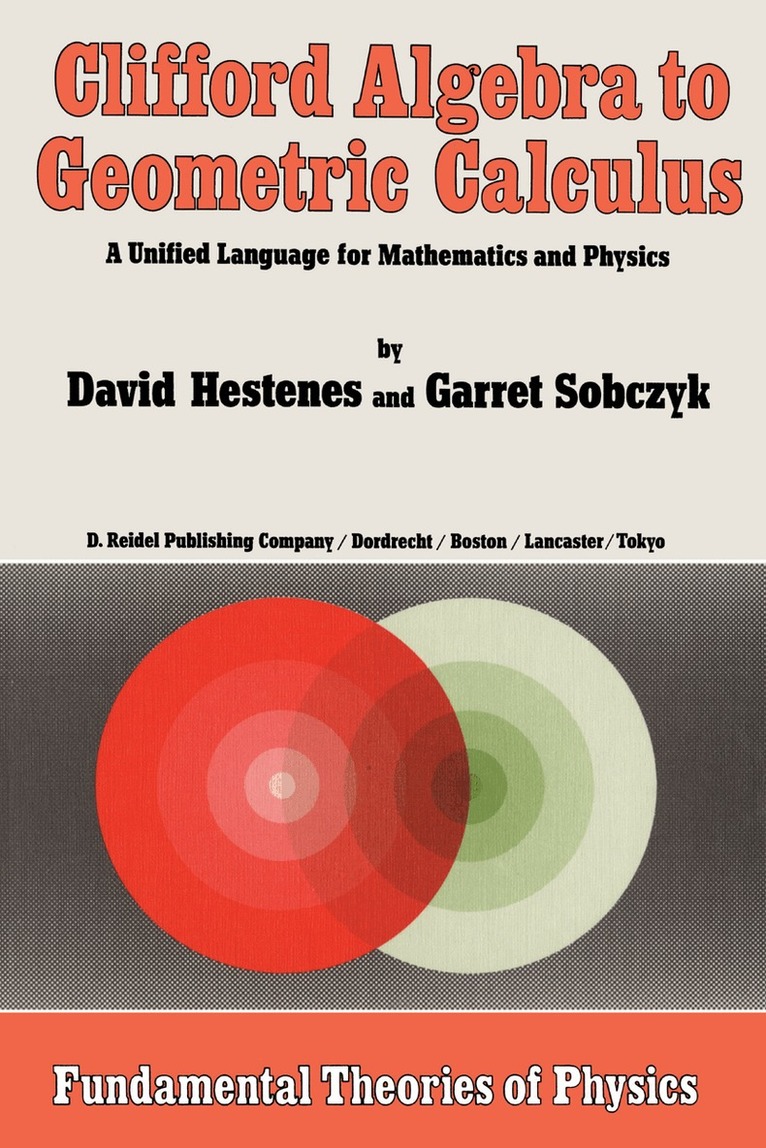
Clifford Algebra to Geometric Calculus
A Unified Language for Mathematics and Physics
Häftad, Engelska, 1987
1 958 kr
Skickas inom 10-15 vardagar
Matrix algebra has been called "the arithmetic of higher mathematics" [Be]. We think the basis for a better arithmetic has long been available, but its versatility has hardly been appreciated, and it has not yet been integrated into the mainstream of mathematics. We refer to the system commonly called 'Clifford Algebra', though we prefer the name 'Geometric Algebm' suggested by Clifford himself. Many distinct algebraic systems have been adapted or developed to express geometric relations and describe geometric structures. Especially notable are those algebras which have been used for this purpose in physics, in particular, the system of complex numbers, the quatemions, matrix algebra, vector, tensor and spinor algebras and the algebra of differential forms. Each of these geometric algebras has some significant advantage over the others in certain applications, so no one of them provides an adequate algebraic structure for all purposes of geometry and physics. At the same time, the algebras overlap considerably, so they provide several different mathematical representations for individual geometrical or physical ideas.
E-bok
PDF, Engelska, 20122 049 kr
Läs direkt efter köp
This is a textbook on classical mechanics at the intermediate level, but its main purpose is to serve as an introduction to a new mathematical language for physics called geometric algebra. Mechanics is most commonly formulated today in terms of the vector algebra developed by the American physicist J. Willard Gibbs, but for some applications of mechanics the algebra of complex numbers is more efficient than vector algebra, while in other applica tions matrix algebra works better. Geometric algebra integrates all these algebraic systems into a coherent mathematical language which not only retains the advantages of each special algebra but possesses powerful new capabilities. This book covers the fairly standard material for a course on the mechanics of particles and rigid bodies. However, it will be seen that geometric algebra brings new insights into the treatment of nearly every topic and produces simplifications that move the subject quickly to advanced levels. That has made it possible in this book to carry the treatment of two major topics in mechanics well beyond the level of other textbooks. A few words are in order about the unique treatment of these two topics, namely, rotational dynamics and celestial mechanics.
E-bok
PDF, Engelska, 20122 435 kr
Läs direkt efter köp
Matrix algebra has been called "the arithmetic of higher mathematics" [Be]. We think the basis for a better arithmetic has long been available, but its versatility has hardly been appreciated, and it has not yet been integrated into the mainstream of mathematics. We refer to the system commonly called ''Clifford Algebra'', though we prefer the name ''Geometric Algebm'' suggested by Clifford himself. Many distinct algebraic systems have been adapted or developed to express geometric relations and describe geometric structures. Especially notable are those algebras which have been used for this purpose in physics, in particular, the system of complex numbers, the quatemions, matrix algebra, vector, tensor and spinor algebras and the algebra of differential forms. Each of these geometric algebras has some significant advantage over the others in certain applications, so no one of them provides an adequate algebraic structure for all purposes of geometry and physics. At the same time, the algebras overlap considerably, so they provide several different mathematical representations for individual geometrical or physical ideas.
Del 45 - Fundamental Theories of Physics
Electron
New Theory and Experiment
Häftad, Engelska, 2012
1 633 kr
Skickas inom 10-15 vardagar
techniques, and raises new issues of physical interpretation as well as possibilities for deepening the theory. (3) Barut contributes a comprehensive review of his own ambitious program in electron theory and quantum electrodynamics. Barut's work is rich with ingenious ideas, and the interest it provokes among other theorists can be seen in the cri tique by Grandy. Cooperstock takes a much different approach to nonlinear field-electron coupling which leads him to conclusions about the size of the electron. (4) Capri and Bandrauk work within the standard framework of quantum electrodynamics. Bandrauk presents a valuable review of his theoretical approach to the striking new photoelectric phenomena in high intensity laser experiments. (5) Jung proposes a theory to merge the ideas of free-free transitions and of scattering chaos, which is becoming increasingly important in the theoretical analysis of nonlinear optical phenomena. For the last half century the properties of electrons have been probed primarily by scattering experiments at ever higher energies. Recently, however, two powerful new experimental techniques have emerged capable of giving alternative experimental views of the electron. We refer to (1) the confinement of single electrons for long term study, and (2) the interaction of electrons with high intensity laser fields. Articles by outstanding practitioners of both techniques are included in Part II of these Proceedings. The precision experiments on trapped electrons by the Washington group quoted above have already led to a Nobel prize for the most accurate measurements of the electron magnetic moment.
E-bok
PDF, Engelska, 20121 977 kr
Läs direkt efter köp
techniques, and raises new issues of physical interpretation as well as possibilities for deepening the theory. (3) Barut contributes a comprehensive review of his own ambitious program in electron theory and quantum electrodynamics. Barut''s work is rich with ingenious ideas, and the interest it provokes among other theorists can be seen in the cri tique by Grandy. Cooperstock takes a much different approach to nonlinear field-electron coupling which leads him to conclusions about the size of the electron. (4) Capri and Bandrauk work within the standard framework of quantum electrodynamics. Bandrauk presents a valuable review of his theoretical approach to the striking new photoelectric phenomena in high intensity laser experiments. (5) Jung proposes a theory to merge the ideas of free-free transitions and of scattering chaos, which is becoming increasingly important in the theoretical analysis of nonlinear optical phenomena. For the last half century the properties of electrons have been probed primarily by scattering experiments at ever higher energies. Recently, however, two powerful new experimental techniques have emerged capable of giving alternative experimental views of the electron. We refer to (1) the confinement of single electrons for long term study, and (2) the interaction of electrons with high intensity laser fields. Articles by outstanding practitioners of both techniques are included in Part II of these Proceedings. The precision experiments on trapped electrons by the Washington group quoted above have already led to a Nobel prize for the most accurate measurements of the electron magnetic moment.