• Fri frakt över 249 kr
  • •
  • Snabba leveranser
  • •
  • Billiga böcker
Kundservice

Du är på sajten för privatpersoner.

Företag, bibliotek eller offentlig verksamhet?

Du handlar på classic.bokus.com, där alla dina funktioner finns intakta.
Till classic.bokus.com
Bokus logotyp. Gå till startsidan.
  • Erbjudanden
  • Nyheter
  • Student
  • Topplistor
  • Barn & ungdom
  • Bokus Play
  • E-böcker
  • Pocketböcker
  • Spel & pussel

10% rabatt på allt med kod NYSTART10 →

Sidfot

Mina sidor

    Hjälp

    • Kundservice
    • Vanliga frågor och svar
    • Frakt och leverans
    • Retur vid ångerrätt
    • Reklamera vara
    • Betalning
    • Köpvillkor
    • Allmänna villkor
    • Information om webbplatsens tillgänglighet

    Om Bokus

    • Om oss
    • Pressrum
    • För studenter
    • För företag
    • För bibliotek och offentlig verksamhet
    • För leverantörer
    • Hållbarhet

    Populärt

    • Aktuella erbjudanden
    • Presentkort
    • Studentlitteratur
    • Nya böcker
    • Topplistor
    • Signerade böcker
    • Engelska böcker

    Inspiration

    • Boktips
    • BookTok
    • Populära bokserier
    • Barnbokskaraktärer
    • Populära författare
    Logotyp för Bokus
    Följ oss på Facebook (extern länk)Följ oss på Instagram (extern länk)Följ oss på YouTube (extern länk)Följ oss på TikTok (extern länk)
    bokus @ CookiesAnpassa cookiesIntegritetspolicyKöpvillkor
    Till Citymail hemsida (extern länk)Till Budbee hemsida (extern länk)Till Postnord hemsida (extern länk)Till Schenker hemsida (extern länk)Till Early Bird hemsida (extern länk)Till Walleys hemsida (extern länk)
    1. Naturvetenskap och teknik
    2. Matematik och naturvetenskap
    3. Fysik
    4. Klassisk mekanik

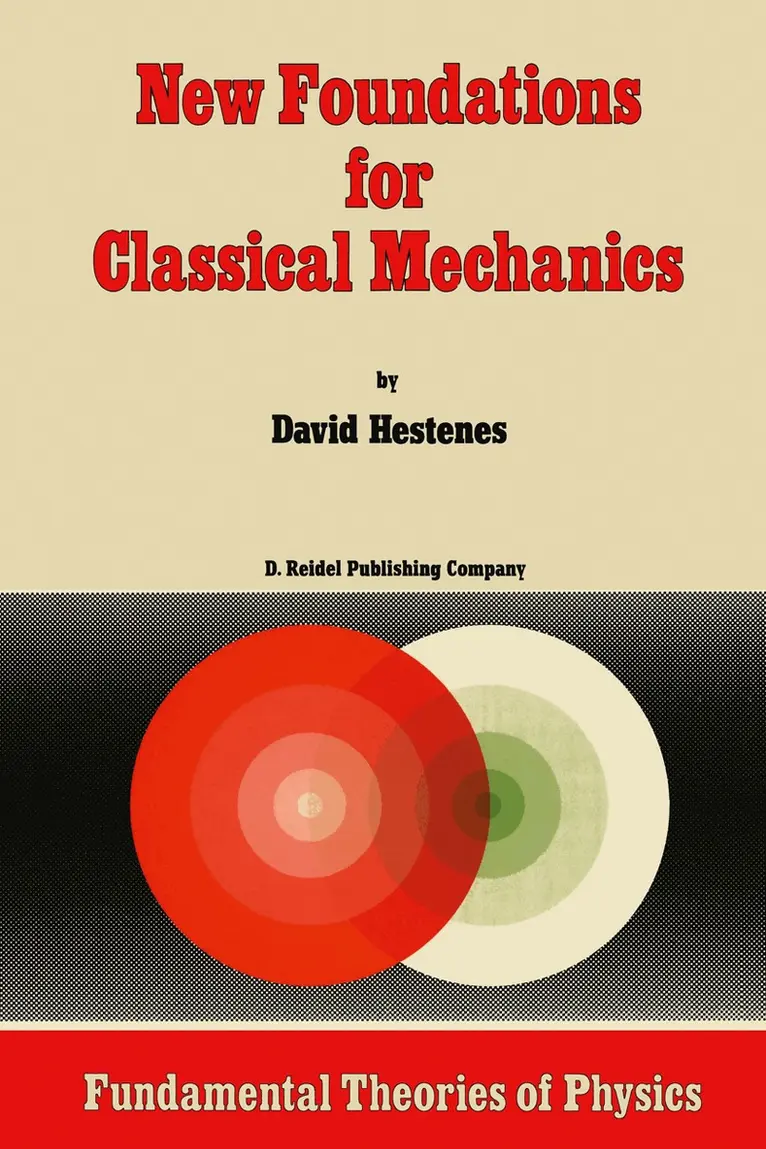
    New Foundations for Classical Mechanics

    AvD. Hestenes

    Häftad, Engelska, 1987

    Del 15 i serien Fundamental Theories of Physics

    1 623 kr

    Beställningsvara. Skickas inom 10-15 vardagar. Fri frakt över 249 kr.

    Fler format och utgåvor

    E-bok

    4 726 kr

    Inbunden

    3 563 kr

    Häftad

    3 778 kr

    E-bok

    2 049 kr

    Beskrivning

    This is a textbook on classical mechanics at the intermediate level, but its main purpose is to serve as an introduction to a new mathematical language for physics called geometric algebra. Mechanics is most commonly formulated today in terms of the vector algebra developed by the American physicist J. Willard Gibbs, but for some applications of mechanics the algebra of complex numbers is more efficient than vector algebra, while in other applica­ tions matrix algebra works better. Geometric algebra integrates all these algebraic systems into a coherent mathematical language which not only retains the advantages of each special algebra but possesses powerful new capabilities. This book covers the fairly standard material for a course on the mechanics of particles and rigid bodies. However, it will be seen that geometric algebra brings new insights into the treatment of nearly every topic and produces simplifications that move the subject quickly to advanced levels. That has made it possible in this book to carry the treatment of two major topics in mechanics well beyond the level of other textbooks. A few words are in order about the unique treatment of these two topics, namely, rotational dynamics and celestial mechanics.

    Produktinformation

    • Utgivningsdatum:1987-11-30
    • Mått:160 x 240 x 36 mm
    • Vikt:1 037 g
    • Format:Häftad
    • Språk:Engelska
    • Serie:Fundamental Theories of Physics
    • Antal sidor:644
    • Förlag:Springer
    • ISBN:9789027725264

    Utforska kategorier

    • Klassisk mekanik inom Naturvetenskap och teknik

    Mer om författaren

    David Hesteness is awarded the Oersted Medal for 2002.The Oersted Award recognizes notable contributions to the teaching of physics. It is the most prestigious award conferred by the American Association of Physics Teachers.

    Innehållsförteckning

    • 1: Origins of Geometric Algebra.- 1–1. Geometry as Physics.- 1–2. Number and Magnitude.- 1–3. Directed Numbers.- 1–4. The Inner Product.- 1–5. The Outer Product.- 1–6. Synthesis and Simplification.- 1–7. Axioms for Geometric Algebra.- 2: Developments in Geometric Algebra.- 2–1. Basic Identities and Definitions.- 2–2. The Algebra of a Euclidean Plane.- 2–3. The Algebra of Euclidean 3-Space.- 2–4. Directions, Projections and Angles.- 2–5. The Exponential Function.- 2–6. Analytic Geometry.- 2–7. Functions of a Scalar Variable.- 2–8. Directional Derivatives and Line Integrals.- 3: Mechanics of a Single Particle.- 3–1. Newton’s Program.- 3–2. Constant Force.- 3–3. Constant Force with Linear Drag.- 3–4. Constant Force with Quadratic Drag.- 3–5. Fluid Resistance.- 3–6. Constant Magnetic Field.- 3–7. Uniform Electric and Magnetic Fields.- 3–8. Linear Binding Force.- 3–9. Forced Oscillations.- 3–10. Conservative Forces and Constraints.- 4: Central Forces and Two-Particle Systems.- 4–1. Angular Momentum.- 4–2. Dynamics from Kinematics.- 4–3. The Kepler Problem.- 4–4. The Orbit in Time.- 4–5. Conservative Central Forces.- 4–6. Two-particle Systems.- 4–7. Elastic Collisions.- 4–8. Scattering Cross Sections.- 5: Operators and Transformations.- 5–1. Linear Operators and Matrices.- 5–2. Symmetric and Skewsymmetric Operators.- 5–3. The Arithmetic of Reflections and Rotations.- 5–4. Transformation Groups.- 5–5. Rigid Motions and Frames of Reference.- 5–6. Motion in Rotating Systems.- 6: Many-Particle Systems.- 6–1. General Properties of Many-Particle Systems.- 6–2. The Method of Lagrange.- 6–3. Coupled Oscillations and Waves.- 6–4. Theory of Small Oscillations.- 6–5. The Newtonian Many BodyProblem.- 7: Rigid Body Mechanics.- 7–1. Rigid Body Modeling.- 7–2. Rigid Body Structure.- 7–3. The Symmetrical Top.- 7–4. Integrable Cases of Rotational Motion.- 7–5. Rolling Motion.- 7–6. Impulsive Motion.- 8: Celestial Mechanics.- 8–1. Gravitational Forces, Fields and Torques.- 8–2. Perturbations of Kepler Motion.- 8–3. Perturbations in the Solar System.- 8–4. Spinor Mechanics and Perturbation Theory.- 9: Foundations of Mechanics.- 9–1. Models and Theories.- 9–2. The Zeroth Law of Physics.- 9–3. Generic Laws and Principles of Particle Mechanics.- 9–4. Modeling Processes.- Appendixes.- A Spherical Trigonometry.- B Elliptic Functions.- C Units, Constants and Data.- Hints and Solutions for Selected Exercises.- References.