D. Hilbert - Böcker
Visar alla böcker från författaren D. Hilbert. Handla med fri frakt och snabb leverans.
3 produkter
3 produkter
787 kr
Skickas inom 7-10 vardagar
This remarkable book has endured as a true masterpiece of mathematical exposition. There are few mathematics books that are still so widely read and continue to have so much to offer—even after more than half a century has passed! The book is overflowing with mathematical ideas, which are always explained clearly and elegantly, and above all, with penetrating insight. It is a joy to read, both for beginners and experienced mathematicians.“Hilbert and Cohn-Vossen” is full of interesting facts, many of which you wish you had known before. It's also likely that you have heard those facts before, but surely wondered where they could be found. The book begins with examples of the simplest curves and surfaces, including thread constructions of certain quadrics and other surfaces. The chapter on regular systems of points leads to the crystallographic groups and the regular polyhedra in R3. In this chapter, they also discuss plane lattices. By considering unit lattices, and throwing in a small amount of number theory when necessary, they effortlessly derive Leibniz's series: ?/4=1?1/3+1/5?1/7+?…. In the section on lattices in three and more dimensions, the authors consider sphere-packing problems, including the famous Kepler problem.One of the most remarkable chapters is “Projective Configurations”. In a short introductory section, Hilbert and Cohn-Vossen give perhaps the most concise and lucid description of why a general geometer would care about projective geometry and why such an ostensibly plain setup is truly rich in structure and ideas. Here, we see regular polyhedra again, from a different perspective. One of the high points of the chapter is the discussion of Schlafli's Double-Six, which leads to the description of the 27 lines on the general smooth cubic surface. As is true throughout the book, the magnificent drawings in this chapter immeasurably help the reader.A particularly intriguing section in the chapter on differential geometry is Eleven Properties of the Sphere. Which eleven properties of such a ubiquitous mathematical object caught their discerning eye and why? Many mathematicians are familiar with the plaster models of surfaces found in many mathematics departments. The book includes pictures of some of the models that are found in the Göttingen collection. Furthermore, the mysterious lines that mark these surfaces are finally explained!The chapter on kinematics includes a nice discussion of linkages and the geometry of configurations of points and rods that are connected and, perhaps, constrained in some way. This topic in geometry has become increasingly important in recent times, especially in applications to robotics. This is another example of a simple situation that leads to a rich geometry.It would be hard to overestimate the continuing influence Hilbert-Cohn-Vossen's book has had on mathematicians of this century. It surely belongs in the “pantheon” of great mathematics books.
864 kr
Skickas inom 11-20 vardagar
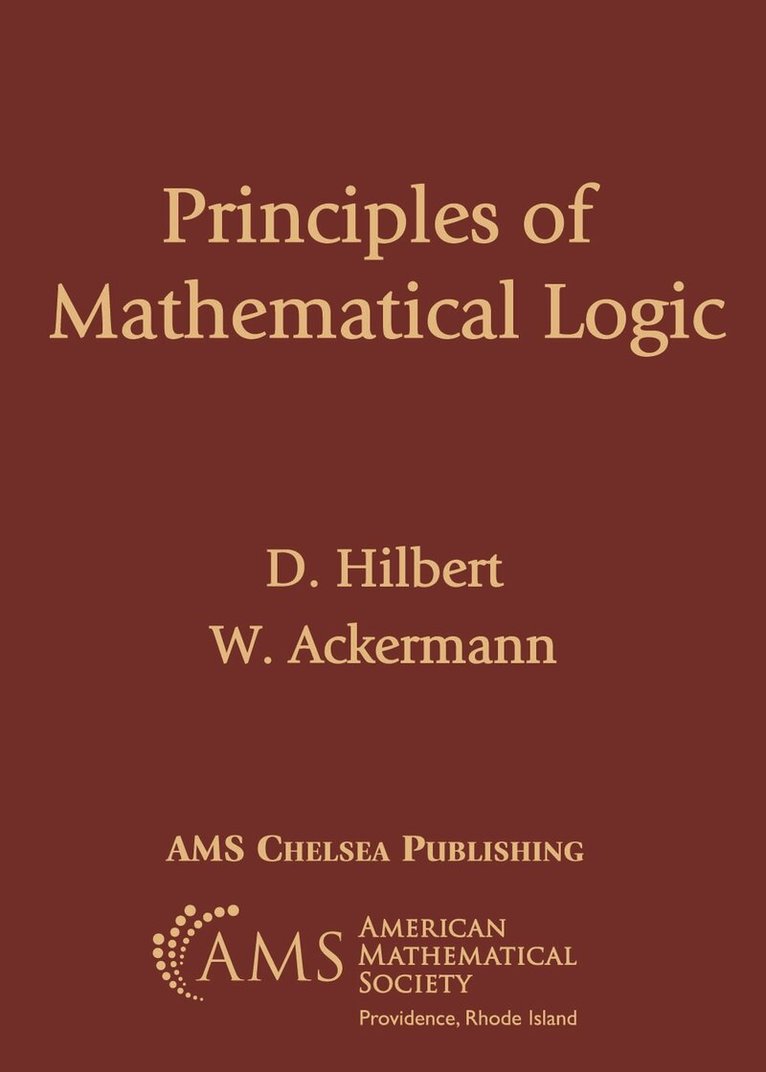
David Hilbert was particularly interested in the foundations of mathematics. Among many other things, he is famous for his attempt to axiomatize mathematics. This now classic text is his treatment of symbolic logic. This translation is based on the second German edition and has been modified according to the criticisms of Church and Quine. In particular, the authors' original formulation of Godel's completeness proof for the predicate calculus has been updated.In the first half of the twentieth century, an important debate on the foundations of mathematics took place. Principles of Mathematical Logic represents one of Hilbert's important contributions to that debate. Although symbolic logic has grown considerably in the subsequent decades, this book remains a classic.
652 kr
Skickas inom 10-15 vardagar
VIII über den Inhalt im einzelnen unterrichtet das ausführliche Ver zeichnis. Zur Form ist etwas Grundsätzliches zu sagen: Das klassische Ideal einer gewissermaßen atomistischen Auffassung der Mathematik ver langt, den Stoff in Form von Voraussetzungen, Sätzen und Beweisen zu kondensieren. Dabei ist der innere Zusammenhang und die Motivierung der Theorie nicht unmittelbar Gegenstand der Darstellung. In kom plementärer Weise kann man ein mathematisches Gebiet als stetiges Gewebe von Zusammenhängen betrachten, bei dessen Beschreibung die Methode und die Motivierung in den Vordergrund treten und die Kri stallisierung der Einsichten in isolierte scharf umrissene Sätze erst eine sekundäre Rolle spielt. Wo eine Synthese beider Auffassungen untunlich schien, habe ich den zweiten Gesichtspunkt bevorzugt. New Rochelle, New York, 24. Oktober 1937. R. Courant. Inhaltsverzeichnis. Erstes Kapitel. Vorbereitung. - Grundbegriffe. § I. Orientierung über die Mannigfaltigkeit der Lösungen 2 1. Beispiele S. 2. - 2. Differentialgleichungen zu gegebenen Funk tionenscharen und -familien S. 7. § 2. Systeme von Differentialgleichungen ............... 10 1. Problem der Äquivalenz von Systemen und einzelnen Differential 2. Bestimmte, überbestimmte, unterbestimmte gleichungen S. 10. - Systeme S. 12. § J. Integrationsmethoden bei speziellen Differentialgleichungen. . . . . . 14 1. Separation der Variablen S. 14. - 2. Erzeugung weiterer Lösungen durch Superposition. Grundlösung der Wärmeleitung. Poissons Integral S.16. § 4. Geometrische Deutung einer partiellen Differentialgleichung erster Ord nung mit zwei unabhängigen Variablen. Das vollständige Integral . . 18 1. Die geometrische Deutung einer partiellen Differentialgleichung erster Ordnung S. 18. - 2. Dasvollständige Integral S. 19. - 3. Singuläre Integrale S. 20.