D. Pasternak – författare
Visar alla böcker från författaren D. Pasternak. Handla med fri frakt och snabb leverans.
8 produkter
8 produkter
Inbunden, Engelska, 2001
1 633 kr
Skickas inom 10-15 vardagar
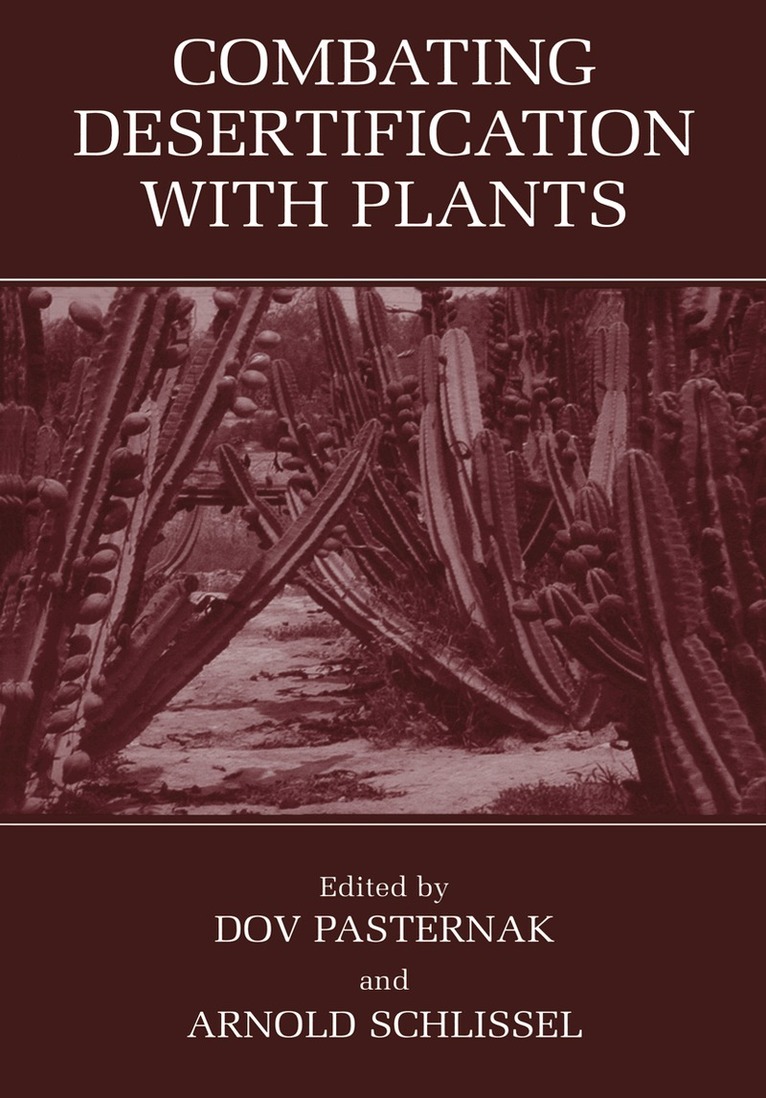
This title discusses the role of plants in combating desertification. Desertification - the degradation of soils in drylands - is a phenomenon occurring in scores of countries around the globe. The number of people (in semiarid regions) affected by the steady decline in the productivity of their lands is in the hundred millions. This work provides the reader with the experience of scientists from 30 countries and international institutions around the globe, working in cold and warm dry regions to bring plant-based solutions to one of the most severe problems of our times. The measures required to halt or reverse the process of desertification fall into many categories - policy, institutional, sociological/anthropological, and technical.
Häftad, Engelska, 2012
1 633 kr
Skickas inom 10-15 vardagar
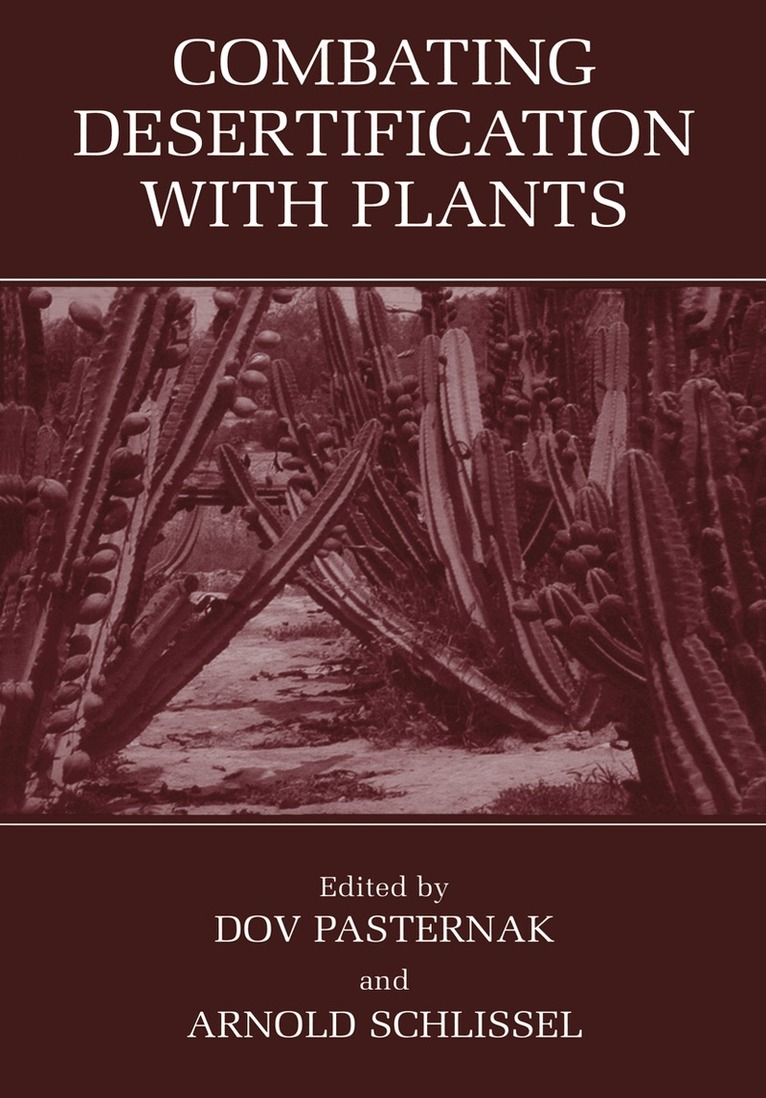
The conference "Combating Desertification with Plants" was held in Beer Sheva, Israel, from November 2-5, 1999, and was attended by 70 participants from 30 countries and/or international organisations. Desertification - the degradation of soils in drylands - is a phenomenon occurring in scores of countries around the globe. The number of people (in semiarid regions) affected by the steady decline in the productivity of their lands is in the hundred millions. The measures required to halt and reverse the process of desertification fall into many categories - policy, institutional, sociological-anthropological, and technical. Although technical "solutions" are not currently in vogue, the conference organizers felt that perhaps the pendulum had swung too far in the direction of "participatory approaches." Hence IPALAC - The International Program for Arid Land Crops - whose function is to serve as a catalyst for optimizing the contribution of plant germplasm to sustainable development in desertification-prone regions - felt the time was opportune for providing a platform for projects where the "plant-driven" approach to development finds expression. Some 45 papers were delivered at the conference, falling into the categories of this volume: Overview, Potential Germplasm for Arid Lands, Introduction, Domestication and Dissemination of Arid Land Plants, Land Rehabilitation, and Mechanisms of Plant Transfer. The conference was funded by UNESCO (Division of Ecological Sciences), the Ministry of Foreign Affairs of Finland, and MASHAV, Israel's Center for International Development Cooperation.
E-bok
PDF, Engelska, 20121 977 kr
Läs direkt efter köp
The conference "Combating Desertification with Plants" was held in Beer Sheva, Israel, from November 2-5, 1999, and was attended by 70 participants from 30 countries and/or international organisations. Desertification - the degradation of soils in drylands - is a phenomenon occurring in scores of countries around the globe. The number of people (in semiarid regions) affected by the steady decline in the productivity of their lands is in the hundred millions. The measures required to halt and reverse the process of desertification fall into many categories - policy, institutional, sociological-anthropological, and technical. Although technical "solutions" are not currently in vogue, the conference organizers felt that perhaps the pendulum had swung too far in the direction of "participatory approaches." Hence IPALAC - The International Program for Arid Land Crops - whose function is to serve as a catalyst for optimizing the contribution of plant germplasm to sustainable development in desertification-prone regions - felt the time was opportune for providing a platform for projects where the "plant-driven" approach to development finds expression. Some 45 papers were delivered at the conference, falling into the categories of this volume: Overview, Potential Germplasm for Arid Lands, Introduction, Domestication and Dissemination of Arid Land Plants, Land Rehabilitation, and Mechanisms of Plant Transfer. The conference was funded by UNESCO (Division of Ecological Sciences), the Ministry of Foreign Affairs of Finland, and MASHAV, Israel''s Center for International Development Cooperation.
E-bok
Ryska, 202011 kr
Läs direkt efter köp
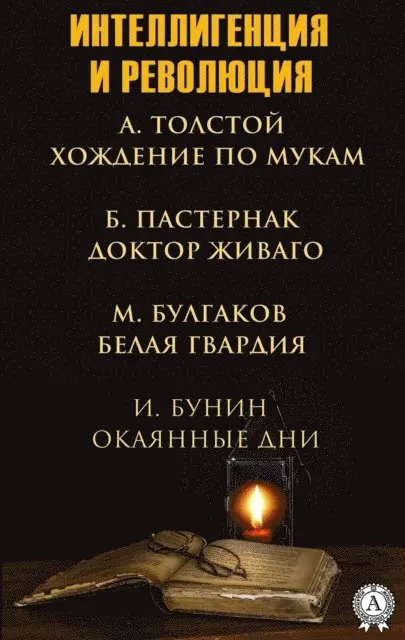
Recently, it is generally accepted that the Russian intelligentsia did not accept the Bolshevik revolution en masse and suffered more than others from it. However, everything is not so simple. On the other hand, hardly any other social group in modern European history was so inclined towards radical non-conformism and rebellion. Indeed, this handful of people managed to shake the foundations of the powerful monarchy and greatly contribute to its collapse. And this despite the fact that the revolutionary intelligentsia had no influence on the apparatus of power, was not in any way rooted in society and in the literal sense of the word personified groundlessness. In this collection, the reader will plunge into artistic depiction and comprehension of those great shocks and transformations that individuals from the intelligentsia experienced during the years of the revolution and civil war. Alexey Nikolaevich Tolstoy. The Road to CalvaryBoris Leonidovich Pasternak. Doctor ZhivagoMikhail Afanasyevich Bulgakov. White GuardIvan Alekseevich Bunin. Cursed days
Del 17 - Developments in Plant and Soil Sciences
Biosalinity in Action: Bioproduction with Saline Water
Inbunden, Engelska, 1985
2 174 kr
Skickas inom 10-15 vardagar
Historically, scientists and laymen have regarded salinity as a hazar dous, detrimental phenomenon. This negative view was a principal reason for the lack of agricultural development of most arid and semi arid zones of the world where the major sources of water for biological production are saline. The late Hugo Boyko was probably the first scientist in recent times to challenge this commonly held, pessimistic view of salinity. His research in Israel indicated that many plants can be irrigated with saline water, even at seawater strength, if they are in sandy soil - a technique that could open much barren land to agriculture. This new, even radical, approach to salinity was clearly enunciated in the book he edited and most appropriately entitled 'Salinity and Aridity: New Approaches to Old Problems' (1966). A decade later, three members of the United States National Science Foundation (NSF), Lewis Mayfield, James Aller and Oskar Zaborsky, formulated the 'Biosaline Concept'; namely, that poor soils, high solar insolation and saline water, which prevail in arid lands, should be viewed as useful resources rather than as disadvantages, and that these resources can be used for non-traditional production of food, fuels and chemicals. The First International Workshop on Biosaline Research was con vened at Kiawah Island, South Carolina, in 1977 by A. San Pietro.
E-bok
PDF, Engelska, 20122 741 kr
Läs direkt efter köp
Historically, scientists and laymen have regarded salinity as a hazar dous, detrimental phenomenon. This negative view was a principal reason for the lack of agricultural development of most arid and semi arid zones of the world where the major sources of water for biological production are saline. The late Hugo Boyko was probably the first scientist in recent times to challenge this commonly held, pessimistic view of salinity. His research in Israel indicated that many plants can be irrigated with saline water, even at seawater strength, if they are in sandy soil - a technique that could open much barren land to agriculture. This new, even radical, approach to salinity was clearly enunciated in the book he edited and most appropriately entitled ''Salinity and Aridity: New Approaches to Old Problems'' (1966). A decade later, three members of the United States National Science Foundation (NSF), Lewis Mayfield, James Aller and Oskar Zaborsky, formulated the ''Biosaline Concept''; namely, that poor soils, high solar insolation and saline water, which prevail in arid lands, should be viewed as useful resources rather than as disadvantages, and that these resources can be used for non-traditional production of food, fuels and chemicals. The First International Workshop on Biosaline Research was con vened at Kiawah Island, South Carolina, in 1977 by A. San Pietro.
Engelska, 2011
644 kr
Skickas inom 5-8 vardagar
Häftad, Engelska, 2011
2 174 kr
Skickas inom 10-15 vardagar
Historically, scientists and laymen have regarded salinity as a hazar dous, detrimental phenomenon. This negative view was a principal reason for the lack of agricultural development of most arid and semi arid zones of the world where the major sources of water for biological production are saline. The late Hugo Boyko was probably the first scientist in recent times to challenge this commonly held, pessimistic view of salinity. His research in Israel indicated that many plants can be irrigated with saline water, even at seawater strength, if they are in sandy soil - a technique that could open much barren land to agriculture. This new, even radical, approach to salinity was clearly enunciated in the book he edited and most appropriately entitled 'Salinity and Aridity: New Approaches to Old Problems' (1966). A decade later, three members of the United States National Science Foundation (NSF), Lewis Mayfield, James Aller and Oskar Zaborsky, formulated the 'Biosaline Concept'; namely, that poor soils, high solar insolation and saline water, which prevail in arid lands, should be viewed as useful resources rather than as disadvantages, and that these resources can be used for non-traditional production of food, fuels and chemicals. The First International Workshop on Biosaline Research was con vened at Kiawah Island, South Carolina, in 1977 by A. San Pietro.