D. V. Griffiths - Böcker
Visar alla böcker från författaren D. V. Griffiths. Handla med fri frakt och snabb leverans.
3 produkter
3 produkter
1 808 kr
Skickas inom 7-10 vardagar
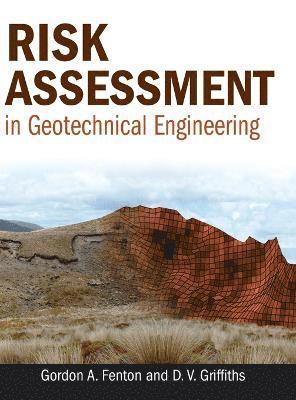
NEW PROBABILISTIC APPROACHES FOR REALISTIC RISK ASSESSMENT IN GEOTECHNICAL ENGINEERING. This text presents a thorough examination of the theories and methodologies available for risk assessment in geotechnical engineering, spanning the full range from established single-variable and "first order" methods to the most recent, advanced numerical developments. In response to the growing application of LRFD methodologies in geotechnical design, coupled with increased demand for risk assessments from clients ranging from regulatory agencies to insurance companies, authors Fenton and Griffiths have introduced an innovative reliability-based risk assessment method, the Random Finite Element Method (RFEM). The authors have spent more than fifteen years developing this statistically based method for modeling the real spatial variability of soils and rocks. As demonstrated in the book, RFEM performs better in real-world applications than traditional risk assessment tools that do not properly account for the spatial variability of geomaterials.This text is divided into two parts:Part One, Theory, explains the theory underlying risk assessment methods in geotechnical engineering. This part's seven chapters feature more than 100 worked examples, enabling you to develop a detailed understanding of the methods.Part Two, Practice, demonstrates how to use advanced probabilistic tools for several classical geotechnical engineering applications. Working with the RFEM, the authors show how to assess risk in problems familiar to all geotechnical engineers.All the programs used for the geotechnical applications discussed in Part Two may be downloaded from the authors' Web site at www.engmath.dal.ca/rfem/ at no charge, enabling you to duplicate the authors' results and experiment with your own data. In short, you get all the theory and practical guidance you need to apply the most advanced probabilistic approaches for managing uncertainty in geotechnical design.
1 123 kr
Skickas inom 7-10 vardagar
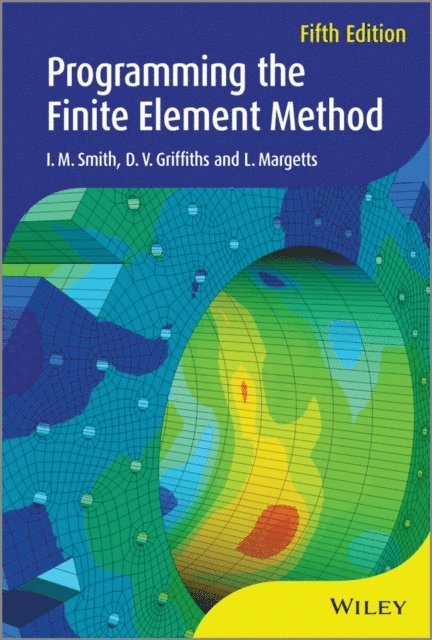
Many students, engineers, scientists and researchers have benefited from the practical, programming-oriented style of the previous editions of Programming the Finite Element Method, learning how to develop computer programs to solve specific engineering problems using the finite element method.This new fifth edition offers timely revisions that include programs and subroutine libraries fully updated to Fortran 2003, which are freely available online, and provides updated material on advances in parallel computing, thermal stress analysis, plasticity return algorithms, convection boundary conditions, and interfaces to third party tools such as ParaView, METIS and ARPACK. As in the previous editions, a wide variety of problem solving capabilities are presented including structural analysis, elasticity and plasticity, construction processes in geomechanics, uncoupled and coupled steady and transient fluid flow and linear and nonlinear solid dynamics.Key features: Updated to take into account advances in parallel computing as well as new material on thermal stress analysisPrograms use an updated version of Fortran 2003Includes exercises for studentsAccompanied by website hosting softwareProgramming the Finite Element Method, Fifth Edition is an ideal textbook for undergraduate and postgraduate students in civil and mechanical engineering, applied mathematics and numerical analysis, and is also a comprehensive reference for researchers and practitioners.Further information and source codes described in this text can be accessed at the following web sites: www.inside.mines.edu/~vgriffit/PFEM5 for the serial programs from Chapters 4-11www.parafem.org.uk for the parallel programs from Chapter 12
1 985 kr
Skickas inom 10-15 vardagar
Soils and rocks are among the most variable of all engineering materials, and as such are highly amenable to a probabilistic treatment. The application of statistical and probabilistic concepts to geotechnical analysis is a rapidly growing area of interest for both academics and practitioners. The book is therefore aimed at students, researchers, and practitioners of geotechnical engineering who wish to keep abreast of developments in this evolving field of study. The course content and will assume no more that an introductory understanding of probability and statistics on the part of the course participants.The main objective is to present a state-of-the-art training on probabilistic techniques applied to geotechnical engineering in relation to both theory and practice. Including:(a) discussion of potential benefits of probabilistic approaches as opposed to the classical “Factor of Safety” methods, to review sources of uncertainty in geotechnical analysis and to introduce methods of LRFD and reliability concepts in Eurocode 7,(b) review of relevant statistical theories needed to develop the methodologies and interpret the results of probabilistic analysis,(c) examples of established probabilistic methods of analysis in geotechnical engineering, such as the First Order Second Moment (FOSM) method, the Point Estimate Method (PEM), the First and Second Order Reliability Methods (FORM SORM) and Random Set (RS) theory,(d) description of numerical methods of probabilistic analysis based on the finite element method, such as the Stochastic Finite Element Method (SFEM) and recent developments on the Random Finite Element Method (RFEM),(e) practical examples and case histories of probabilistic applications in geotechnical engineering.