D.A. Hills – författare
Visar alla böcker från författaren D.A. Hills. Handla med fri frakt och snabb leverans.
6 produkter
6 produkter
Inbunden, Engelska, 1994
2 152 kr
Skickas inom 10-15 vardagar
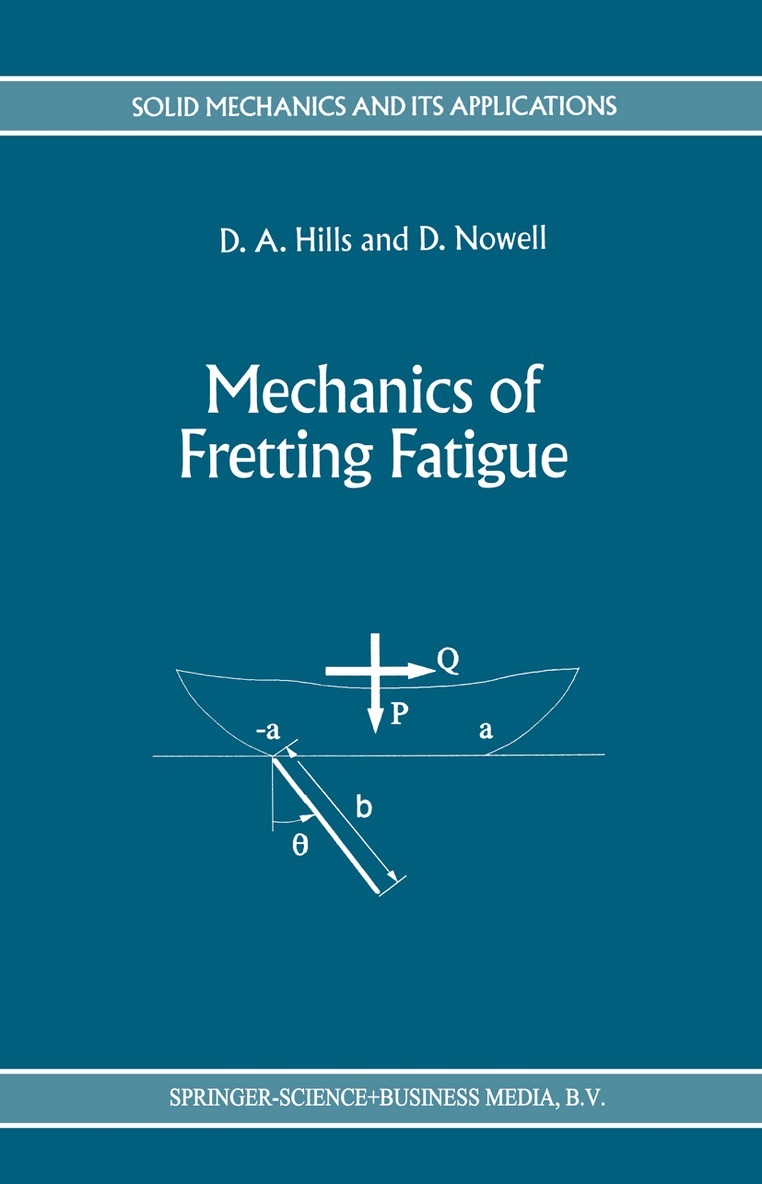
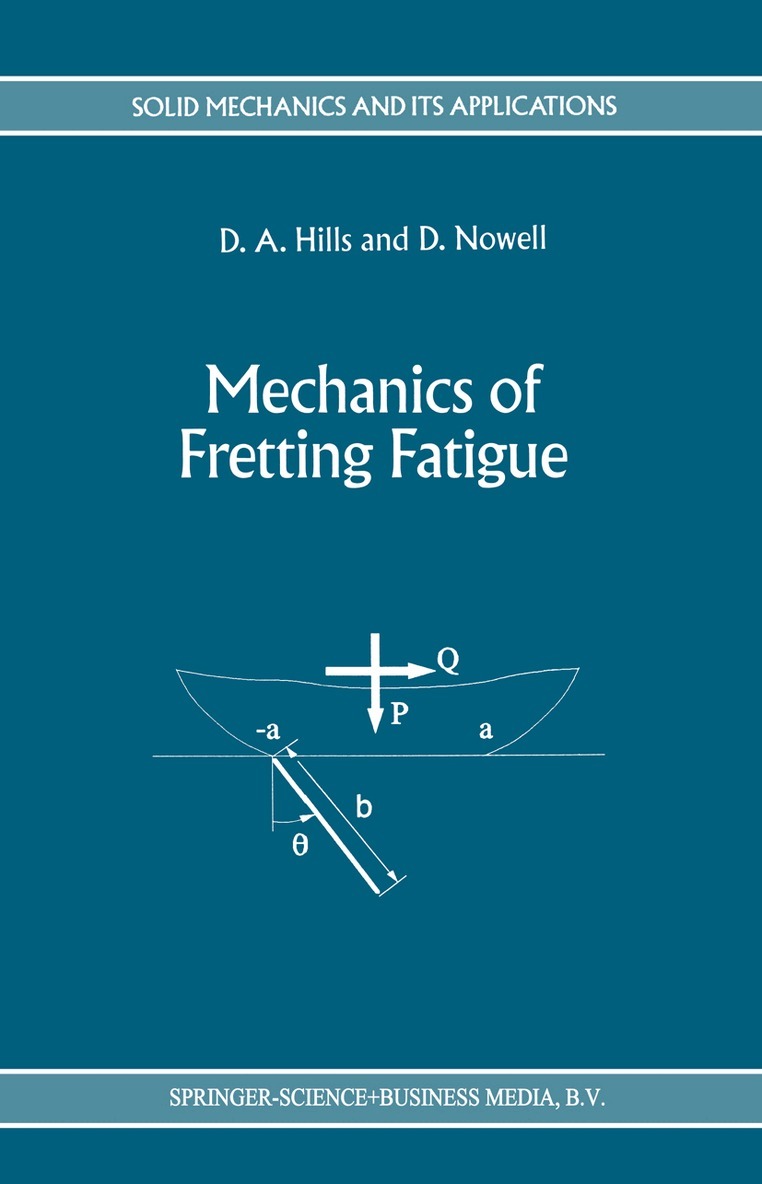
Failures of many mechanical components in service result from fatigue. The cracks which grow may either originate from some pre-existing macroscopic defect, or, if the component is of high integrity but highly stressed, a region of localized stress concentration. In turn, such concentrators may be caused by some minute defect, such as a tiny inclusion, or inadvertent machining damage. Another source of surface damage which may exist between notionally 'bonded' components is associated with minute relative motion along the interface, brought about usually be cyclic tangential loading. Such fretting damage is quite insidious, and may lead to many kinds of problems such as wear, but it is its influence on the promotion of embryo cracks with which we are concerned here. When the presence of fretting is associated with decreased fatigue performance the effect is known as fretting fatigue. Fretting fatigue is a subject drawing equally on materials science and applied mechanics, but it is the intention in this book to concentrate attention entirely on the latter aspects, in a search for the quantification of the influence of fretting on both crack nucleation and propagation. There have been very few previous texts in this area, and the present volume seeks to cover five principal areas; (a) The modelling of contact problems including partial slip under tangentialloading, which produces the surface damage. (b) The modelling of short cracks by rigorous methods which deal effectively with steep stress gradients, kinking and closure. (c) The experimental simulation of fretting fatigue.
Inbunden, Engelska, 1996
1 616 kr
Skickas inom 10-15 vardagar
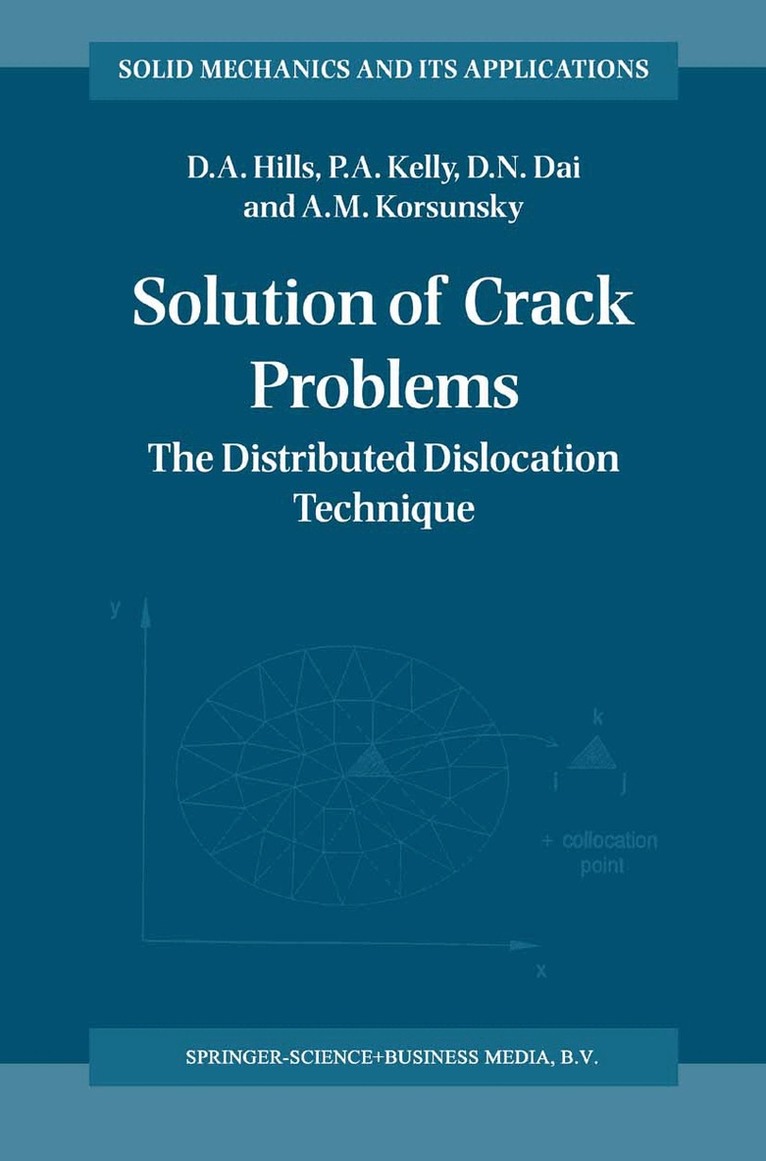
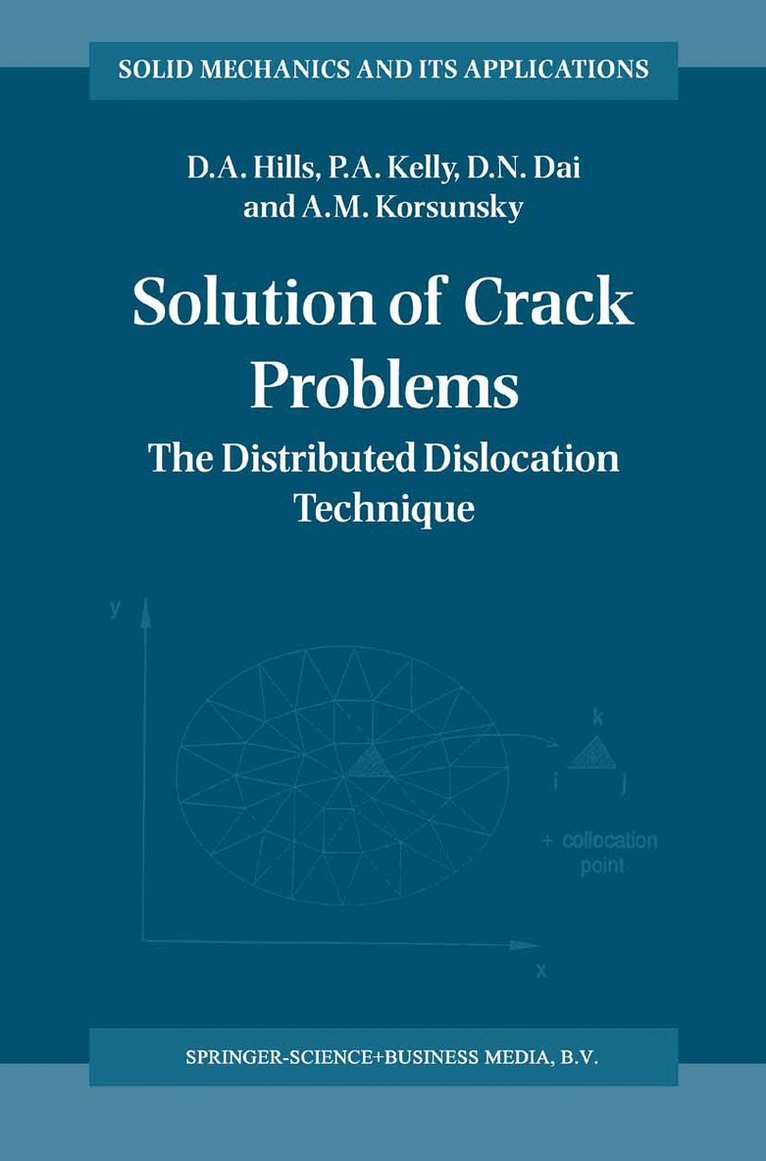
This book is concerned with the numerical solution of crack problems. The techniques to be developed are particularly appropriate when cracks are relatively short, and are growing in the neighbourhood of some stress raising feature, causing a relatively steep stress gradient. It is therefore practicable to represent the geometry in an idealised way, so that a precise solution may be obtained. This contrasts with, say, the finite element method in which the geometry is modelled exactly, but the subsequent solution is approximate, and computationally more taxing. The family of techniques presented in this book, based loosely on the pioneering work of Eshelby in the late 1950's, and developed by Erdogan, Keer, Mura and many others cited in the text, present an attractive alternative. The basic idea is to use the superposition of the stress field present in the unfiawed body, together with an unknown distribution of 'strain nuclei' (in this book, the strain nucleus employed is the dislocation), chosen so that the crack faces become traction-free. The solution used for the stress field for the nucleus is chosen so that other boundary conditions are satisfied. The technique is therefore efficient, and may be used to model the evolution of a developing crack in two or three dimensions. Solution techniques are described in some detail, and the book should be readily accessible to most engineers, whilst preserving the rigour demanded by the researcher who wishes to develop the method itself.
Häftad, Engelska, 2010
2 152 kr
Skickas inom 10-15 vardagar
Failures of many mechanical components in service result from fatigue. The cracks which grow may either originate from some pre-existing macroscopic defect, or, if the component is of high integrity but highly stressed, a region of localized stress concentration. In turn, such concentrators may be caused by some minute defect, such as a tiny inclusion, or inadvertent machining damage. Another source of surface damage which may exist between notionally 'bonded' components is associated with minute relative motion along the interface, brought about usually be cyclic tangential loading. Such fretting damage is quite insidious, and may lead to many kinds of problems such as wear, but it is its influence on the promotion of embryo cracks with which we are concerned here. When the presence of fretting is associated with decreased fatigue performance the effect is known as fretting fatigue. Fretting fatigue is a subject drawing equally on materials science and applied mechanics, but it is the intention in this book to concentrate attention entirely on the latter aspects, in a search for the quantification of the influence of fretting on both crack nucleation and propagation. There have been very few previous texts in this area, and the present volume seeks to cover five principal areas; (a) The modelling of contact problems including partial slip under tangentialloading, which produces the surface damage. (b) The modelling of short cracks by rigorous methods which deal effectively with steep stress gradients, kinking and closure. (c) The experimental simulation of fretting fatigue.
Häftad, Engelska, 2010
1 616 kr
Skickas inom 10-15 vardagar
This book is concerned with the numerical solution of crack problems. The techniques to be developed are particularly appropriate when cracks are relatively short, and are growing in the neighbourhood of some stress raising feature, causing a relatively steep stress gradient. It is therefore practicable to represent the geometry in an idealised way, so that a precise solution may be obtained. This contrasts with, say, the finite element method in which the geometry is modelled exactly, but the subsequent solution is approximate, and computationally more taxing. The family of techniques presented in this book, based loosely on the pioneering work of Eshelby in the late 1950's, and developed by Erdogan, Keer, Mura and many others cited in the text, present an attractive alternative. The basic idea is to use the superposition of the stress field present in the unfiawed body, together with an unknown distribution of 'strain nuclei' (in this book, the strain nucleus employed is the dislocation), chosen so that the crack faces become traction-free. The solution used for the stress field for the nucleus is chosen so that other boundary conditions are satisfied. The technique is therefore efficient, and may be used to model the evolution of a developing crack in two or three dimensions. Solution techniques are described in some detail, and the book should be readily accessible to most engineers, whilst preserving the rigour demanded by the researcher who wishes to develop the method itself.
E-bok
PDF, Engelska, 20132 765 kr
Läs direkt efter köp
Failures of many mechanical components in service result from fatigue. The cracks which grow may either originate from some pre-existing macroscopic defect, or, if the component is of high integrity but highly stressed, a region of localized stress concentration. In turn, such concentrators may be caused by some minute defect, such as a tiny inclusion, or inadvertent machining damage. Another source of surface damage which may exist between notionally ''bonded'' components is associated with minute relative motion along the interface, brought about usually be cyclic tangential loading. Such fretting damage is quite insidious, and may lead to many kinds of problems such as wear, but it is its influence on the promotion of embryo cracks with which we are concerned here. When the presence of fretting is associated with decreased fatigue performance the effect is known as fretting fatigue. Fretting fatigue is a subject drawing equally on materials science and applied mechanics, but it is the intention in this book to concentrate attention entirely on the latter aspects, in a search for the quantification of the influence of fretting on both crack nucleation and propagation. There have been very few previous texts in this area, and the present volume seeks to cover five principal areas; (a) The modelling of contact problems including partial slip under tangentialloading, which produces the surface damage. (b) The modelling of short cracks by rigorous methods which deal effectively with steep stress gradients, kinking and closure. (c) The experimental simulation of fretting fatigue.
E-bok
PDF, Engelska, 20132 049 kr
Läs direkt efter köp
This book is concerned with the numerical solution of crack problems. The techniques to be developed are particularly appropriate when cracks are relatively short, and are growing in the neighbourhood of some stress raising feature, causing a relatively steep stress gradient. It is therefore practicable to represent the geometry in an idealised way, so that a precise solution may be obtained. This contrasts with, say, the finite element method in which the geometry is modelled exactly, but the subsequent solution is approximate, and computationally more taxing. The family of techniques presented in this book, based loosely on the pioneering work of Eshelby in the late 1950''s, and developed by Erdogan, Keer, Mura and many others cited in the text, present an attractive alternative. The basic idea is to use the superposition of the stress field present in the unfiawed body, together with an unknown distribution of ''strain nuclei'' (in this book, the strain nucleus employed is the dislocation), chosen so that the crack faces become traction-free. The solution used for the stress field for the nucleus is chosen so that other boundary conditions are satisfied. The technique is therefore efficient, and may be used to model the evolution of a developing crack in two or three dimensions. Solution techniques are described in some detail, and the book should be readily accessible to most engineers, whilst preserving the rigour demanded by the researcher who wishes to develop the method itself.