D. Nowell – författare
Visar alla böcker från författaren D. Nowell. Handla med fri frakt och snabb leverans.
4 produkter
4 produkter
Inbunden, Engelska, 1994
2 152 kr
Skickas inom 10-15 vardagar
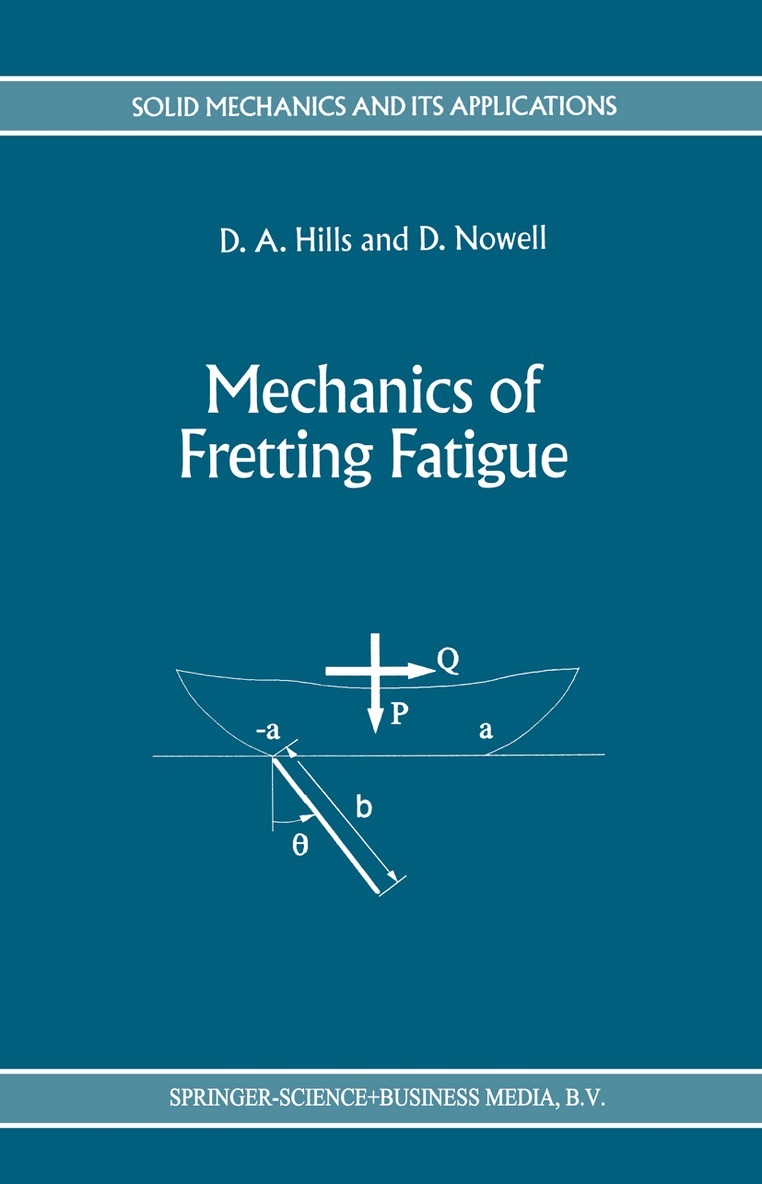
Failures of many mechanical components in service result from fatigue. The cracks which grow may either originate from some pre-existing macroscopic defect, or, if the component is of high integrity but highly stressed, a region of localized stress concentration. In turn, such concentrators may be caused by some minute defect, such as a tiny inclusion, or inadvertent machining damage. Another source of surface damage which may exist between notionally 'bonded' components is associated with minute relative motion along the interface, brought about usually be cyclic tangential loading. Such fretting damage is quite insidious, and may lead to many kinds of problems such as wear, but it is its influence on the promotion of embryo cracks with which we are concerned here. When the presence of fretting is associated with decreased fatigue performance the effect is known as fretting fatigue. Fretting fatigue is a subject drawing equally on materials science and applied mechanics, but it is the intention in this book to concentrate attention entirely on the latter aspects, in a search for the quantification of the influence of fretting on both crack nucleation and propagation. There have been very few previous texts in this area, and the present volume seeks to cover five principal areas; (a) The modelling of contact problems including partial slip under tangentialloading, which produces the surface damage. (b) The modelling of short cracks by rigorous methods which deal effectively with steep stress gradients, kinking and closure. (c) The experimental simulation of fretting fatigue.
E-bok
PDF, Engelska, 20131 015 kr
Läs direkt efter köp
Materials and mechanical engineering researchers studying wear, fretting, elastic indentation testing and other tribological processes frequently need closed-form solutions for various attributes of contacts. These characteristics include contact law, pressure distribution, internal state of stress induced and the influence of friction. Materials and mechanical engineering researchers studying wear, fretting, elastic indentation testing and other tribological processes frequently need closed-form solutions for various attributes of contacts. These characteristics include contact law, pressure distribution, internal state of stress induced and the influence of friction. These solutions, scattered throughout the applied mechanics literature, are difficult to locate, are presented using a range of solution techniques, and expressresults in a way that is suitable only for experts in the field. `Mechanics of Elastic Contacts'' uses a consistent set of recipes for the solution of all relevant problems, presents results in the simplest possible forms, and contains summaries usingtabulated data. This reference source will provide a clear guide to elastic contacts for engineering designers, materials scientists and tribologists irrespective of their level of expertise in this important subject.
Häftad, Engelska, 2010
2 152 kr
Skickas inom 10-15 vardagar
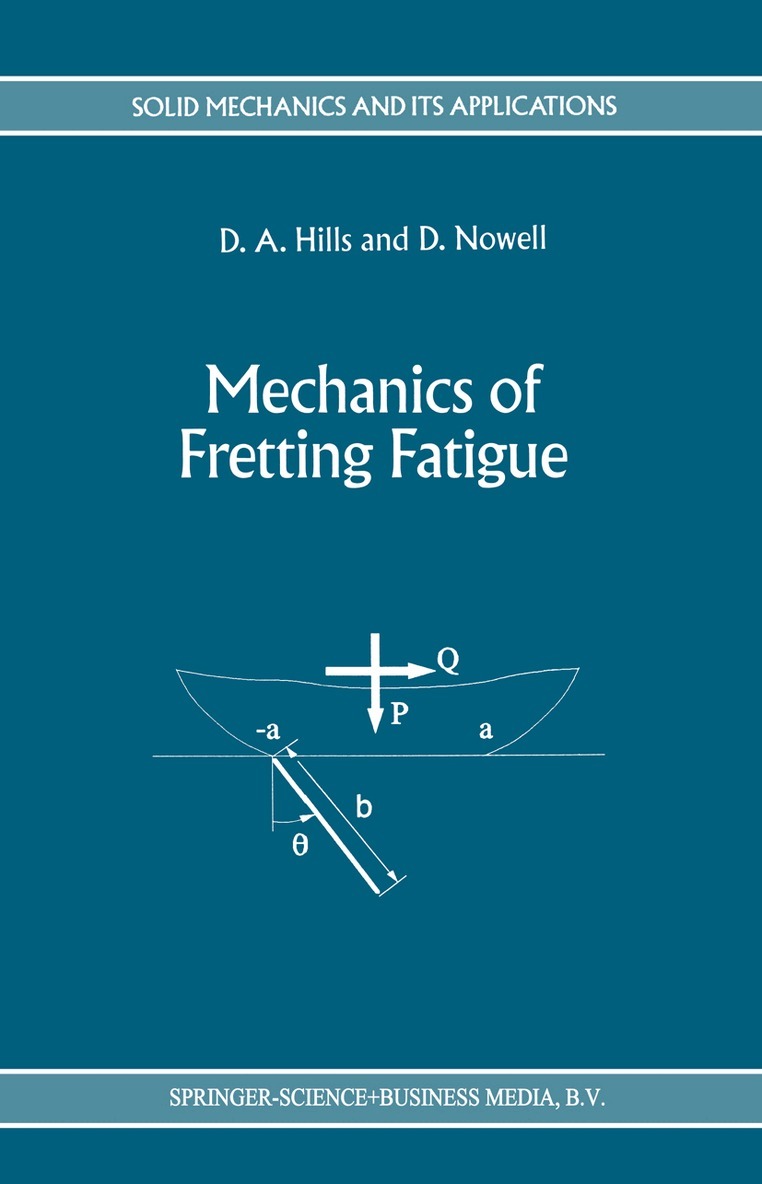
Failures of many mechanical components in service result from fatigue. The cracks which grow may either originate from some pre-existing macroscopic defect, or, if the component is of high integrity but highly stressed, a region of localized stress concentration. In turn, such concentrators may be caused by some minute defect, such as a tiny inclusion, or inadvertent machining damage. Another source of surface damage which may exist between notionally 'bonded' components is associated with minute relative motion along the interface, brought about usually be cyclic tangential loading. Such fretting damage is quite insidious, and may lead to many kinds of problems such as wear, but it is its influence on the promotion of embryo cracks with which we are concerned here. When the presence of fretting is associated with decreased fatigue performance the effect is known as fretting fatigue. Fretting fatigue is a subject drawing equally on materials science and applied mechanics, but it is the intention in this book to concentrate attention entirely on the latter aspects, in a search for the quantification of the influence of fretting on both crack nucleation and propagation. There have been very few previous texts in this area, and the present volume seeks to cover five principal areas; (a) The modelling of contact problems including partial slip under tangentialloading, which produces the surface damage. (b) The modelling of short cracks by rigorous methods which deal effectively with steep stress gradients, kinking and closure. (c) The experimental simulation of fretting fatigue.
E-bok
PDF, Engelska, 20132 765 kr
Läs direkt efter köp
Failures of many mechanical components in service result from fatigue. The cracks which grow may either originate from some pre-existing macroscopic defect, or, if the component is of high integrity but highly stressed, a region of localized stress concentration. In turn, such concentrators may be caused by some minute defect, such as a tiny inclusion, or inadvertent machining damage. Another source of surface damage which may exist between notionally ''bonded'' components is associated with minute relative motion along the interface, brought about usually be cyclic tangential loading. Such fretting damage is quite insidious, and may lead to many kinds of problems such as wear, but it is its influence on the promotion of embryo cracks with which we are concerned here. When the presence of fretting is associated with decreased fatigue performance the effect is known as fretting fatigue. Fretting fatigue is a subject drawing equally on materials science and applied mechanics, but it is the intention in this book to concentrate attention entirely on the latter aspects, in a search for the quantification of the influence of fretting on both crack nucleation and propagation. There have been very few previous texts in this area, and the present volume seeks to cover five principal areas; (a) The modelling of contact problems including partial slip under tangentialloading, which produces the surface damage. (b) The modelling of short cracks by rigorous methods which deal effectively with steep stress gradients, kinking and closure. (c) The experimental simulation of fretting fatigue.