Dale Dannefer - Böcker
Visar alla böcker från författaren Dale Dannefer. Handla med fri frakt och snabb leverans.
6 produkter
6 produkter
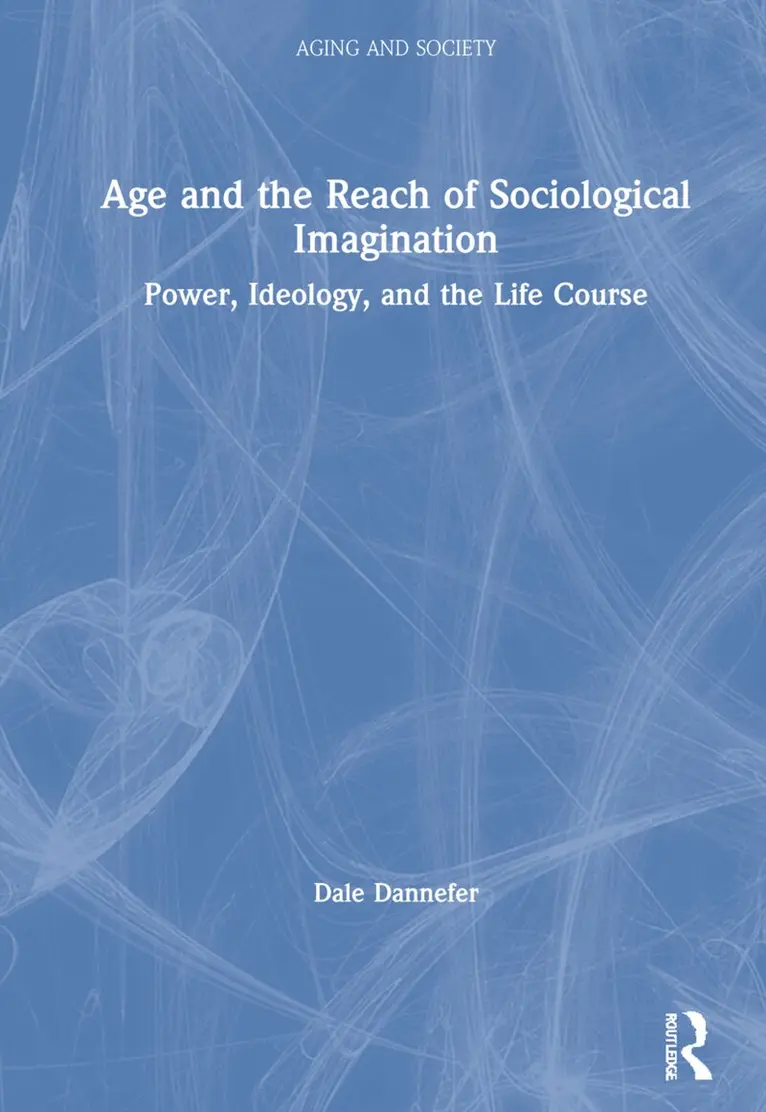
Age and the Reach of Sociological Imagination
Power, Ideology and the Life Course
Inbunden, Engelska, 2021
2 305 kr
Skickas inom 10-15 vardagar
The dominant narratives of both science and popular culture typically define aging and human development as self-contained individual matters, failing to recognize the degree to which they are shaped by experiential and contextual contingencies. Our understandings of age are thereby "boxed in" and constricted by assumptions of "normality" and naturalness that limit our capacities to explore possible alternative experiences of development and aging, and the conditions – both individual and social – that might foster such experiences.Combining foundational principles of critical social science with recent breakthroughs in research across disciplines ranging from biology to economics, this book offers a scientifically and humanly expanded landscape for apprehending the life course. Rejecting familiar but false dichotomies such as "nature vs. nurture" and "structure vs. agency", it clarifies the organismic fundamentals that make the actual content of experience so centrally important in age and development, and it also explores why attention to these fundamentals has been so resisted in studies of individuals and individual change, and in policy and practice as well.In presenting the basic principles and reviewing the current state of knowledge, Dale Dannefer introduces multi-levelled social processes that shape human development and aging over the life course and age as a cultural phenomenon – organizing his approach around three key frontiers of inquiry that each invite a vigorous exercise of sociological imagination: the Social-Structural Frontier, the Biosocial Frontier and the Critical-Reflexive Frontier.
Age and the Reach of Sociological Imagination
Power, Ideology and the Life Course
Häftad, Engelska, 2021
457 kr
Skickas inom 10-15 vardagar
The dominant narratives of both science and popular culture typically define aging and human development as self-contained individual matters, failing to recognize the degree to which they are shaped by experiential and contextual contingencies. Our understandings of age are thereby "boxed in" and constricted by assumptions of "normality" and naturalness that limit our capacities to explore possible alternative experiences of development and aging, and the conditions – both individual and social – that might foster such experiences.Combining foundational principles of critical social science with recent breakthroughs in research across disciplines ranging from biology to economics, this book offers a scientifically and humanly expanded landscape for apprehending the life course. Rejecting familiar but false dichotomies such as "nature vs. nurture" and "structure vs. agency", it clarifies the organismic fundamentals that make the actual content of experience so centrally important in age and development, and it also explores why attention to these fundamentals has been so resisted in studies of individuals and individual change, and in policy and practice as well.In presenting the basic principles and reviewing the current state of knowledge, Dale Dannefer introduces multi-levelled social processes that shape human development and aging over the life course and age as a cultural phenomenon – organizing his approach around three key frontiers of inquiry that each invite a vigorous exercise of sociological imagination: the Social-Structural Frontier, the Biosocial Frontier and the Critical-Reflexive Frontier.
710 kr
Skickas inom 10-15 vardagar
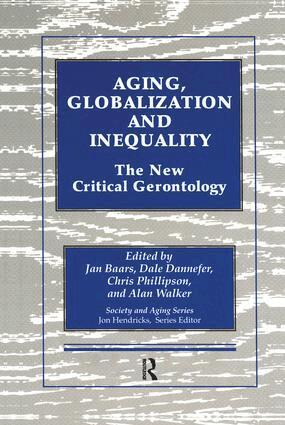
This book is a major reassessment of work in the field of critical gerontology, providing a comprehensive survey of issues by a team of contributors drawn from Europe and North America. The book focuses on the variety of ways in which age and ageing are socially constructed, and the extent to which growing old is being transformed through processes associated with globalisation. The collection offers a range of alternative views and visions about the nature of social ageing, making a major contribution to theory-building within the discipline of gerontology. The different sections of the book give an overview of the key issues and concerns underlying the development of critical gerontology. These include: first, the impact of globalisation and of multinational organizations and agencies on the lives of older people; second, the factors contributing to the "social construction" of later life; and third, issues associated with diversity and inequality in old age, arising through the effects of cumulative advantage and disadvantage over the life course. These different themes are analysed using a variety of theoretical perspectives drawn from sociology, social policy, political science, and social anthropology. "Aging, Globalization and Inequality" brings together key contributors to critical perspectives on aging and is unique in the range of themes and concerns covered in a single volume. The study moves forward an important area of debate in studies of aging, and thus provides the basis for a new type of critical gerontology relevant to the twenty-first century.
2 373 kr
Skickas inom 10-15 vardagar
This book is a major reassessment of work in the field of critical gerontology, providing a comprehensive survey of issues by a team of contributors drawn from Europe and North America. The book focuses on the variety of ways in which age and ageing are socially constructed, and the extent to which growing old is being transformed through processes associated with globalisation. The collection offers a range of alternative views and visions about the nature of social ageing, making a major contribution to theory-building within the discipline of gerontology. The different sections of the book give an overview of the key issues and concerns underlying the development of critical gerontology. These include: first, the impact of globalisation and of multinational organizations and agencies on the lives of older people; second, the factors contributing to the "social construction" of later life; and third, issues associated with diversity and inequality in old age, arising through the effects of cumulative advantage and disadvantage over the life course. These different themes are analysed using a variety of theoretical perspectives drawn from sociology, social policy, political science, and social anthropology. "Aging, Globalization and Inequality" brings together key contributors to critical perspectives on aging and is unique in the range of themes and concerns covered in a single volume. The study moves forward an important area of debate in studies of aging, and thus provides the basis for a new type of critical gerontology relevant to the twenty-first century.
2 712 kr
Skickas inom 3-6 vardagar
This SAGE Handbook integrates basic research on social dimensions of aging. It presents programmatic applications of research in areas not often seen in Handbooks including imprisonment, technology and aging, urban society aged, and elderly migration. The authors constitute a Who's Who of international gerontology, and the focus on globalization and aging is unique among Handbooks today. This Handbook should be in the library of every social gerontologist. - Vern L. Bengtson, Professor of Gerontology, University of Southern California This volume reflects the emergence of ageing as a global concern, including chapters by international scholars from Asia, Australasia, Europe and North America. It provides a comprehensive overview of key trends and issues in the field, drawing upon the full range of social science disciplines. The Handbook is organized into five parts, each exploring different aspects of research into social aspects of ageing: Disciplinary overviews: summaries of findings from key disciplinary areas within social gerontology. Social relationships and social differences: explores area like social inequality, gender, religion, inter-generational ties, social networks, and friendships. Individual characteristics and change in later life: examines different aspects of individual aging, including self and identity, cognitive processes, and bio-social interactions and their impact on physical and psychological aging. Comparative perspectives and cultural innovations: topics include ageing and development, ageing in a global context, migration, and cross-cultural perspectives on grandparenthood. Policy issues: covering policy concerns such aslong-term care, technology and older people, end of life issues, work and retirement, and the politics of old age.
This will be essential reading for all students, researchers and policy-makers concerned with the major issues influencing the lives of older people across the globe.
972 kr
Skickas inom 3-6 vardagar
This SAGE Handbook integrates basic research on social dimensions of aging. It presents programmatic applications of research in areas not often seen in Handbooks including imprisonment, technology and aging, urban society aged, and elderly migration. The authors constitute a Who's Who of international gerontology, and the focus on globalization and aging is unique among Handbooks today. This Handbook should be in the library of every social gerontologist. - Vern L. Bengtson, Professor of Gerontology, University of Southern California This volume reflects the emergence of ageing as a global concern, including chapters by international scholars from Asia, Australasia, Europe and North America. It provides a comprehensive overview of key trends and issues in the field, drawing upon the full range of social science disciplines. The Handbook is organized into five parts, each exploring different aspects of research into social aspects of ageing: Disciplinary overviews: summaries of findings from key disciplinary areas within social gerontology. Social relationships and social differences: explores area like social inequality, gender, religion, inter-generational ties, social networks, and friendships. Individual characteristics and change in later life: examines different aspects of individual aging, including self and identity, cognitive processes, and bio-social interactions and their impact on physical and psychological aging. Comparative perspectives and cultural innovations: topics include ageing and development, ageing in a global context, migration, and cross-cultural perspectives on grandparenthood. Policy issues: covering policy concerns such aslong-term care, technology and older people, end of life issues, work and retirement, and the politics of old age.
This will be essential reading for all students, researchers and policy-makers concerned with the major issues influencing the lives of older people across the globe.