Daniel Bodansky - Böcker
Visar alla böcker från författaren Daniel Bodansky. Handla med fri frakt och snabb leverans.
4 produkter
4 produkter
1 179 kr
Skickas inom 7-10 vardagar
In countless ways we are affected by international environmental norms: some social, others legal; some quite general, others very specific. For example, the norms limiting the refrigerants used in air conditioners have been agreed upon in legal form internationally, and are mandated and enforced by national governments. The sustainable fishery and forestry standards used by Carrefour and Ikea were developed more informally by environmental groups and businesses, and are applied to producers through supply-chain contracts, without any government involvement. The reluctance to eat tuna fish or own elephant ivory reflects more general social norms, disseminated through education and culture.How and why do these norms arise? In what ways do they affect behavior? Do they change what states and individuals actually do and, if so, why? How effective are they in solving international environmental problems? In the second edition of The Art and Craft of International Environmental Law, Daniel Bodansky and Harro van Asselt explore these and other questions.Revisions cover the numerous developments spanning the 13 years since the first edition was published. New chapters address the growing role of environmental NGOs and the increasingly complex architecture of environmental law involving multiple institutions, levels of governance, and actors. Recent research has been incorporated on treaty design and policy implementation and effectiveness, and greater attention has been given to the role of the judiciary in standard-setting, implementation, and enforcement.A sophisticated yet highly readable introduction to how international environmental law works (and sometimes doesn't work), this book is essential reading for a wide audience.
476 kr
Skickas
In countless ways we are affected by international environmental norms: some social, others legal; some quite general, others very specific. For example, the norms limiting the refrigerants used in air conditioners have been agreed upon in legal form internationally, and are mandated and enforced by national governments. The sustainable fishery and forestry standards used by Carrefour and Ikea were developed more informally by environmental groups and businesses, and are applied to producers through supply-chain contracts, without any government involvement. The reluctance to eat tuna fish or own elephant ivory reflects more general social norms, disseminated through education and culture.How and why do these norms arise? In what ways do they affect behavior? Do they change what states and individuals actually do and, if so, why? How effective are they in solving international environmental problems? In the second edition of The Art and Craft of International Environmental Law, Daniel Bodansky and Harro van Asselt explore these and other questions.Revisions cover the numerous developments spanning the 13 years since the first edition was published. New chapters address the growing role of environmental NGOs and the increasingly complex architecture of environmental law involving multiple institutions, levels of governance, and actors. Recent research has been incorporated on treaty design and policy implementation and effectiveness, and greater attention has been given to the role of the judiciary in standard-setting, implementation, and enforcement.A sophisticated yet highly readable introduction to how international environmental law works (and sometimes doesn't work), this book is essential reading for a wide audience.
1 897 kr
Skickas inom 5-8 vardagar
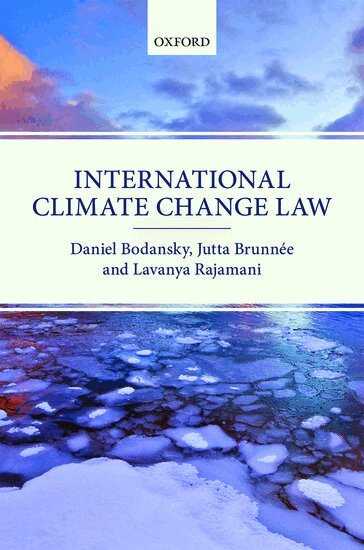
This textbook, by three experts in the field, provides a comprehensive overview of international climate change law. Climate change is one of the fundamental challenges facing the world today, and is the cause of significant international concern. In response, states have created an international climate regime. The treaties that comprise the regime - the 1992 United Nations Framework Convention on Climate Change, the 1997 Kyoto Protocol and the 2015 Paris Agreement establish a system of governance to address climate change and its impacts. This book provides a clear analytical guide to the climate regime, as well as other relevant international legal rules. The book begins by locating international climate change law within the broader context of international law and international environmental law. It considers the evolution of the international climate change regime, and the process of law-making that has led to it. It examines the key provisions of the Framework Convention, the Kyoto Protocol and the Paris Agreement. It analyses the principles and obligations that underpin the climate regime, as well as the elaborate institutional and governance architecture that has been created at successive international conferences to develop commitments and promote transparency and compliance. The final two chapters address the polycentric nature of international climate change law, as well as the intersections of international climate change law with other areas of international regulation. This book is an essential introduction to international climate change law for students, scholars and negotiators.
943 kr
Skickas inom 5-8 vardagar
This textbook, by three experts in the field, provides a comprehensive overview of international climate change law. Climate change is one of the fundamental challenges facing the world today, and is the cause of significant international concern. In response, states have created an international climate regime. The treaties that comprise the regime - the 1992 United Nations Framework Convention on Climate Change, the 1997 Kyoto Protocol and the 2015 Paris Agreement establish a system of governance to address climate change and its impacts. This book provides a clear analytical guide to the climate regime, as well as other relevant international legal rules. The book begins by locating international climate change law within the broader context of international law and international environmental law. It considers the evolution of the international climate change regime, and the process of law-making that has led to it. It examines the key provisions of the Framework Convention, the Kyoto Protocol and the Paris Agreement. It analyses the principles and obligations that underpin the climate regime, as well as the elaborate institutional and governance architecture that has been created at successive international conferences to develop commitments and promote transparency and compliance. The final two chapters address the polycentric nature of international climate change law, as well as the intersections of international climate change law with other areas of international regulation. This book is an essential introduction to international climate change law for students, scholars and negotiators.