Daniel Lindley - Böcker
Visar alla böcker från författaren Daniel Lindley. Handla med fri frakt och snabb leverans.
6 produkter
6 produkter
1 071 kr
Skickas inom 10-15 vardagar
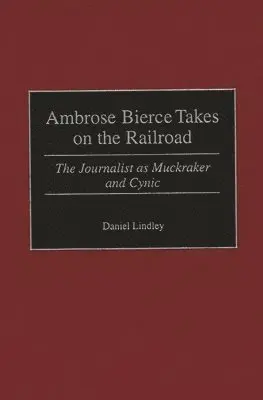
An account of California journalist and wit Ambrose Bierce and his struggle with the railroad octopus controlled by the Big Four (Collis P. Huntington, Leland Stanford, Charles Crocker, and Mark Hopkins). This is the first book to look at Bierce's early muckraking campaign in depth through Bierce's acid journalism and the railroad's private and public reactions. After a brief literature review and biography of Bierce, one of America's greatest wits, journalists, and short-story writers, the study turns to his thirty-year battle with the Central Pacific Railroad, which controlled much of California's economy and politics, often through bribery of politicians and newspaper editors and publishers. Lindley looks at the initial funding of the railroad through the U.S. government, the development of railroads as symbols of hope and progress, and the eventual corruption of that optimistic outlook by railroad owners and politicians.Bierce attacked the railroads in his columns during his tenure at three San Francisco periodicals, the Argonaut, the Wasp, and the Examiner. His efforts culminated in a trip to Washington, D.C., in 1896 to cover the funding bill debate in Congress, during which railroad officials attempted to avoid repaying millions of dollars in government loans. Bierce did not consider himself a muckraker. He derided the generation of Progressive journalists who followed him a decade after he ended his campaign against the railroad. Yet, Bierce's journalism was a precursor of what is popularly known as the muckraking period, 1902-1914.
597 kr
Skickas inom 7-10 vardagar
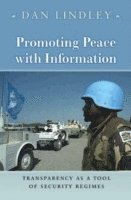
It is normally assumed that international security regimes such as the United Nations can reduce the risk of war by increasing transparency among adversarial nations. The more adversaries understand each other's intentions and capabilities, the thinking goes, the less likely they are to be led to war by miscalculations and unwarranted fears. But how is transparency provided, how does it actually work, and how effective is it in preserving or restoring peace? In Promoting Peace with Information, Dan Lindley provides the first scholarly answer to these important questions. Lindley rigorously examines a wide range of cases, including U.N. peacekeeping operations in Cyprus, the Golan Heights, Namibia, and Cambodia; arms-control agreements, including the Nuclear Non-Proliferation Treaty; and the historical example of the Concert of Europe, which sought to keep the peace following the defeat of Napoleon in 1815. Making nuanced arguments based on extensive use of primary sources, interviews, and field research, Lindley shows when transparency succeeds in promoting peace, and when it fails. His analysis reveals, for example, that it is surprisingly hard for U.N. buffer-zone monitors to increase transparency, yet U.N. nation-building missions have creatively used transparency to refute harmful rumors and foster democracy. For scholars, Promoting Peace with Information is a major advance into the relatively uncharted intersection of institutionalism and security studies. For policymakers, its findings will lead to wiser peacekeeping, public diplomacy, and nation building.
786 kr
Skickas inom 10-15 vardagar
Teachers, in Lindley's view, perform the equivalent of Prospero's rough magic in classrooms day in and day out. They do this, as Shakespeare's magician did, by combining their own stories--their own lives--with the art and craft of teaching. Lindley sets out to heighten the awareness of experienced and novice teachers alike by connecting concrete illustrations of the teaching/learning process with the teacher's inner world.Lindley emphasizes the practical in his discussion of what happens when teachers and students interact in real classrooms. He makes use of his own and others' school teaching, his long experience as a director of a teacher education program, and his training in Jungian psychoanalysis. In the process, he has created a book to re-energize the in-service teacher and to educate the pre-service teacher. Parents, administrators, indeed anyone interested not only in teaching but in communicating across generational and cultural gaps will find this book fascinating and useful.
474 kr
Skickas inom 10-15 vardagar
Teachers, in Lindley's view, perform the equivalent of Prospero's rough magic in classrooms day in and day out. They do this, as Shakespeare's magician did, by combining their own stories--their own lives--with the art and craft of teaching. Lindley sets out to heighten the awareness of experienced and novice teachers alike by connecting concrete illustrations of the teaching/learning process with the teacher's inner world.Lindley emphasizes the practical in his discussion of what happens when teachers and students interact in real classrooms. He makes use of his own and others' school teaching, his long experience as a director of a teacher education program, and his training in Jungian psychoanalysis. In the process, he has created a book to re-energize the in-service teacher and to educate the pre-service teacher. Parents, administrators, indeed anyone interested not only in teaching but in communicating across generational and cultural gaps will find this book fascinating and useful.
324 kr
Skickas inom 5-8 vardagar
556 kr
Skickas inom 3-6 vardagar
In The Development of Personality, C. G. Jung wrote, "In every adult there lurks a child—an eternal child, something that is always becoming, is never completed, and calls for unceasing care, attention, and education. That is the part of the human personality that wants to develop and become whole." In this reflection on life’s journey, Daniel Lindley applies the insights gleaned from many years of study of literature and psychoanalysis to show how we are always becoming—and always obligated to care for that archetypal child. Drawing upon psychological truths expressed by Shakespeare, Wordsworth, Eliot, and others, Lindley illuminates the process of individuation through personal experience, art, and archetype. From birth to old age, he shows that, even in our separateness, we share an archetypal ground. According to the author, at any point in our lives, the path we walk is not unknown but has purpose and direction. We live out stories, which existed long before we did and will continue long after we are gone.