Daniel Visser - Böcker
Visar alla böcker från författaren Daniel Visser. Handla med fri frakt och snabb leverans.
4 produkter
4 produkter
4 673 kr
Skickas inom 7-10 vardagar
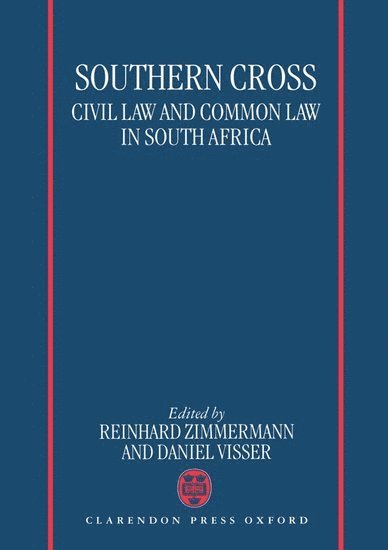
This book provides a history of some of the main institutions of South African private law and in so doing explores the process through which integration of the English common law and the continental civil law came about in that jurisdiction. Here is a book aimed at both European and South African audiences. For European lawyers it provides a stimulating insight into the way the process of harmonization of private law has occurred in South Africa and may occur within the European Union. By analysing the historical evolution of the most important institutions of the law of obligations and the law of property the book demonstrates how the two legal traditions have been accommodated within one system. The starting point for each essay is the "pure" Roman-Dutch law as it was transplanted to the Cape of Good Hope in the years following 1652 (and as it has been examined in considerable detail in another volume edited by Robert Feenstra and Reinhard Zimmerman, published in 1992). the analysis focuses on how the Roman-Dutch law has been preserved, changed, modified or replaced in the course of the nineteenth century when the Cape became a British colony; and on what happened after the creation of the union of South Africa in 1910. Each essay therefore attempts, in the field of law with which it is dealing, to answer questions such as: what was the level of interaction between the civil law and the common law? What were the mechanisms that brought about the particular form of competition, coexistence or fusion that exists in that area of law? Is the process complete or is it still continuing? Is it possible to observe the emergence, from these two routes, of a genuinely South African private law? How is the result to be evaluated? In establishing reception patterns at the level of specific areas of law, they go beyond generalization about the compatibility of the two traditions and present evidence of a possible symbiosis of English and Continental law.For South African readers the principal value of the book is that it offers essays by the most prominent South African private lawyers refelecting on the history of their subjects. It therefore constitutes the first stage in the writing of a history of substantive private law in South Africa. So far the focus has mainly been on the so called "external history" of South African law, and such texts as there are on the development of the institutions of private law are often in Afrikaans and mainly to be found in unpublished theses. Thus this book fulfils a real need for those teaching South African private law and legal history.Although the volume investigates a specific aspect of the making of modern South African law it is imperative not to lose sight of the fact that private law in that country, as every way else did not develop in a vacuum, but as part of a wider political and social prcess. For this reason the book opens with an essay which contextualizes the contributions that follow, giving a view of the "setting" in which the development of South Africa took place: colonial domination, cultural imperialism, and racial and nationalistic ideologies. Two further introductory essays pay specific attention to the impact of the procedural framework on the substantive private law and to the "architects" of the mixed system.
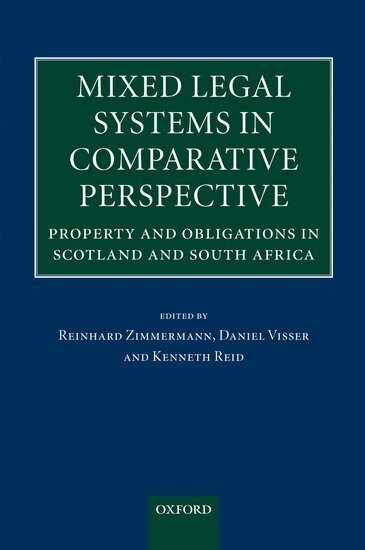
Mixed Legal Systems in Comparative Perspective
Property and Obligations in Scotland and South Africa
Inbunden, Engelska, 2005
4 342 kr
Skickas inom 5-8 vardagar
Placed uniquely at the intersection of common law and civil law, mixed legal systems are today attracting the attention both of scholars of comparative law, and of those concerned with the development of a European private law. Pre-eminent among the mixed legal systems are those of Scotland and South Africa. In South Africa the Roman-Dutch law, brought to the Cape by the Dutch East India Company in 1652 was, from the early nineteenth century onwards, infused with and re-moulded by the common law of the British imperial master. In Scotland a more gradual and elusive process saw the Roman-Scots law of the early modern period fall under the influence of English law after the Act of Union in 1707. The result, in each case, was a system of law which drew from both of the great European traditions whilst containing distinctive elements of its own. This volume sets out to compare the effects of this historical development by assessing whether shared experience has led to shared law. Key topics from the law of property and obligations are examined, collaboratively and comparatively, by teams of leading experts from both jurisdictions. The individual chapters reveal an intricate pattern of similarity and difference, enabling courts and legal writers in Scotland and South Africa to learn from the experience of a kindred jurisdiction. They also, in a number of areas, reveal an emerging and distinctive jurisprudence of mixed systems, and thus suggest viable answers to some of the great questions which must be answered on the path towards a European private law.
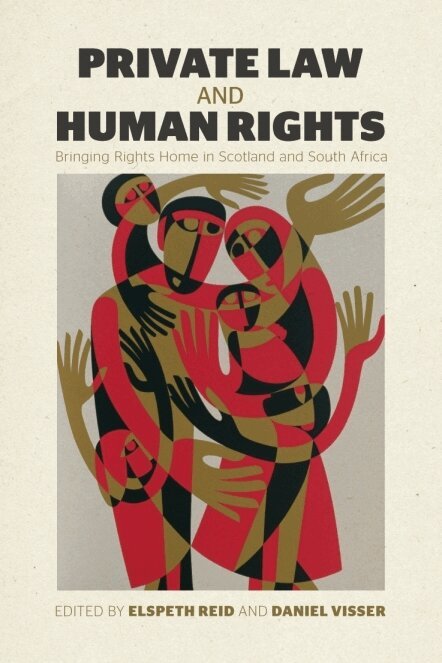
Private Law and Human Rights
Bringing Rights Home in Scotland and South Africa
Inbunden, Engelska, 2013
1 685 kr
Skickas inom 7-10 vardagar
Scotland and South Africa are mixed jurisdictions, combining features of common law and civil law traditions. Over the last decade, a shared feature in both Scotland and South Africa has been a new and intense focus on human rights. In Scotland, the European Convention on Human Rights now constitutes an important element in the foundation of all domestic law. Similarly, the Constitution of the Republic of South Africa, adopted in 1996, has a Bill of Rights as its cornerstone. This binds the legislature, the executive, the judiciary and all organs of state - and also private parties. In some ways, the Scottish and South African experience could not be more dissimilar, and the ‘constitutional moments’ from which these documents sprang were very different. At the same time, the parallels are close and compelling. This book, written by experts from both jurisdictions, examines exactly how human-rights provisions influence private law, looking at all branches of the subject. Moreover, it gives a unique perspective by comparing the approach in these kindred legal systems, providing a benchmark for both.
316 kr
Kommande
Scotland and South Africa are mixed jurisdictions, combining features of common law and civil law traditions. Over the last decade, a shared feature in both Scotland and South Africa has been a new and intense focus on human rights. In Scotland, the European Convention on Human Rights now constitutes an important element in the foundation of all domestic law. Similarly, the Constitution of the Republic of South Africa, adopted in 1996, has a Bill of Rights as its cornerstone. This binds the legislature, the executive, the judiciary and all organs of state - and also private parties. In some ways, the Scottish and South African experience could not be more dissimilar, and the ‘constitutional moments’ from which these documents sprang were very different. At the same time, the parallels are close and compelling. This book, written by experts from both jurisdictions, examines exactly how human-rights provisions influence private law, looking at all branches of the subject. Moreover, it gives a unique perspective by comparing the approach in these kindred legal systems, providing a benchmark for both.