Daniela Giannetti - Böcker
Visar alla böcker från författaren Daniela Giannetti. Handla med fri frakt och snabb leverans.
4 produkter
4 produkter
2 306 kr
Skickas inom 10-15 vardagar
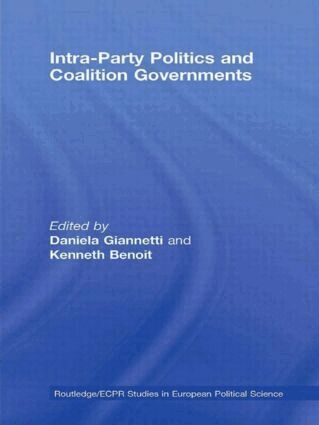
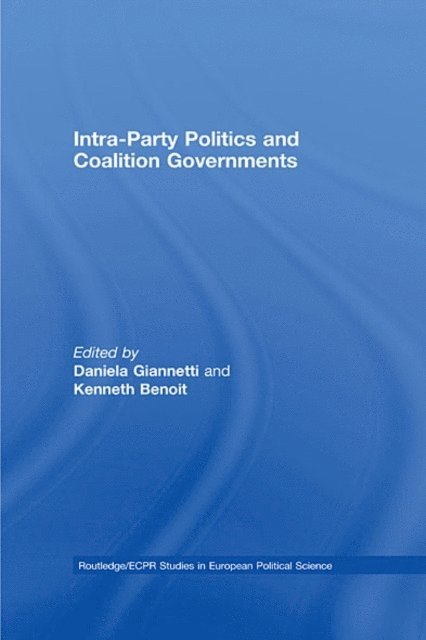
This book explores how intra-party politics affects government formation and termination in parliamentary systems, where the norm is the formation of coalition governments. The authors look beyond party cohesion and discipline in parliamentary democracies to take a broader view, assuming a diversity of preferences among party members and then exploring the incentives that give rise to coordinated party behaviour at the electoral, legislative and executive levels. The chapters in this book share a common analytical framework, confronting theoretical models of government formation with empirical data, some drawn from cross-national analyses and others from theoretically structured case studies. A distinctive feature of the book is that it explores the impact of intra-party politics at different levels of government: national, local and EU. This offers the opportunity to investigate existing theories of coalition formation in new political settings. Finally, the book offers a range of innovative methods for investigating intra-party politics which, for example, creates a need to estimate the policy positions of individual politicians inside political parties. This book will be of interest to political scientists, especially scholars involved in research on political parties, parliamentary systems, coalition formation and legislative behaviour, multilevel governance, European and EU politics.
676 kr
Skickas inom 10-15 vardagar
This book explores how intra-party politics affects government formation and termination in parliamentary systems, where the norm is the formation of coalition governments. The authors look beyond party cohesion and discipline in parliamentary democracies to take a broader view, assuming a diversity of preferences among party members and then exploring the incentives that give rise to coordinated party behaviour at the electoral, legislative and executive levels. The chapters in this book share a common analytical framework, confronting theoretical models of government formation with empirical data, some drawn from cross-national analyses and others from theoretically structured case studies. A distinctive feature of the book is that it explores the impact of intra-party politics at different levels of government: national, local and EU. This offers the opportunity to investigate existing theories of coalition formation in new political settings. Finally, the book offers a range of innovative methods for investigating intra-party politics which, for example, creates a need to estimate the policy positions of individual politicians inside political parties. This book will be of interest to political scientists, especially scholars involved in research on political parties, parliamentary systems, coalition formation and legislative behaviour, multilevel governance, European and EU politics.
Del 24 - Studies in Public Choice
Natural Experiment on Electoral Law Reform
Evaluating the Long Run Consequences of 1990s Electoral Reform in Italy and Japan
Inbunden, Engelska, 2010
1 073 kr
Skickas inom 10-15 vardagar
In the early 1990s, major electoral reforms took place in both Italy and Japan; each replaced a form of “proportional representation” (in which voters cast a ballot for a party list) with a “mixed member” system (in which voters cast ballots for individual candidates and party lists). The reforms were enacted by political elites in the context of divisions within the dominant party, changing patterns of party support, and party splits, in efforts to retain power while responding to charges of corruption, clientelism, and lack of accountability. The experiences of both countries provide a laboratory in which to investigate the effects and implications of the reforms, and, more broadly to analyze voter behavior in the context of institutional change. The introduction provides an overview of post-WWII politics and electoral reform in Italy and Japan. In each of the next four chapters, specialists in Italian and Japanese electoral politics are teamed up to review data both before and after the reforms. Within this comparative framework, the authors explore such topics as changes in party competition, candidate selection mechanisms, and intra-party politics. The concluding chapter considers the longer-term consequences—both anticipated and unanticipated—of the reforms; despite superficially similar conditions, the effects in the two countries were dramatically different: in Japan, the new system has taken hold, with minor modifications, while in Italy, there was a reversion to a proportional representation system. As the essays in this volume demonstrate, to understand why similar reforms had such different effects in the two countries we must examine how electoral systems are embedded in broader institutional and social arrangements, and at the complex interplay of political geography, political history, and the rational calculations of political actors.
Del 24 - Studies in Public Choice
Natural Experiment on Electoral Law Reform
Evaluating the Long Run Consequences of 1990s Electoral Reform in Italy and Japan
Häftad, Engelska, 2013
1 073 kr
Skickas inom 10-15 vardagar
In the early 1990s, major electoral reforms took place in both Italy and Japan; each replaced a form of “proportional representation” (in which voters cast a ballot for a party list) with a “mixed member” system (in which voters cast ballots for individual candidates and party lists). The reforms were enacted by political elites in the context of divisions within the dominant party, changing patterns of party support, and party splits, in efforts to retain power while responding to charges of corruption, clientelism, and lack of accountability. The experiences of both countries provide a laboratory in which to investigate the effects and implications of the reforms, and, more broadly to analyze voter behavior in the context of institutional change. The introduction provides an overview of post-WWII politics and electoral reform in Italy and Japan. In each of the next four chapters, specialists in Italian and Japanese electoral politics are teamed up to review data both before and after the reforms. Within this comparative framework, the authors explore such topics as changes in party competition, candidate selection mechanisms, and intra-party politics. The concluding chapter considers the longer-term consequences—both anticipated and unanticipated—of the reforms; despite superficially similar conditions, the effects in the two countries were dramatically different: in Japan, the new system has taken hold, with minor modifications, while in Italy, there was a reversion to a proportional representation system. As the essays in this volume demonstrate, to understand why similar reforms had such different effects in the two countries we must examine how electoral systems are embedded in broader institutional and social arrangements, and at the complex interplay of political geography, political history, and the rational calculations of political actors.