Daowei Zhang - Böcker
Visar alla böcker från författaren Daowei Zhang. Handla med fri frakt och snabb leverans.
6 produkter
6 produkter
559 kr
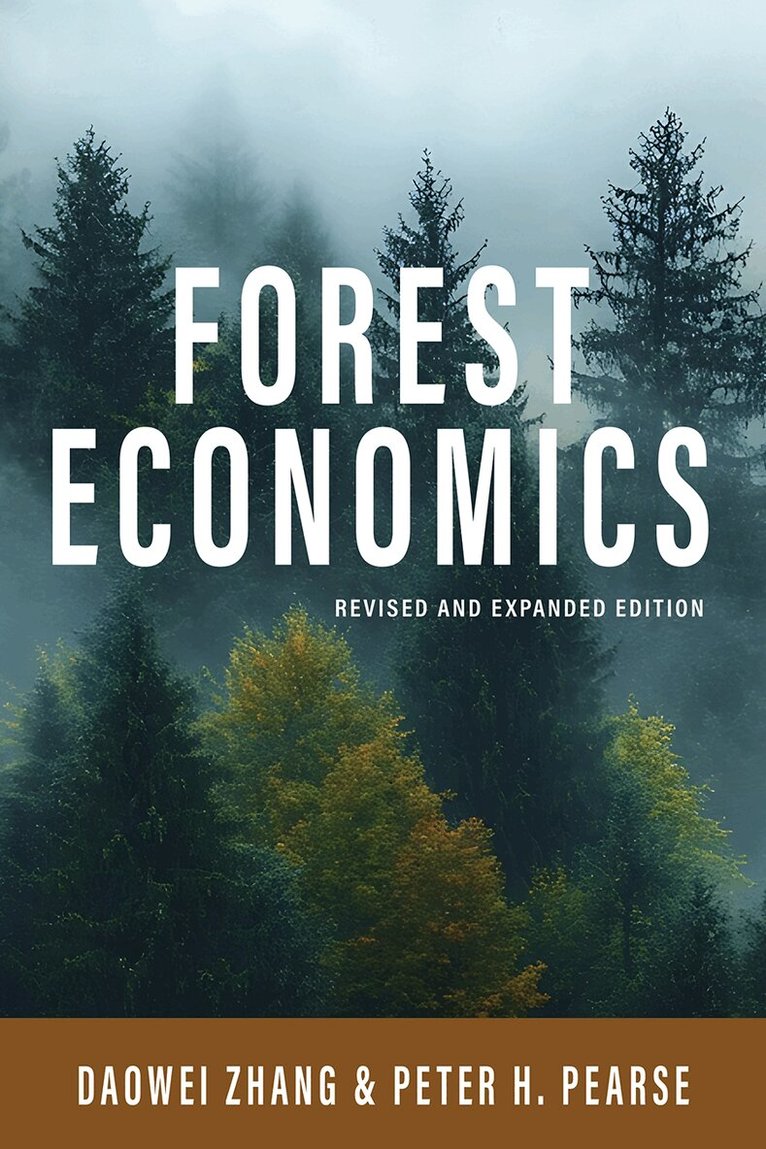
This book covers the basic economic principles and concepts and their application to modern forest management and policy issues.
612 kr
Skickas inom 7-10 vardagar
A firm grounding in economics is integral to sound forest management, investment, policies, and practices. Forest Economics covers the basic economic concepts, principles, and constructs and shows how these are applied in private and public forestry decision making.This comprehensive edition contains up-to-date data, examples, and applications of economic principles, along with literature and study questions, and additional valuable content in several key areas:forest finance and forestland investment/ownership, including financial economic modelssimple interest rate and risk measurementsmarket distortionconsumer theorypriced non-timber values and payment for ecosystem servicesland rent theorythe economics of forest management planning and forest health/wildfire economicsan international comparison of forest taxes and feesproperty rights beyond the private/public ownership binarythe measurement of competitiveness in international tradea new theory of foreign direct investment.The advanced empirical presentation and keen attention to new developments in the field reflect the authors' decades of teaching experience in the United States and Canada. Forest Economics is quite simply indispensable.
1 914 kr
Skickas inom 7-10 vardagar
There is currently great concern about the sustainability of forestry and the contribution of private forestry towards this aim. The need to better understand the impact of different policy choices on private forestry has never been more important. This book includes a selection of peer-reviewed papers from a conference held in Atlanta in March 2001.
From Backwoods to Boardrooms
The Rise of Institutional Investment in Timberland
Häftad, Engelska, 2021
481 kr
Skickas inom 7-10 vardagar
In the past 100-plus years, forestland ownerships have gone through two structural changes in the US and other parts of the world: the accumulation of industrial timberlands between 1900s and 1980s and the transformation of industrial timberlands to institutional ownerships afterwards. This book is about the history and economics of these two structural changes with the emphasis on the latter. The scale of both changes is unprecedented and truly revolutionary, impacting tens of millions of acres of private landholdings and billions of dollars of investment and affecting industrial structure, forest management and policy, research and development, community welfare, and forest sustainability.Looking though a historical count of key events, players, prevailing management philosophies, public policy, and institutional factors, the author of this book searches for an economic explanation and assesses the impact of these two changes. Its main contributions are three folds. First, it explains why industrial firms were able to profit from owning large areas of forest lands in the first place and how institutional investors could purchase these lands later. Many details of the history that could have otherwise been lost are revealed in this book for the first time. Second, it compares private and public equity timberland investments with respect to risk-adjusted returns as well as such other dimensions of interest to investors and forest managers including alignment of interests, capacity to exploit market inefficiencies, and their forest management and conservation records. Finally, it provides thoughtful commentary into the future of institutional timberland investments and global forest sustainability. This book is required reading for anyone interested in understanding the workings of the modern forest sector in the U.S. and elsewhere, forest investment, and forest sustainability.
Softwood Lumber War
Politics, Economics, and the Long U.S.-Canadian Trade Dispute
Inbunden, Engelska, 2007
2 155 kr
Skickas inom 10-15 vardagar
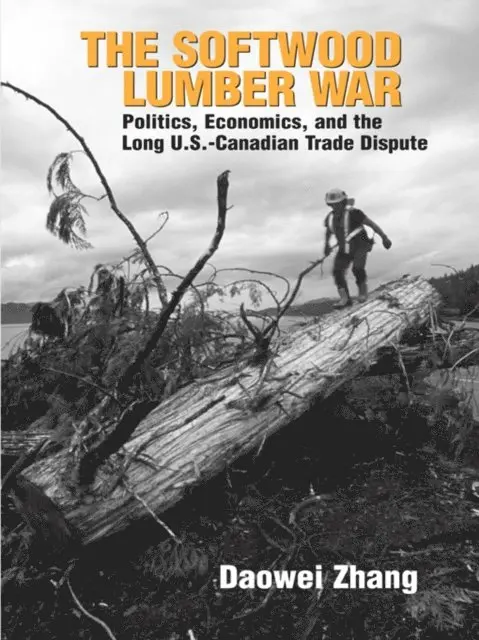
As a forester interested in economics and policy, Daowei Zhang followed the softwood lumber dispute between the U.S. and Canada for nearly 20 years. Dubbed the 'Softwood Lumber War,' the conflict enveloped politicians and business leaders on both sides of the border and placed strains on the historically close economic and political relations between the two countries. This book is an unprecedentedly detailed evaluation of how the conflict began and how it was sustained for such a long period of time. The book considers the implications that may follow from the 2006 agreement between the nations, and the broader lessons that might be learned about international trade conflicts. The early 1980s was a difficult time for U.S. lumber producers. Finding their domestic market share in decline, they requested restrictions on Canadian lumber imports. Alleging that the Canadian producers were being subsidized, they eventually secured a 15 percent export tax on Canadian lumber in 1986. A long series of trade battles followed against a background of shortages in the U.S. timber supply, changing international markets, and the establishment of the North American Free Trade Agreement and the World Trade Organization. Canada and the United States are the world's largest trading partners, but, as Zhang demonstrates, it is a relationship in which domestic pressure groups, different institutional structures within each government, and differences in the relative economic power of each country remain extremely important determinants of foreign policy. The fact that the softwood lumber dispute has taken so long to resolve-and the prospect that the 2006 agreement has the potential to be undone by continuing litigation and trade friction-raise important questions about international relations in a world that is supposedly moving toward free trade.
Softwood Lumber War
Politics, Economics, and the Long U.S.-Canadian Trade Dispute
Häftad, Engelska, 2007
712 kr
Skickas inom 10-15 vardagar
As a forester interested in economics and policy, Daowei Zhang followed the softwood lumber dispute between the U.S. and Canada for nearly 20 years. Dubbed the 'Softwood Lumber War,' the conflict enveloped politicians and business leaders on both sides of the border and placed strains on the historically close economic and political relations between the two countries. This book is an unprecedentedly detailed evaluation of how the conflict began and how it was sustained for such a long period of time. The book considers the implications that may follow from the 2006 agreement between the nations, and the broader lessons that might be learned about international trade conflicts. The early 1980s was a difficult time for U.S. lumber producers. Finding their domestic market share in decline, they requested restrictions on Canadian lumber imports. Alleging that the Canadian producers were being subsidized, they eventually secured a 15 percent export tax on Canadian lumber in 1986. A long series of trade battles followed against a background of shortages in the U.S. timber supply, changing international markets, and the establishment of the North American Free Trade Agreement and the World Trade Organization. Canada and the United States are the world's largest trading partners, but, as Zhang demonstrates, it is a relationship in which domestic pressure groups, different institutional structures within each government, and differences in the relative economic power of each country remain extremely important determinants of foreign policy. The fact that the softwood lumber dispute has taken so long to resolve-and the prospect that the 2006 agreement has the potential to be undone by continuing litigation and trade friction-raise important questions about international relations in a world that is supposedly moving toward free trade.