David A. Nichols – författare
Visar alla böcker från författaren David A. Nichols. Handla med fri frakt och snabb leverans.
8 produkter
8 produkter
Häftad, Engelska, 2023
289 kr
Skickas inom 5-8 vardagar
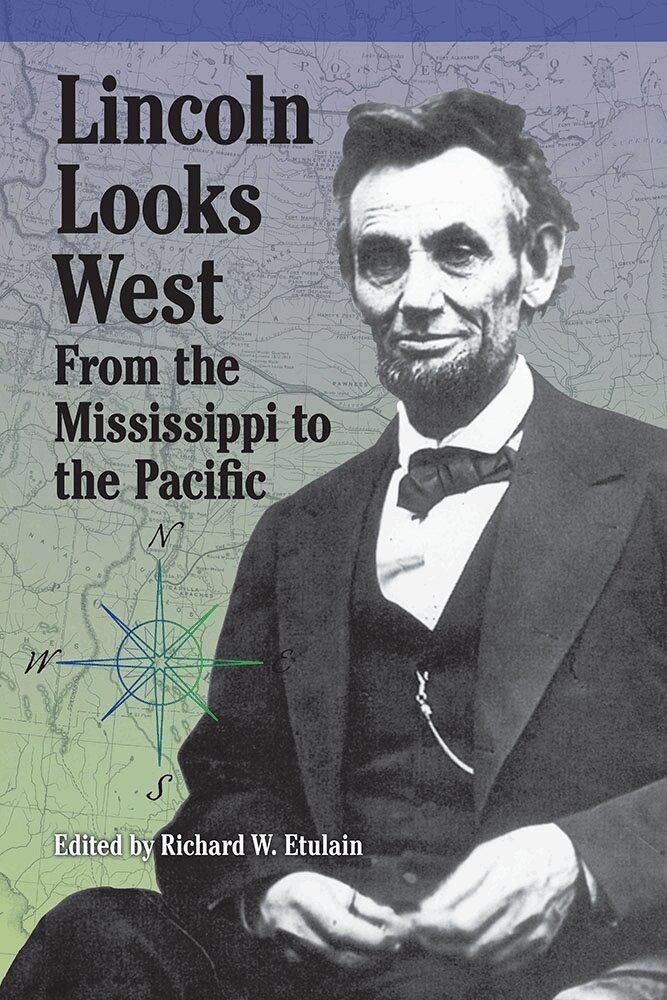
This volume explores Abraham Lincoln’s ties to the American West, bringing together a variety of scholars and experts who offer a look at the sixteenth president’s legacy in the territory beyond the Mississippi River. Included in this collection are an examination of Lincoln’s opposition to the Mexican War; a discussion of antislavery politics as applied to the West; perspectives on Lincoln’s views on the Thirteenth Amendment and his reluctance to admit Nevada to the Union; a look at the impact of the Radical Republicans on Lincoln’s patronage and appointments; and discussion of Lincoln’s favorable treatment of New Mexico and Arizona in an effort to garner their loyalty to the Union. Also analyzed is “The Tribe of Abraham”—Lincoln’s less-than-competent appointments in Washington Territory—and the ways in which Lincoln’s political friends in the Western Territories influenced his western policies. Other essays look at Lincoln’s dealings with the Mormons of Utah, who supported the president in exchange for his tolerance, and Native Americans, whose relations with the government suffered as the president’s attention was consumed by the Civil War. Loaded with a wealth of information, Lincoln Looks West explores yet another dimension to this dynamic leader and to the history of the American West.
Häftad, Engelska, 2012
261 kr
Skickas inom 3-6 vardagar
E-bok
Engelska, 2012196 kr
Läs direkt efter köp
"Lincoln and the Indians has stood the test of time and offers this generation of readers a valuable interpretation of the U.S. government's Indian policies—and sometimes the lack thereof—during the Civil War era. Providing a critical perspective on Lincoln's role, Nichols sets forth an especially incisive analysis of the trial of participants in the Dakota War of 1862 in Minnesota and Lincoln's role in sparing the lives of most of those who were convicted." — James M. McPherson, Pulitzer Prize–winning author of Battle Cry of Freedom "For the Dakota people, the Indian System started with the doctrine of discovery and continued through Abraham Lincoln's presidency and beyond. The United States was bound to protect the rights of Indian parties. But in the end, the guilty were glorified and the laws for humanity disgraced. This book tells that story, and it should be required reading at all educational institutions." —Sheldon Wolfchild, independent filmmaker, artist, and actor"Undoubtedly the best book published on Indian affairs in the years of Lincoln's presidency." —American Historical Review
Häftad, Engelska, 2008
310 kr
Skickas inom 3-6 vardagar
E-bok
Engelska, 2007208 kr
Läs direkt efter köp
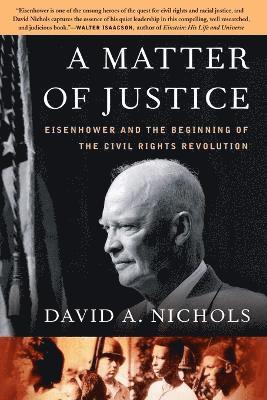
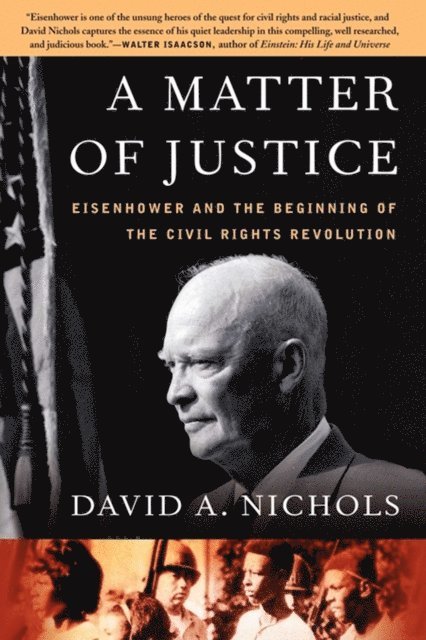
Fifty years after President Dwight D. Eisenhower ordered troops to Little Rock, Arkansas, to enforce a federal court order desegregating the city''s Central High School, a leading authority on Eisenhower presents an original and engrossing narrative that places Ike and his civil rights policies in dramatically new light. Historians such as Stephen Ambrose and Arthur Schlesinger, Jr., have portrayed Eisenhower as aloof, if not outwardly hostile, to the plight of African-Americans in the 1950s. It is still widely assumed that he opposed the Supreme Court''s landmark 1954 Brown v. Board of Education decision mandating the desegregation of public schools, that he deeply regretted appointing Earl Warren as the Court''s chief justice because of his role in molding Brown, that he was a bystander in Congress''s passage of the civil rights acts of 1957 and 1960, and that he so mishandled the Little Rock crisis that he was forced to dispatch troops to rescue a failed policy. In this sweeping narrative, David A. Nichols demonstrates that these assumptions are wrong. Drawing on archival documents neglected by biographers and scholars, including thousands of pages newly available from the Eisenhower Presidential Library, Nichols takes us inside the Oval Office to look over Ike''s shoulder as he worked behind the scenes, prior to Brown, to desegregate the District of Columbia and complete the desegregation of the armed forces. We watch as Eisenhower, assisted by his close collaborator, Attorney General Herbert Brownell, Jr., sifted through candidates for federal judgeships and appointed five pro-civil rights justices to the Supreme Court and progressive judges to lower courts. We witness Eisenhower crafting civil rights legislation, deftly building a congressional coalition that passed the first civil rights act in eighty-two years, and maneuvering to avoid a showdown with Orval Faubus, the governor of Arkansas, over desegregation of Little Rock''s Central High. Nichols demonstrates that Eisenhower, though he was a product of his time and its backward racial attitudes, was actually more progressive on civil rights in the 1950s than his predecessor, Harry Truman, and his successors, John F. Kennedy and Lyndon Johnson. Eisenhower was more a man of deeds than of words and preferred quiet action over grandstanding. His cautious public rhetoric -- especially his legalistic response to Brown -- gave a misleading impression that he was not committed to the cause of civil rights. In fact, Eisenhower''s actions laid the legal and political groundwork for the more familiar breakthroughs in civil rights achieved in the 1960s. Fair, judicious, and exhaustively researched, A Matter of Justice is the definitive book on Eisenhower''s civil rights policies that every presidential historian and future biographer of Ike will have to contend with.
Häftad, Engelska, 2012
296 kr
Skickas inom 3-6 vardagar
E-bok
Engelska, 2011117 kr
Läs direkt efter köp
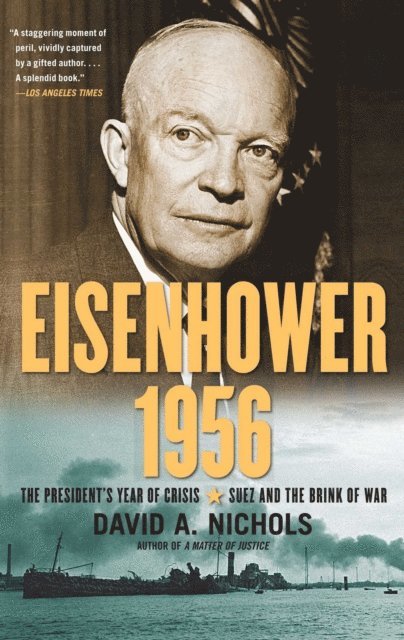
A gripping tale of international intrigue and betray-al, Eisenhower 1956 is the white-knuckle story of how President Dwight D. Eisenhower guided the United States through the Suez Canal crisis of 1956. The crisis climaxed in a tumultuous nine-day period fraught with peril just prior to the 1956 presidential election, with Great Britain, France, and Israel invading Egypt while the Soviet Union ruthlessly crushed rebellion in Hungary. David A. Nichols, a leading expert on Eisenhower’s presidency, draws on hundreds of documents declassified in the last thirty years, enabling the reader to look over Ike’s shoulder and follow him day by day, sometimes hour by hour as he grappled with the greatest international crisis of his presidency. The author uses formerly top secret minutes of National Security Council and Oval Office meetings to illuminate a crisis that threatened to escalate into global conflict. Nichols shows how two life-threatening illnesses—Eisenhower’s heart attack in September 1955 and his abdominal surgery in June 1956—took the president out of action at critical moments and contributed to missteps by his administration. In 1956, more than two thirds of Western Europe’s oil supplies transited the Suez Canal, which was run by a company controlled by the British and French, Egypt’s former colonial masters. When the United States withdrew its offer to finance the Aswan Dam in July of that year, Egypt’s president, Gamal Abdel Nasser, nationalized the canal. Without Eisenhower’s knowledge, Britain and France secretly plotted with Israel to invade Egypt and topple Nasser. On October 29—nine days before the U.S. presidential election—Israel invaded Egypt, setting the stage for a “perfect storm.” British and French forces soon began bombing Egyptian ports and airfields and landing troops who quickly routed the Egyptian army. Eisenhower condemned the attacks and pressed for a cease-fire at the United Nations. Within days, in Hungary, Soviet troops and tanks were killing thousands to suppress that nation’s bid for freedom. When Moscow openly threatened to intervene in the Middle East, Eisenhower placed American military forces—including some with nuclear weapons—on alert and sternly warned the Soviet Union against intervention. On November 6, Election Day, after voting at his home in Gettysburg, Ike rushed back to the White House to review disturbing intelligence from Moscow with his military advisors. That same day, he learned that the United Nations had negotiated a cease-fire in the Suez war—a result, in no small measure, of Eisenhower’s steadfast opposition to the war and his refusal to aid the allies. In the aftermath of the Suez crisis, the United States effectively replaced Great Britain as the guarantor of stability in the Middle East. More than a half century later, that commitment remains the underlying premise for American policy in the region. Historians have long treated the Suez Crisis as a minor episode in the dissolution of colonial rule after World War II. As David Nichols makes clear in Eisenhower 1956, it was much more than that.
E-bok
Engelska, 2017142 kr
Läs direkt efter köp
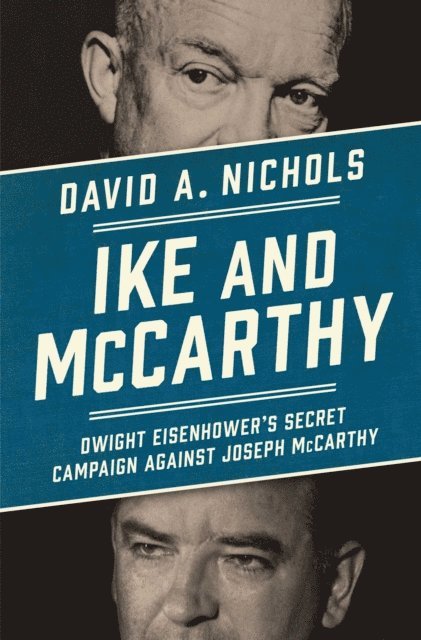
The full, little-known story of how President Dwight Eisenhower masterminded the downfall of the anti-Communist demagogue Senator Joseph McCarthy is “a gripping, detailed account of how the executive branch subtly but decisively defeated one of America’s most dangerous demagogues” (The Washington Post).They shook hands for the cameras, but Dwight Eisenhower privately abhorred Senator Joseph McCarthy, the powerful Republican senator notorious for his anti-Communist campaign. In spite of a public perception that Eisenhower was unwilling to challenge McCarthy, Ike believed that directly confronting the senator would diminish the presidency. Therefore, the president operated—more discreetly and effectively—with a “hidden hand.” In “a thorough, well-written, and surprising picture of a man who was much more than a ‘do-nothing’ president” (Kirkus Reviews, starred review), David A. Nichols shows how the tension between the two men escalated. In a direct challenge to Eisenhower, McCarthy alleged that the US Army was harboring communists and launched an investigation. But the senator had unwittingly signed his own political death warrant. The White House employed surrogates to conduct a clandestine campaign against McCarthy and was not above using information about the private lives of McCarthy’s aides as ammunition. By January 1954 McCarthy was arguably the most powerful member of the Senate. Yet at the end of that year, he had been censured by his colleagues for unbecoming conduct. Eisenhower’s covert operation had discredited the senator months earlier, exploiting the controversy that resulted from the televised Army-McCarthy hearings. McCarthy would never recover his lost prestige. In Ike and McCarthy, Nichols uses documents previously unavailable or overlooked to authenticate the extraordinary story of Eisenhower’s anti-McCarthy campaign. The result is “a well-researched and sturdily written account of what may be the most important such conflict in modern history….Americans have as much to learn today from Eisenhower as his many liberal critics did in 1954” (The Atlantic Monthly).