David Coplan – författare
Visar alla böcker från författaren David Coplan. Handla med fri frakt och snabb leverans.
9 produkter
9 produkter
E-bok
Engelska, 2008386 kr
Läs direkt efter köp
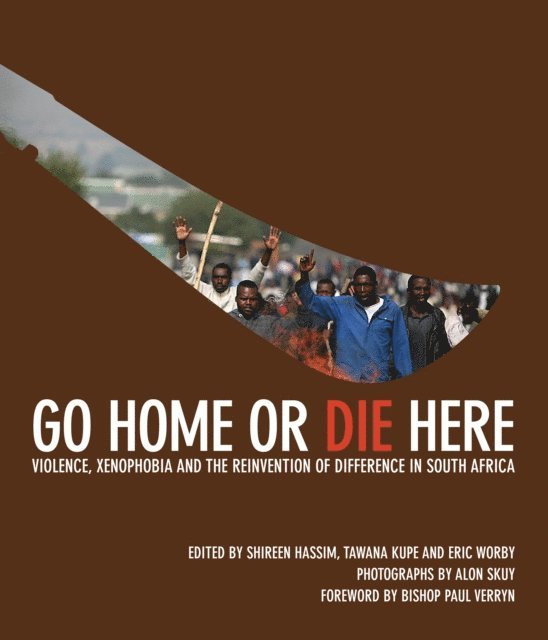
The xenophobic attacks that started in Alexandra, Johannesburg in May 2008 before quickly spreading around the country caused an outcry across the world and raised many fundamental questions: Of what profound social malaise is xenophobia – and the violence that it inspires – a symptom? Have our economic and political choices created new forms of exclusion that fuel anger and distrust? What consequences does the emergence of xenophobia hold for the idea of an equal, non-racial society as symbolised by a democratic South Africa?On 28 May 2008 the Faculty of Humanities in the University of the Witwatersrand, Johannesburg convened an urgent colloquium that focused on searching for short and long-term solutions. Nearly twenty individuals – mostly Wits academics from a variety of disciplines, but also two student leaders, a journalist and a bishop – addressed the unfolding violence in ways that were conversant with the moment, yet rooted in scholarship and ongoing research.Go Home or Die Here emanates directly from the colloquium. It hopes to make sense of the nuances and trajectories of building a democratic society out of a deeply divided and conflictual past, in the conditions of global recession, heightening inequalities and future uncertainty. The authors hoped to pose questions that would lead both to research and to more informed, reflective forms of public action. With extensive photographs by award-winning photographer Alon Skuy, who covered the violence for The Times newspaper, the volume is passionate and engaged, and aims to stimulate reflection, debate and activism among concerned members of a broad public.
Häftad, Engelska, 2008
388 kr
Skickas inom 5-8 vardagar
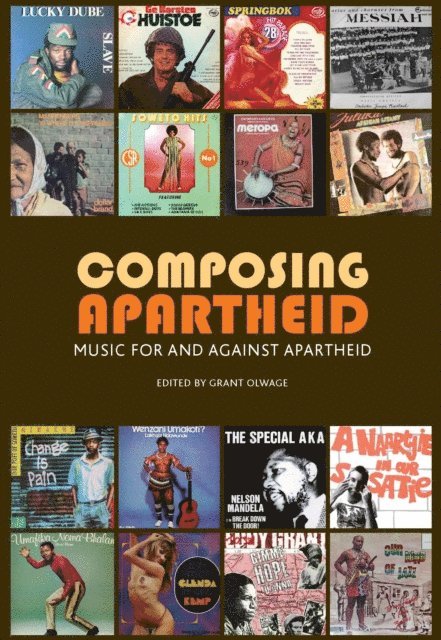
Composing Apartheid is the first book ever to chart the musical world of a notorious period in world history, apartheid South Africa. It explores how music was produced through, and was productive of, key features of apartheid's social and political topography, as well as how music and musicians contested and even helped to conquer apartheid. The collection of essays is intentionally broad, and the contributors include historians, sociologists and anthropologists, as well as ethnomusicologists, music theorists and historical musicologists. The essays focus on a variety of music (jazz, music in the Western art tradition, popular music) and on major composers (such as Kevin Volans) and works (Handel's Messiah). Musical institutions and previously little-researched performers (such as the African National Congress's troupe-in-exile, Amandla) are explored. The writers move well beyond their subject matter, intervening in debates on race, historiography, and postcolonial epistemologies and pedagogies.
E-bok
PDF, Engelska, 2008386 kr
Läs direkt efter köp
The xenophobic attacks that started in Alexandra, Johannesburg in May 2008 before quickly spreading around the country caused an outcry across the world and raised many fundamental questions: Of what profound social malaise is xenophobia – and the violence that it inspires – a symptom? Have our economic and political choices created new forms of exclusion that fuel anger and distrust? What consequences does the emergence of xenophobia hold for the idea of an equal, non-racial society as symbolised by a democratic South Africa?On 28 May 2008 the Faculty of Humanities in the University of the Witwatersrand, Johannesburg convened an urgent colloquium that focused on searching for short and long-term solutions. Nearly twenty individuals – mostly Wits academics from a variety of disciplines, but also two student leaders, a journalist and a bishop – addressed the unfolding violence in ways that were conversant with the moment, yet rooted in scholarship and ongoing research.Go Home or Die Here emanates directly from the colloquium. It hopes to make sense of the nuances and trajectories of building a democratic society out of a deeply divided and conflictual past, in the conditions of global recession, heightening inequalities and future uncertainty. The authors hoped to pose questions that would lead both to research and to more informed, reflective forms of public action. With extensive photographs by award-winning photographer Alon Skuy, who covered the violence for The Times newspaper, the volume is passionate and engaged, and aims to stimulate reflection, debate and activism among concerned members of a broad public.
E-bok
PDF, Engelska, 2008398 kr
Läs direkt efter köp
Composing Apartheid is the first book ever to chart the musical world of a notorious period in world history, apartheid South Africa. It explores how music was produced through, and was productive of, key features of apartheid’s social and political topography, as well as how music and musicians contested and even helped to conquer apartheid. The collection of essays is intentionally broad, and the contributors include historians, sociologists and anthropologists, as well as ethnomusicologists, music theorists and historical musicologists. The essays focus on a variety of music (jazz, music in the Western art tradition, popular music) and on major composers (such as Kevin Volans) and works (Handel’s Messiah). Musical institutions and previously little-researched performers (such as the African National Congress’s troupe-in-exile, Amandla) are explored. The writers move well beyond their subject matter, intervening in debates on race, historiography, and postcolonial epistemologies and pedagogies.
E-bok
PDF, Engelska, 2014459 kr
Läs direkt efter köp
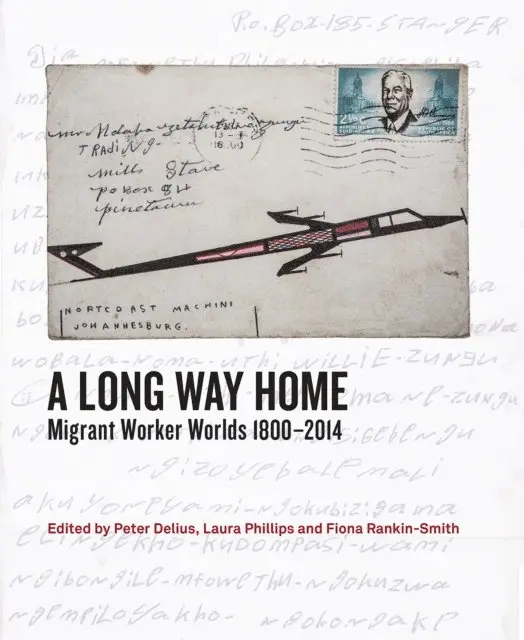
In no other society in the world have urbanisation and industrialization been as comprehensively based on migrant labour as in South Africa. Rather than focusing on the well-documented narrative of displacement and oppression, A Long Way Home captures the humanity, agency and creative modes of self-expression of the millions of workers who helped to build and shape modern South Africa. The book spans a three-hundred-year history beginning with the exportation of slave labour from Mozambique in the eighteenth century and ending with the strikes and tensions on the platinum belt in recent years. It shows not only the age-old mobility of African migrants across the continent but also, with the growing demand for labour in the mining industry, the importation of Chinese indentured migrant workers. Contributions include 18 essays and over 90 artworks and photographs that traverse homesteads, chiefdoms and mining hostels, taking readers into the materiality of migrant life and its customs and traditions, including the rituals practiced by migrants in an effort to preserve connections to “home” and create a sense of “belonging”. The essays and visual materials provide multiple perspectives on the lived experience of migrant labourers and celebrate their extraordinary journeys. A Long Way Home was conceived during the planning of an art exhibition entitled ‘Ngezinyawo: Migrant Journeys’ at Wits Art Museum. The interdisciplinary nature of the contributions and the extraordinary collection of images selected to complement and expand on the text make this a unique collection.
E-bok
Engelska, 2008398 kr
Läs direkt efter köp
Composing Apartheid is the first book ever to chart the musical world of a notorious period in world history, apartheid South Africa. It explores how music was produced through, and was productive of, key features of apartheid’s social and political topography, as well as how music and musicians contested and even helped to conquer apartheid. The collection of essays is intentionally broad, and the contributors include historians, sociologists and anthropologists, as well as ethnomusicologists, music theorists and historical musicologists. The essays focus on a variety of music (jazz, music in the Western art tradition, popular music) and on major composers (such as Kevin Volans) and works (Handel’s Messiah). Musical institutions and previously little-researched performers (such as the African National Congress’s troupe-in-exile, Amandla) are explored. The writers move well beyond their subject matter, intervening in debates on race, historiography, and postcolonial epistemologies and pedagogies.
E-bok
Engelska, 2014459 kr
Läs direkt efter köp
In no other society in the world have urbanisation and industrialization been as comprehensively based on migrant labour as in South Africa. Rather than focusing on the well-documented narrative of displacement and oppression, A Long Way Home captures the humanity, agency and creative modes of self-expression of the millions of workers who helped to build and shape modern South Africa. The book spans a three-hundred-year history beginning with the exportation of slave labour from Mozambique in the eighteenth century and ending with the strikes and tensions on the platinum belt in recent years. It shows not only the age-old mobility of African migrants across the continent but also, with the growing demand for labour in the mining industry, the importation of Chinese indentured migrant workers. Contributions include 18 essays and over 90 artworks and photographs that traverse homesteads, chiefdoms and mining hostels, taking readers into the materiality of migrant life and its customs and traditions, including the rituals practiced by migrants in an effort to preserve connections to “home” and create a sense of “belonging”. The essays and visual materials provide multiple perspectives on the lived experience of migrant labourers and celebrate their extraordinary journeys. A Long Way Home was conceived during the planning of an art exhibition entitled ‘Ngezinyawo: Migrant Journeys’ at Wits Art Museum. The interdisciplinary nature of the contributions and the extraordinary collection of images selected to complement and expand on the text make this a unique collection.
347 kr
Läs direkt efter köp
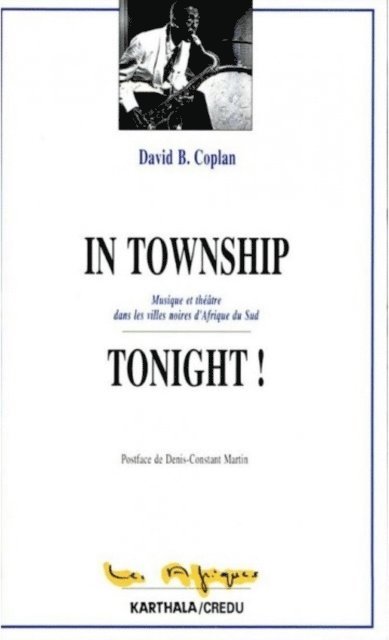
« Pendant l''année qui suivit l''explosion de Soweto, en 1976, je tournais dans Johannesburg et dans d''autres villes, occupé à observer toute forme de spectacle ou de concert, de réjouissance familiale ou communautaire, et à y participer ; j''assistais à des répétitions, à des séances d''enregistrement, je voyais des pièces, j''allais dans les clubs et au concert, j''interrogeais des membres actuels du monde du spectacle, et des anciens membres, je dépouillais des archives en quatre langues avec l''aide de mes camarades de recherche : j''essayais de replacer la culture du spectacle noir contemporain dans le cadre des processus historiques et des forces sociales qui l''avaient forgée. »Du XIXe siècle à nos jours, cette fresque de la musique noire sud-africaine est vaste et passionnante. Y trouveront leur compte, spécialistes et amoureux de la musique, comme tous ceux qui ont soutenu la lutte contre l''apartheid et continuent à en suivre l''évolution.
Häftad, Engelska, 2017
259 kr
Tillfälligt slut
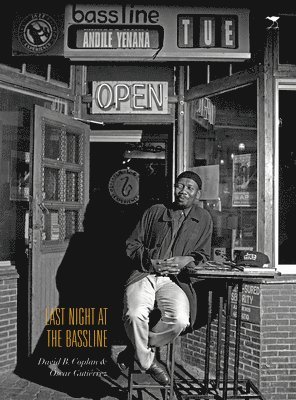
In 1994 Brad and Paige Holmes opened a small, live-music venue in the bohemian suburb of Melville in Johannesburg. They called it Bassline, which very soon became synonymous with cigarette smoke, great jazz and nights you wished would never end. They later moved the club to Newtown where it grew in prominence as the ultimate venue for live music, hosting amazing artists like Thandiswa Mazwai, Jimmy Dludlu, Lira, The Soil and Grammy Award-winning group Ladysmith Black Mambazo. In 2016 word spread like wildfire that everyone's favourite club was closing its doors forever; this place that held all the promises of a new South Africa, a place where people of all races could come together, share a drink, dance and fall in love was to be no more. But as Bassline starts its new journey with Live @ the Bassline, yet another great story begins with Last Night at the Bassline.