David G. Rickerby – författare
Visar alla böcker från författaren David G. Rickerby. Handla med fri frakt och snabb leverans.
3 produkter
3 produkter
Inbunden, Engelska, 1999
1 083 kr
Skickas inom 10-15 vardagar
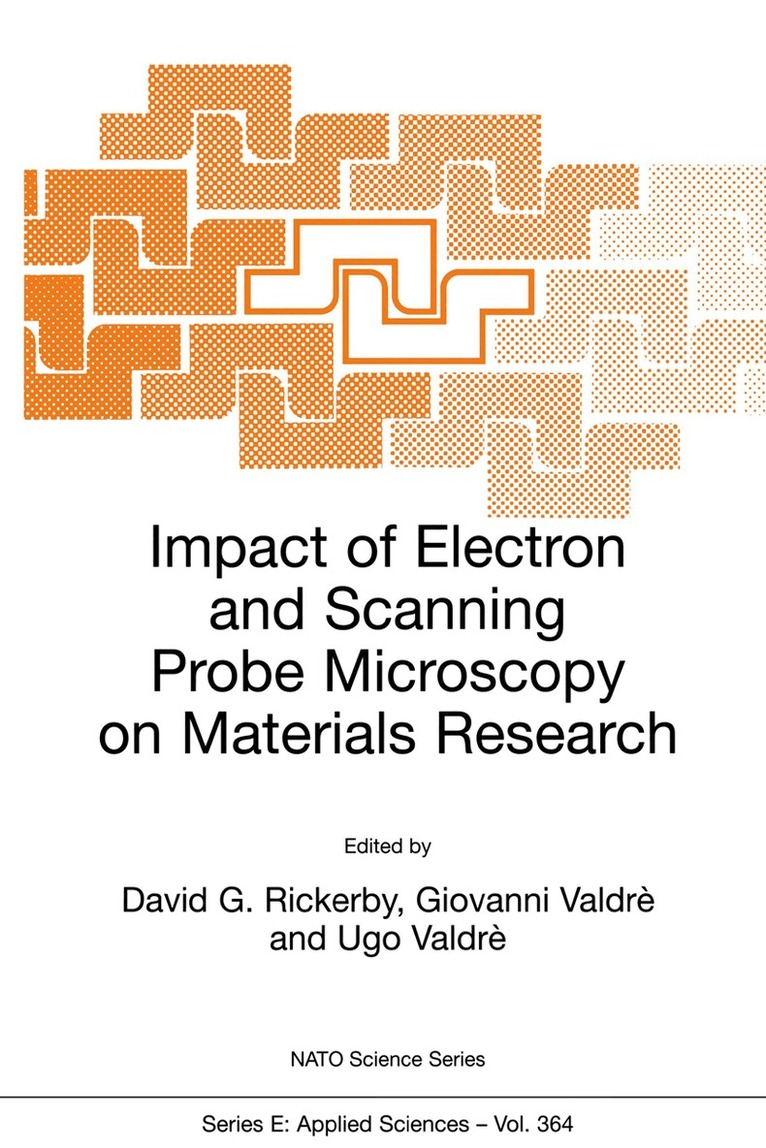
This volume presents a coherent synopsis of a rapidly evolving field. Subjects covered include diffraction contrast and defect analysis by conventional TEM lattice imaging, phase contrast and resolution limits in high resolution electron microscopy. Specialized electron diffraction techniques are also covered, as is the application of parallel electron energy loss spectroscopy and scanning transmission EM for subnanometer analysis. Materials analyzed include thin films, interfaces and non-conventional materials. WDS and EDS are treated, with an emphasis on o(pZ) techniques for the analysis of thin layers and surface films. Theoretical and practical aspects of ESEM are discussed in relation to applications in crystal growth, biomaterials and polymers. Developments in SPM are also described.
Häftad, Engelska, 1999
1 083 kr
Skickas inom 10-15 vardagar
This volume presents a coherent synopsis of a rapidly evolving field. Subjects covered include diffraction contrast and defect analysis by conventional TEM lattice imaging, phase contrast and resolution limits in high resolution electron microscopy. Specialized electron diffraction techniques are also covered, as is the application of parallel electron energy loss spectroscopy and scanning transmission EM for subnanometer analysis. Materials analyzed include thin films, interfaces and non-conventional materials. WDS and EDS are treated, with an emphasis on o(pZ) techniques for the analysis of thin layers and surface films. Theoretical and practical aspects of ESEM are discussed in relation to applications in crystal growth, biomaterials and polymers. Developments in SPM are also described.
E-bok
PDF, Engelska, 20121 367 kr
Läs direkt efter köp
The Advanced Study Institute provided an opportunity for researchers in universities, industry and National and International Laboratories, from the disciplines ofmaterials science, physics, chemistry and engineering to meet together in an assessment of the impact of electron and scanning probe microscopy on advanced material research. Since these researchers have traditionally relied upon different approaches, due to their different scientific background, to advanced materials problem solving, presentations and discussion within the Institute sessions were initially devoted to developing a set ofmutually understood basic concepts, inherently related to different techniques ofcharacterization by microscopy and spectroscopy. Particular importance was placed on Electron Energy Loss Spectroscopy (EELS), Scanning Probe Microscopy (SPM), High Resolution Transmission and Scanning Electron Microscopy (HRTEM, HRSTEM) and Environmental Scanning Electron Microscopy (ESEM). It was recognized that the electronic structure derived directly from EELS analysis as well as from atomic positions in HRTEM or High Angle Annular Dark Field STEM can be used to understand the macroscopic behaviour of materials. The emphasis, however, was upon the analysis of the electronic band structure of grain boundaries, fundamental for the understanding of macroscopic quantities such as strength, cohesion, plasticity, etc.