David Gauthier - Böcker
Visar alla böcker från författaren David Gauthier. Handla med fri frakt och snabb leverans.
7 produkter
7 produkter
1 281 kr
Skickas inom 5-8 vardagar
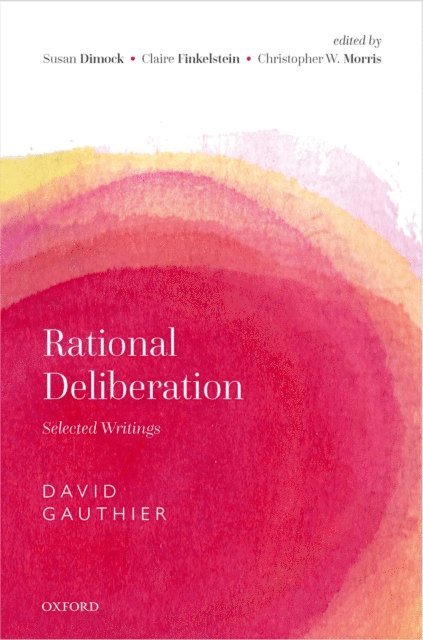
For several decades, David Gauthier has been one of the leading philosophers working on practical rationality and deliberation. This book presents a selection of Gauthier's writings on these topics, all but two of which were written after Morals by Agreement (OUP, 1986). They represent Gauthier's most important contributions to the theory of practical reason, moving some distance from the view a first presented in "Reason and Maximization" and developed in a much-reprinted chapter of Morals by Agreement. These essays challenge common misconceptions of Gauthier's revisionist conception of practical rationality, and provide important insights with implications for economic theory.
1 240 kr
Skickas inom 7-10 vardagar
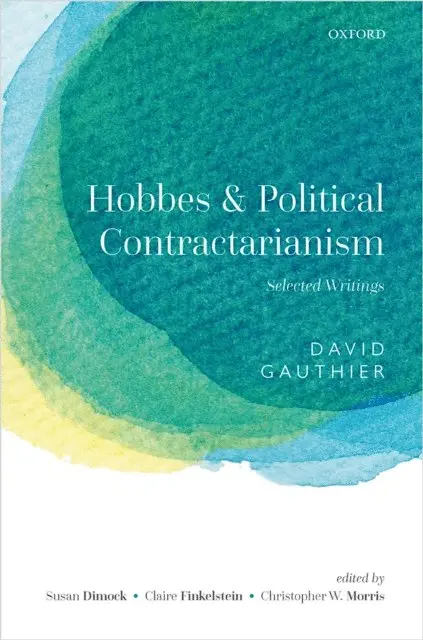
This volume presents a selection of David Gauthier's writings on Thomas Hobbes (1588-1679) and the theory of political contractarianism. The eight essays on Hobbes, written over four decades, represent the author's changing understanding of the moral and political theories since the publication of The Logic of Leviathan (OUP, 1969). These include essays on Hobbes on law, challenging influential readings of his legal philosophy, and a previously unpublished piece, 'The True and Only Moral Philosophy', providing a close reading of chapters 13-15 of Leviathan. The four essays on social contract theory include an extended version of 'Political Contractarianism' (1997), Gauthier's well-known 'Public Reason' (1994), and a paper previously available only in French and Spanish translations.
659 kr
Skickas inom 5-8 vardagar
In this book the author argues that moral principles are principles of rational choice. According to the usual view of choice, a rational person selects what is likely to give the greatest expectation of value or utility. But in many situations, if each person chooses in this way, everyone will be worse off than need be. Instead, Professor Gauthier proposes a principle whereby choice is made on an agreed basis of co-operation, rather than according to what would give the individual the greatest expectation of value. He shows that such a principle not only ensures mutual benefit and fairness, thus satisfying the standards of morality, but also that each person may actually expect greater utility by adhering to morality, even though the choice did not have that end primarily in view. In resolving what may appear to be a paradox, the author establishes morals on the firm foundation of reason.
347 kr
Skickas inom 7-10 vardagar
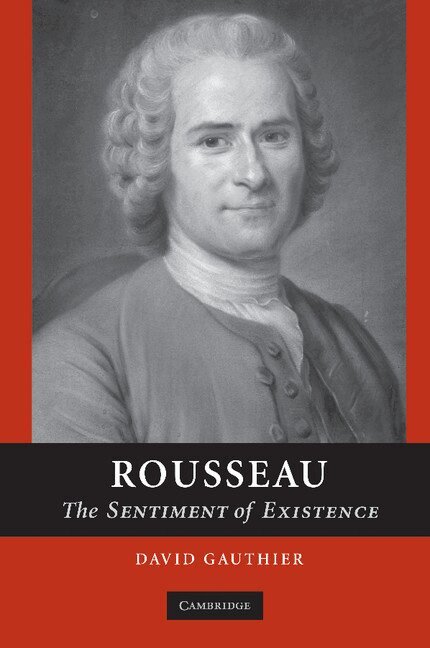
Rousseau is often portrayed as an educational and social reformer whose aim was to increase individual freedom. In this volume David Gauthier examines Rousseau's evolving notion of freedom, where he focuses on a single quest: can freedom and the independent self be regained? Rousseau's first answer is given in Emile, where he seeks to create a self-sufficient individual, neither materially nor psychologically enslaved to others. His second is in the Social Contract, where he seeks to create a citizen who identifies totally with his community, experiencing his dependence on it only as a dependence on himself. Rousseau implicitly recognized the failure of these solutions. His third answer is one of the main themes of the Confessions and Reveries, where he is made for a love that merges the selves of the lovers into a single, psychologically sufficient unity that makes each 'better than free'. But is this response a chimaera?
1 087 kr
Skickas inom 7-10 vardagar
Rousseau is often portrayed as an educational and social reformer whose aim was to increase individual freedom. In this volume David Gauthier examines Rousseau's evolving notion of freedom, where he focuses on a single quest: can freedom and the independent self be regained? Rousseau's first answer is given in Emile, where he seeks to create a self-sufficient individual, neither materially nor psychologically enslaved to others. His second is in the Social Contract, where he seeks to create a citizen who identifies totally with his community, experiencing his dependence on it only as a dependence on himself. Rousseau implicitly recognized the failure of these solutions. His third answer is one of the main themes of the Confessions and Reveries, where he is made for a love that merges the selves of the lovers into a single, psychologically sufficient unity that makes each 'better than free'. But is this response a chimaera?
732 kr
Skickas inom 11-20 vardagar
629 kr
Skickas inom 5-8 vardagar