David Masser – författare
Visar alla böcker från författaren David Masser. Handla med fri frakt och snabb leverans.
3 produkter
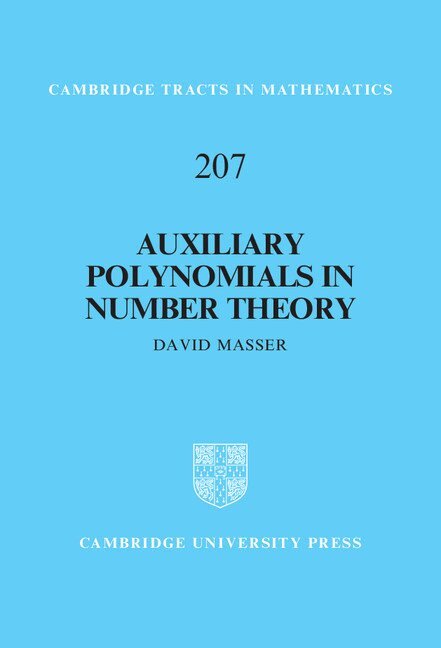
Auxiliary Polynomials in Number Theory
Av David Masser
Inbunden, 2016
2312 kr
Lägg i varukorg
This unified account of various aspects of a powerful classical method, easy to understand in its simplest forms, is illustrated by applications in several areas of number theory. As well as including diophantine approximation and transcendence, which were mainly responsible for its invention, the …
Diophantine Approximation
Lectures given at the C.I.M.E. Summer School held in Cetraro, Italy, June 28 – July 6, 2000
Av David Masser, Yuri V. Nesterenko m. fl.
Häftad, 2003
552 kr
Lägg i varukorg
Diophantine Approximation is a branch of Number Theory having its origins intheproblemofproducing“best”rationalapproximationstogivenrealn- bers. Since the early work of Lagrange on Pell’s equation and the pioneering work of Thue on the rational approximations to algebraic numbers of degree ? 3, it …
Diophantine Approximation
Lectures given at the C.I.M.E. Summer School held in Cetraro, Italy, June 28 – July 6, 2000
Av Michel Waldschmidt, Wolfgang M. Schmidt m. fl.
E-bok, 2008
734 kr
Lägg i varukorg
Diophantine Approximation is a branch of Number Theory having its origins intheproblemofproducing“best”rationalapproximationstogivenrealn- bers. Since the early work of Lagrange on Pell’s equation and the pioneering work of Thue on the rational approximations to algebraic numbers of degree ? 3, it …