David Mcneill - Böcker
Visar alla böcker från författaren David Mcneill. Handla med fri frakt och snabb leverans.
13 produkter
13 produkter
539 kr
Tillfälligt slut
Gesturing is such an integral yet unconscious part of communication that we are mostly oblivious to it. But if you observe anyone in conversation, you are likely to see his or her fingers, hands, and arms in some form of spontaneous motion. Why? David McNeill, a pioneer in the ongoing study of the relationship between gesture and language, set about answering this question in "Gesture and Thought" with an unlikely accomplice - Tweety Bird. McNeill argues that gestures are active participants in both speaking and thinking. He posits that gestures are key ingredients in an "imagery-language dialectic" that fuels speech and thought; gestures are the "imagery" and also the components of "language," rather than mere consequences. The smallest unit of this dialectic is the "growth point," a snapshot of an utterance at its beginning psychological stage. Enter Tweety Bird. In "Gesture and Thought", the central growth point comes from a cartoon. In his quest to eat Tweety Bird, Sylvester the cat first scales the outside of a rain gutter to reach his prey. Unsuccessful, he makes a second attempt by climbing up the inside of the gutter.Tweety, however, drops a bowling ball down the gutter; Sylvester swallows the ball. Over the course of twenty-five years, McNeill showed this cartoon to numerous subjects who spoke a variety of languages. A fascinating pattern emerged. Those who remembered the exact sequence of the cartoon while retelling it all used the same gesture to describe Sylvester's position inside the gutter. Those who forgot, in the retelling, that Sylvester had first climbed the outside of the gutter did not use this gesture at all. Thus that gesture becomes part of the "growth point" - the building block of language and thought. An ambitious project in the ongoing study of the relationship of how we communicate and its connection to thought, "Gesture and Thought" is a work of such consequence that it will influence all subsequent linguistic and evolutionary theory on the subject.
290 kr
Skickas inom 7-10 vardagar
David McNeill, a pioneer in the ongoing study of the relationship between gesture and language, here argues that gestures are active participants in both speaking and thinking. He posits that gestures are key ingredients in an "imagery-language dialectic" that fuels speech and thought. The smallest unit of this dialectic is the growth point, a snapshot of an utterance at its beginning psychological stage. In "Gesture and Thought", the central growth point comes from a Tweety Bird cartoon. Over the course of twenty-five years, the McNeill Lab showed this cartoon to numerous subjects who spoke a variety of languages, and a fascinating pattern emerged. The shape and timing of gestures depends not only on what speakers see but on what they take to be distinctive; this, in turn, depends on the context. Those who remembered the same context saw the same distinctions and used similar gestures; those who forgot the context understood something different and changed gestures or used none at all. Thus, the gesture becomes part of the growth point - the building block of language and thought."Gesture and Thought" is an ambitious project in the ongoing study of how we communicate and how language is connected to thought.
412 kr
Skickas inom 7-10 vardagar
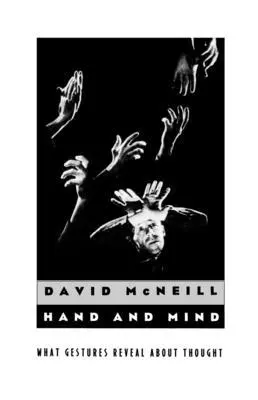
Using data from more than ten years of research, David McNeill shows that gestures do not simply form a part of what is said and meant but have an impact on thought itself. Hand and Mind persuasively argues that because gestures directly transfer mental images to visible forms, conveying ideas that language cannot always express, we must examine language and gesture together to unveil the operations of the mind.
548 kr
Skickas
A new way of viewing language, as a dynamic mode of meaning-making of which gesture is a fundamental part.When David McNeill began his work on gesture more than forty years ago, language and the action of speaking were regarded as separate realms. But language, says McNeill in Language Is Gesture, is dynamic and gesture is fundamental to speaking. Central to his conception of language, and distinct from linguistic analysis, is what McNeill calls the “growth point,” the starting point of making thought and speech one. He uses the term “gesture–speech unity” to refer to the dynamic dimension of adding gesture to speaking. It is the growth point that achieves this unity, whereby thought is embedded in gesture and speech at the same time.Gesture is the engine of language. It is foundational to speaking, language acquisition, the origin of language, animal communication, thought, and consciousness. Gesture is global and synthetic and brings energy; speech is linear and segmented and brings cultural standards. The growth point is a snapshot of an utterance at its beginning psychological stage, the starting point of unifying thought and speech. Growth points create gesture–speech unity by synchronizing a bundle of linguistic features with a gesture that carries the same meaning. This gesture–speech unity is a form of thought, a unique form of cognition.
2 288 kr
Skickas inom 10-15 vardagar
In this volume, the author deals explicitly and literally with the speech-thought relationship. Departing boldly from contemporary linguistic and psycholinguistic thinking, the author offers us one of the truly serious efforts since Vygotsky to deal with this question. A unifying theme is the organization of action, and speech is seen as growing out of sensory-motor representations that are simultaneously part of meaning and part of action.
658 kr
Skickas inom 7-10 vardagar
This landmark study examines the role of gestures in relation to speech and thought. Leading scholars, including psychologists, linguists and anthropologists, offer state-of-the-art analyses to demonstrate that gestures are not merely an embellishment of speech but are integral parts of language itself. Language and Gesture offers a wide range of theoretical approaches, with emphasis not simply on behavioural descriptions but also on the underlying processes. The book has strong cross-linguistic and cross-cultural components, examining gestures by speakers of Mayan, Australian, East Asian as well as English and other European languages. The content is diverse including chapters on gestures during aphasia and severe stuttering, the first emergence of speech-gesture combinations of children, and a section on sign language. In a rapidly growing field of study this volume opens up the agenda for research into a new approach to understanding language, thought and society.
591 kr
Skickas inom 7-10 vardagar
This landmark study examines the role of gestures in relation to speech and thought. Leading scholars, including psychologists, linguists and anthropologists, offer state-of-the-art analyses to demonstrate that gestures are not merely an embellishment of speech but are integral parts of language itself. Language and Gesture offers a wide range of theoretical approaches, with emphasis not simply on behavioural descriptions but also on the underlying processes. The book has strong cross-linguistic and cross-cultural components, examining gestures by speakers of Mayan, Australian, East Asian as well as English and other European languages. The content is diverse including chapters on gestures during aphasia and severe stuttering, the first emergence of speech-gesture combinations of children, and a section on sign language. In a rapidly growing field of study this volume opens up the agenda for research into a new approach to understanding language, thought and society.
2 113 kr
Kommande
Japan is often seen through the lens of an unusually resilient stereotype that it is a nation of risk-averse conformists. David McNeill and Stephen McClure deconstruct that stereotype by showing that there have always been Japanese people who have rejected the status quo, challenged injustice and fought for personal freedom.The book delves into the notion that Japan is a monolithic society in the hope of dispelling it. The authors profile people who have dared to make their voices heard in a society that has traditionally placed a premium on fitting in and not rocking the boat. By sharing their unique stories, it offers readers a more nuanced and deeper understanding of movements for change in historical and contemporary Japan.This book is a critical read for academics and scholars in the fields of Japanese studies, Asian studies, sociology and anthropology, as well as those with a long-standing interest in Japan and Asia, especially in individual or social movements for reform and freedom of expression.
1 024 kr
Skickas inom 7-10 vardagar
Human language is not the same as human speech. We use gestures and signs to communicate alongside, or instead of, speaking. Yet gestures and speech are processed in the same areas of the human brain, and the study of how both have evolved is central to research on the origins of human communication. Written by one of the pioneers of the field, this is the first book to explain how speech and gesture evolved together into a system that all humans possess. Nearly all theorizing about the origins of language either ignores gesture, views it as an add-on or supposes that language began in gesture and was later replaced by speech. David McNeill challenges the popular 'gesture-first' theory that language first emerged in a gesture-only form and proposes a groundbreaking theory of the evolution of language which explains how speech and gesture became unified.
1 417 kr
Skickas inom 7-10 vardagar
As children begin to use language in early childhood, they produce increasingly large units of coherent speech, including narrative descriptions of events. This book examines the process of narrative development in young children, focusing on the development of 'cohesion' - the use of speech and gesture to create coherent perspectives on events. Surveying early narrative development in which gesture plays an integral part, the book explores the development of cohesive, clause-linking devices during the period from age two to three. Illustrated with longitudinal cases studies, the book examines the crib-talk of two-year-old Emily and compares it to the discourse patterns of storybooks and nursery rhymes, and to her father's pre-bedtime routines. In a second case study, the authors trace the changing relationships between speech and gesture in the spontaneous narratives of two-year-old Ella. This book will be invaluable to students and researchers in language acquisition, developmental psychology and gesture studies.
691 kr
Skickas inom 10-15 vardagar
In this volume, the author deals explicitly and literally with the speech-thought relationship. Departing boldly from contemporary linguistic and psycholinguistic thinking, the author offers us one of the truly serious efforts since Vygotsky to deal with this question. A unifying theme is the organization of action, and speech is seen as growing out of sensory-motor representations that are simultaneously part of meaning and part of action.
370 kr
Skickas inom 7-10 vardagar
Gestures are fundamental to the way we communicate, yet our understanding of this communicative impulse is clouded by a number of ingrained assumptions. Are gestures merely ornamentation to speech? Are they simply an 'add-on' to spoken language? Why do we gesture? These and other questions are addressed in this fascinating book. McNeill explains that the common view of language and gesture as separate entities is misinformed: language is inseparable from gesture. There is gesture-speech unity. Containing over 100 illustrations, Why We Gesture provides visual evidence to support the book's central argument that gestures orchestrate speech. This compelling book will be welcomed by students and researchers working in linguistics, psychology and communication.
7 720 kr
Skickas inom 3-6 vardagar
Volume II of the handbook offers a unique collection of exemplary case studies. In five chapters and 99 articles it presents the state of the art on how body movements are used for communication around the world. Topics include the functions of body movements, their contexts of occurrence, their forms and meanings, their integration with speech, and how bodily motion can function as language. By including an interdisciplinary chapter on ‘embodiment’, volume II explores the body and its role in the grounding of language and communication from one of the most widely discussed current theoretical perspectives. Volume II of the handbook thus entails the following chapters: VI. Gestures across cultures, VII. Body movements: functions, contexts and interactions, VIII. Gesture and language,IX. Embodiment: the body and its role for cognition, emotion, and communication, X. Sign Language: Visible body movements as language. Authors include: Mats Andrèn, Richard Asheley, Benjamin Bergen, Ulrike Bohle, Dominique Boutet, Heather Brookes, Penelope Brown, Kensy Cooperrider, Onno Crasborn, Seana Coulson, James Essegby, Maria Graziano, Marianne Gullberg, Simon Harrison, Hermann Kappelhoff, Mardi Kidwell, Irene Kimbara, Stefan Kopp, Grigoriy Kreidlin, Dan Loehr, Irene Mittelberg, Aliyah Morgenstern, Rafael Nuñez, Isabella Poggi, David Quinto-Pozos, Monica Rector, Pio Enrico Ricci-Bitti, Göran Sonesson, Timo Sowa, Gale Stam, Eve Sweetser, Mark Tutton, Ipke Wachsmuth, Linda Waugh, Sherman Wilcox.