David N. Schramm - Böcker
Visar alla böcker från författaren David N. Schramm. Handla med fri frakt och snabb leverans.
10 produkter
10 produkter
2 107 kr
Skickas inom 10-15 vardagar
The second Erice course in the school of Particle-Astrophysics was held in May, 1988. The topic choosen was Dark Matter. This is one of the most exciting top ics at the interface of particle physics and astrophysics. It is developing rapidly now due to a coming together not only of the theoretical concepts from the early universe with the theoretical concepts of galaxy formation, but also the coming to gether of the theorists, experimentalists and observers. It is with Dark Matter, the combined interrelated topics of galaxy formation and the generation of large scale structure that we see a confrontation of the exotic ideas from the early universe, such as phase transitions and unification, coming face to face with the realities of traditional observational cosmology. These realities have recently been heightened by the tremendous number of new observations, demonstrating that large scale structure of the universe is far more complex than anybody had suspected. In particular, we now see large scale foam, apparent large scale velocity fields, indicating devations from the Hubble flow, large scales of the order 100 Mpc, and galaxy formation occurring at high red shifts much greater than unity. We also see an apparent correlation of clusters of galaxies that may even exceed the c- relation of galaxies despite their being on much larger scales with lower average densities.
Supernovae
The Proceedings of a Special IAU Session on Supernovae Held on September 1, 1976 in Grenoble, France
Inbunden, Engelska, 1977
1 067 kr
Skickas inom 10-15 vardagar
Supernovae are among the most exciting things occurring in the universe. Much recent research has concentrated on phenomena related to supernovae. For example, the origin of the cosmic rays and the origin of the bulk of the heavy elements seem to be closely associated with the phenomenon of supernovae. With the discovery of the pulsar in the Crab, it seemed clear that supernovae were also intimately as sociated with the formation of neutron stars and perhaps even black holes. The purpose of the conference, of which this volume contains the proceedings, was to bring together the leaders of supernova re search, each of whom has concentrated on different aspects of the problem, to try to form a coherent picture both observationally and theoretically of our current understanding of supernovae. In so doing, key invited talks were presented on the light curves of super novae, both observationally and theoretically; on the possible uses of supernovae, for example in determination of the Hubble Constant; on the formation and evolution of supernova remnants, again both ob servationally and theoretically. The possibility that supernovae might explain quasars was also presented. A review of the current status of statistics of supernovae was presented, giving the rate at which they go off and the implications with regard to what mass stars are the progenitors for supernovae. Again, this was presented both from the observational point of view and from the theoretical stellar evolution point of view.
1 067 kr
Skickas inom 10-15 vardagar
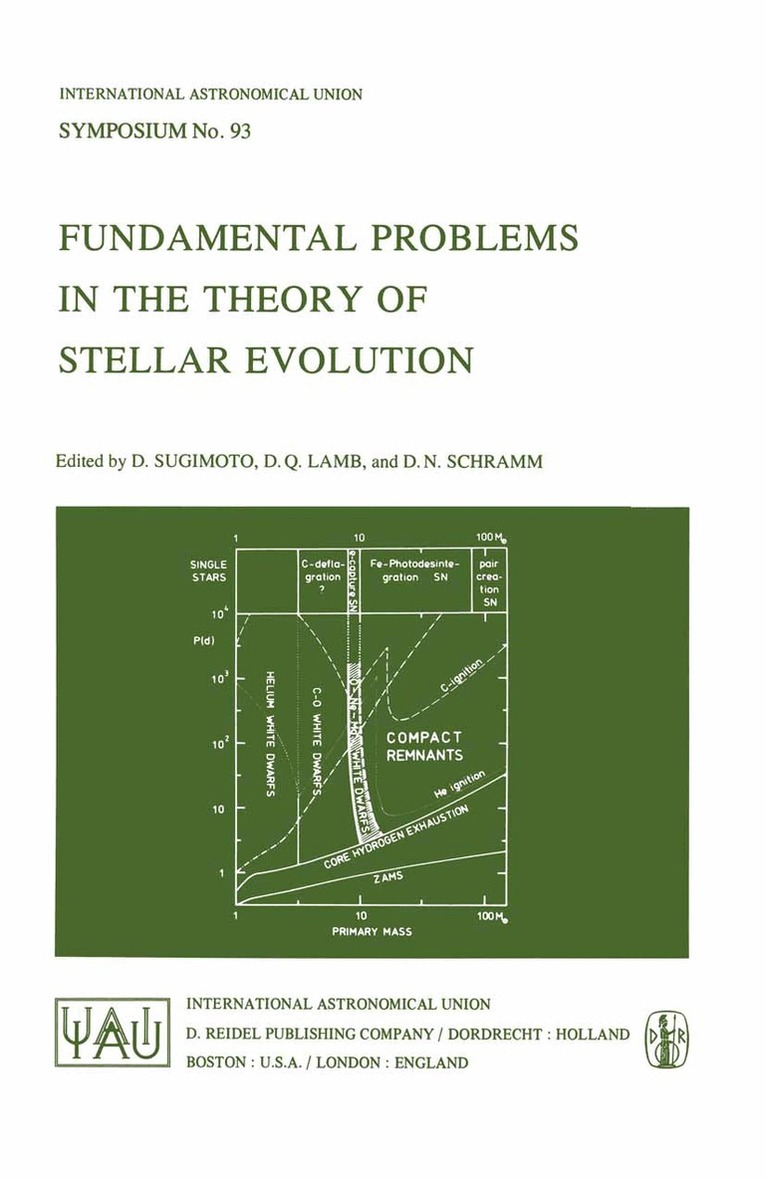
This volume presents the Proceedings of International Astronomical Union Symposium No.93 on Fundamental Problems in the Theory of Stellar Evolution. It contains the texts of all the invited papers, the abstracts of the contributed papers that were read by one of the attending author(s), and edited discussions. Only one abstract is included in this volume from each author who attended, and the abstracts of papers which were read on behalf of absent author(s) are not included. Those papers, which were read but are not included in the volume, are indicated by asterisks in the table of contents. The meeting took place at the University Hall, Kyoto University, Kyoto, Japan from July 22 to 25, 1980, and was sponsored by IAU Commission 35 on Stellar Constitution and co-sponsored by the IAU Commission 42 on Close Binary Stars. Locally, the Symposium was hosted by the Research Institute for Fundamental Physics, Kyoto University with encouragement from the Astronomical Society of Japan. Financial support for the meeting was provided by the IAU, the Japan Society for the Promotion of Sciences, the Japan World Exposition Commemorative Fund, and the Yamada Science Foundation. Preparation for the Symposium and editing of the Proceedings were supported in part by Scientific Research Fund of Japanese Ministry of Education, Science and Culture (530603).
Supernovae
The Proceedings of a Special IAU Session on Supernovae Held on September 1, 1976 in Grenoble, France
Häftad, Engelska, 2011
1 067 kr
Skickas inom 10-15 vardagar
Supernovae are among the most exciting things occurring in the universe. Much recent research has concentrated on phenomena related to supernovae. For example, the origin of the cosmic rays and the origin of the bulk of the heavy elements seem to be closely associated with the phenomenon of supernovae. With the discovery of the pulsar in the Crab, it seemed clear that supernovae were also intimately as sociated with the formation of neutron stars and perhaps even black holes. The purpose of the conference, of which this volume contains the proceedings, was to bring together the leaders of supernova re search, each of whom has concentrated on different aspects of the problem, to try to form a coherent picture both observationally and theoretically of our current understanding of supernovae. In so doing, key invited talks were presented on the light curves of super novae, both observationally and theoretically; on the possible uses of supernovae, for example in determination of the Hubble Constant; on the formation and evolution of supernova remnants, again both ob servationally and theoretically. The possibility that supernovae might explain quasars was also presented. A review of the current status of statistics of supernovae was presented, giving the rate at which they go off and the implications with regard to what mass stars are the progenitors for supernovae. Again, this was presented both from the observational point of view and from the theoretical stellar evolution point of view.
537 kr
Skickas inom 10-15 vardagar
This volwne is the proceedings of the third school in particle astrophysics that Schramm and Galeotti have organized at Erice. The focus of thirs third school was the Generation of Cosmological Large-Scale Structure. It was held in November of 1996. The fIrst school in the series was on "Gauge Theory and the Early Universe" in May 1986, the second was on "Dark Matter in the Universe" in May 1988. All three schools have been successful under the auspices of the NATO Advanced Study Institute. This volume is thus the third in the series of the proceedings of these schools. The choice of the topic for this third school was natural, since the problem of generating a large-scale structure has become the most pressing problem in cosmology today. In particular, it is this generation of structure that is the interface between astronomical observations and particle models for the early universe. To date, all models for generating structures inevitably require new fundamental physics beyond the standard, SU x SU X U , model of high energy physics. The 3 2 I seeds for generating structures usually invoke unifIcation physics, and the matter needed to clump and form them seems to require particle properties that have not been seen in laboratories to date.
2 107 kr
Skickas inom 10-15 vardagar
The second Erice course in the school of Particle-Astrophysics was held in May, 1988. The topic choosen was Dark Matter. This is one of the most exciting top ics at the interface of particle physics and astrophysics. It is developing rapidly now due to a coming together not only of the theoretical concepts from the early universe with the theoretical concepts of galaxy formation, but also the coming to gether of the theorists, experimentalists and observers. It is with Dark Matter, the combined interrelated topics of galaxy formation and the generation of large scale structure that we see a confrontation of the exotic ideas from the early universe, such as phase transitions and unification, coming face to face with the realities of traditional observational cosmology. These realities have recently been heightened by the tremendous number of new observations, demonstrating that large scale structure of the universe is far more complex than anybody had suspected. In particular, we now see large scale foam, apparent large scale velocity fields, indicating devations from the Hubble flow, large scales of the order 100 Mpc, and galaxy formation occurring at high red shifts much greater than unity. We also see an apparent correlation of clusters of galaxies that may even exceed the c- relation of galaxies despite their being on much larger scales with lower average densities.
537 kr
Skickas inom 10-15 vardagar
P. de Bernardis, S. Masi , G. Moreno Dipartimento di Fisica, Universita' "La Sapienza" 00184 Roma Italy ABSTRACT. Anisotropy measurement techniques and results are reviewed, with special attention given to experimental problems. The cosmological relevance of the dipole anisotropy, the only anisotropy truly detected in the Cosmic Background Radiation, is discussed. 1. INTRODUCTION Anisotropy of the Cosmic Background Radiation at 2.7 K (CBR hereafter) is a cosmological topic with a wide range of applications. In order to define anisotropy let us consider fig. 1 a, where the celestial sphere is shown with two beams A and B, with beamwidth 0 and angular separation e. We define the anisotropy of CBR at angular scale e in terms of the difference i'2,1 between the CBR flux I(ex,u) measured in the two beams. At small angular scales (e ) a "stochastic" approach is preferred, and the anisotropy is defined as .cJ I = GBP (1) I e where the brackets indicate averages over the whole celestial sphere.At large angular scales e>l a deterministic approach is preferred, and the CBR flux I(ex, S) is expressed as a sum of spherical harmonics (2) I (ex, S) = I ~ aIm Y (ex, S) lm I,m The alm coefficients give the dipole, quadrupole and higher order components of the anisotropy. 257 P. Galeotti and D. N. Schramm (eds.), Gauge Theory and the Early Universe, 257-282.
3 978 kr
Tillfälligt slut
This volume of important papers by one the world's leading astrophysicists provides a sweeping survey of the incisive and exciting applications of nuclear and particle physics to a wide range of problems in astrophysics and cosmology.The prime focus of the book is on Big Bang cosmology and the role of primordial nucleosynthesis in establishing the modern consensus on the Big Bang. This leads into the connection of cosmology to particle physics and the constraints put on various elementary particles by astrophysical arguments. Big Bang Nucleosynthesis has also led to the argument for nonbaryonic dark matter and is thus related to the major problem in physical cosmology today, namely, structure formation. The nuclear-particle interface with astrophysics also extends to the other topics of major interest such as the age of the universe, cosmic rays, supernovae, and solar neutrinos, each of which will be discussed in some detail. Each section contains historical papers, current papers, and frequently a popular article on the subject which provides an overview of the topic.This volume is testimony to the success of the integration of nuclear and particle physics with astrophysics and cosmology, and to the ingenuity of the work in this area which has earned the author numerous prestigious awards. The book, which is accessible to beginning graduate students, should be of particular interest to researchers and students in astronomy, astrophysics, cosmology and gravitation, and also in high energy and nuclear physics.
1 066 kr
Tillfälligt slut
This volume of important papers by one the world's leading astrophysicists provides a sweeping survey of the incisive and exciting applications of nuclear and particle physics to a wide range of problems in astrophysics and cosmology.The prime focus of the book is on Big Bang cosmology and the role of primordial nucleosynthesis in establishing the modern consensus on the Big Bang. This leads into the connection of cosmology to particle physics and the constraints put on various elementary particles by astrophysical arguments. Big Bang Nucleosynthesis has also led to the argument for nonbaryonic dark matter and is thus related to the major problem in physical cosmology today, namely, structure formation. The nuclear-particle interface with astrophysics also extends to the other topics of major interest such as the age of the universe, cosmic rays, supernovae, and solar neutrinos, each of which will be discussed in some detail. Each section contains historical papers, current papers, and frequently a popular article on the subject which provides an overview of the topic.This volume is testimony to the success of the integration of nuclear and particle physics with astrophysics and cosmology, and to the ingenuity of the work in this area which has earned the author numerous prestigious awards. The book, which is accessible to beginning graduate students, should be of particular interest to researchers and students in astronomy, astrophysics, cosmology and gravitation, and also in high energy and nuclear physics.
Relativistic Astrophysics And Cosmology: Proceedings Of The Eighteenth Texas Symposium
Inbunden, Engelska, 1998
4 258 kr
Tillfälligt slut
Since 1963, the Texas Symposia have been a biennial, peripatetic forum for forefront developments on a wide range of topics in relativistic astrophysics, from pulsars to string theory, from the birth of the universe to the death of stars. The 26 plenary lectures, 230 parallel session talks and 265 poster presentations attest to the scientific vitality of this interdisciplinary field.