David Quentin Voigt - Böcker
Visar alla böcker från författaren David Quentin Voigt. Handla med fri frakt och snabb leverans.
3 produkter
3 produkter
467 kr
Skickas
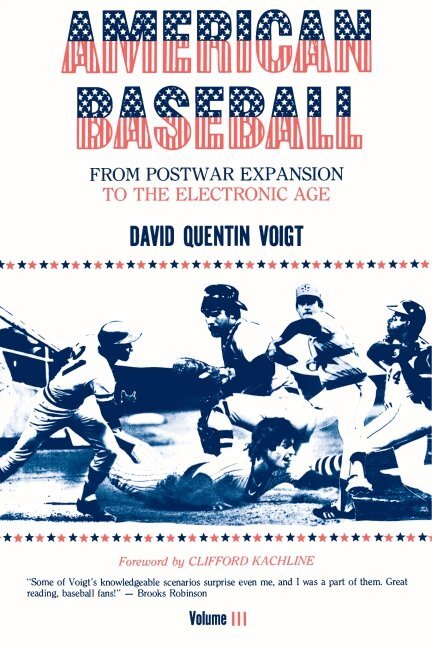
The National Pastime has made big news and big money since its Silver Age (1900–1920), but what old-timer would have dreamed of TV networks bidding tens of millions for camera time, of baseballers getting paid like movie stars, or of all concerned—players, managers, owners, even umpires—having their lives exposed in intimate detail by keyhole journalists? So far the great American game has survived media hype, as this book shows, with the same vitality that brought it through the doldrums of World Wars I and II and the Great Depression and that withstood the shocks of racial integration and union organization. Voigt's overview of American baseball at mid-century shows both major and minor league attendance reaching peaks in 1950, then declining under competition from pro football, basketball, and hockey. Although the minors have steadily lost ground, the majors have held on to profitable turf thanks to westward expansion, night games, TV franchises, and new sources of talent. Black players numbered 100 by 1960 after Jackie Robinson broke the color barrier in 1947, while Hispanic baseballers from the Caribbean and Central America became almost as numerous. About half the big leaguers now hail from university and college teams, and platoons of scouts spot the best talent in high schools and on sandlots. Many of the post-World War II players have become baseball stars, and many have become media superstars.New owners took charge in the expansion era, men described by the author as "individualistic, competitive, and mercenary—qualities sometimes gentled by altruism." Walter O'Malley of the Dodgers is presented as a representative expansionist, a "throwback to the robber barons," a glory-seeker intent on erasing Branch Rickey's fame, and yet a modern Barnum devoted to giving fans their money's worth. A showdown between owners of this stripe and the players' hard-bargaining Marvin Miller seemed a no-win game for the fans.Yet, as America enters the 1980s, this book reports, its "vast enthusiasm for major league baseball remains awesome." Despite the modern world's threats to the stability of the National Pastime, the diamond's mythic power justifies cautious optimism.
463 kr
Skickas inom 7-10 vardagar
Organized baseball from the establishment of the National Commission in 1903 to the period of national expansion in the 1950s and 1960s—buffeted by the winds of two world wars and a Great Depression—is chronicled here in colorful detail.The glories of the Silver Age—Ty Cobb's record-setting, Ed Walsh's pitching innovations, Tinker-to-Evers-to-Chance fielding orchestration—might have been eclipsed by World War I and the 1919 "Black Sox" scandal. Instead, the Roaring Twenties boomed for baseball as well as the stock market. Baseball stars like Babe Ruth rivaled movie stars like Valentino, and baseball managers like Barrow, McGraw, and Mack were as famous as Hollywood directors like DeMille.Professional baseball weathered the Depression and World War II, partly thanks to the introduction of night games. Electronic communication, first radio and then television, hurt the already crippled minor leagues but helped the majors. The electronic media also magnified the impact of stardom, both in its rewards and in its psychic costs. Branch Rickey was a step ahead of the civil rights movement when he signed Jackie Robinson in 1946, starting a quick influx of black and Hispanic players.Desegregation brought some strains, as author Voigt recounts, but fewer than did the advent of successful unionization. Growing pains resulted from rapid league expansion into the burgeoning cities of the Far West and South.Constantly accelerating social and economic change, characteristic of the United States in the 20th century, is mirrored in the history of its National Pastime.
467 kr
Skickas
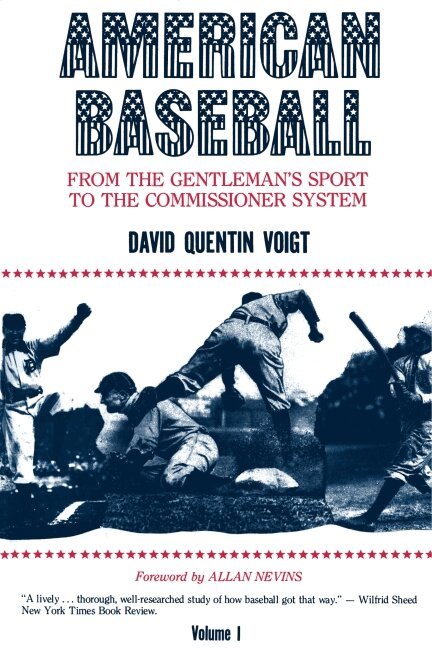
How did "America's National Game" evolve from a gentlemen's pastime in the 1850s to a national obsession in the Roaring Twenties? What really happened at Cooperstown in 1839, and why does the "Doubleday legend" persist? How did the commissioner system develop, and what was the impact of the "Black Sox" scandal? These questions and many others are answered in this book, with colorful details about early big league stars such as Mike "King" Kelly and pious Billy Sunday, Charles Comiskey and Ty Cobb, Napoleon Lajoie and "Cy" (Cyclone) Young. The author explores historically the four major periods of transformation of the game: the Gentlemen's Era, the Golden Age, the Feudal Age, and the incipient Silver Age. Attention is given to the changing face of the major league spectacle, the evolving style of the game, and the changing interests of players, fans, and owners, along with influential innovators and their innovations. There are a number of surprises in the book. For instance, several black players made the big leagues in the 1880s, only to be driven out by a rising tide of Jim Crowism. For three generations black players were to be confined to their own clubs and leagues.American baseball history reflects the nation's economic and social history, as author Voigt graphically demonstrates. On the fans' side, mass attendance at ball games reflects the rise of cities and the dilution of a work ethic with pursuit of leisure; on the owners' and players' side, organized baseball reflects the developing tension between big business and skilled employees. The result—despite ups and downs—is a typical American success story.