David R. Law - Böcker
Visar alla böcker från författaren David R. Law. Handla med fri frakt och snabb leverans.
7 produkter
7 produkter
448 kr
Skickas inom 5-8 vardagar
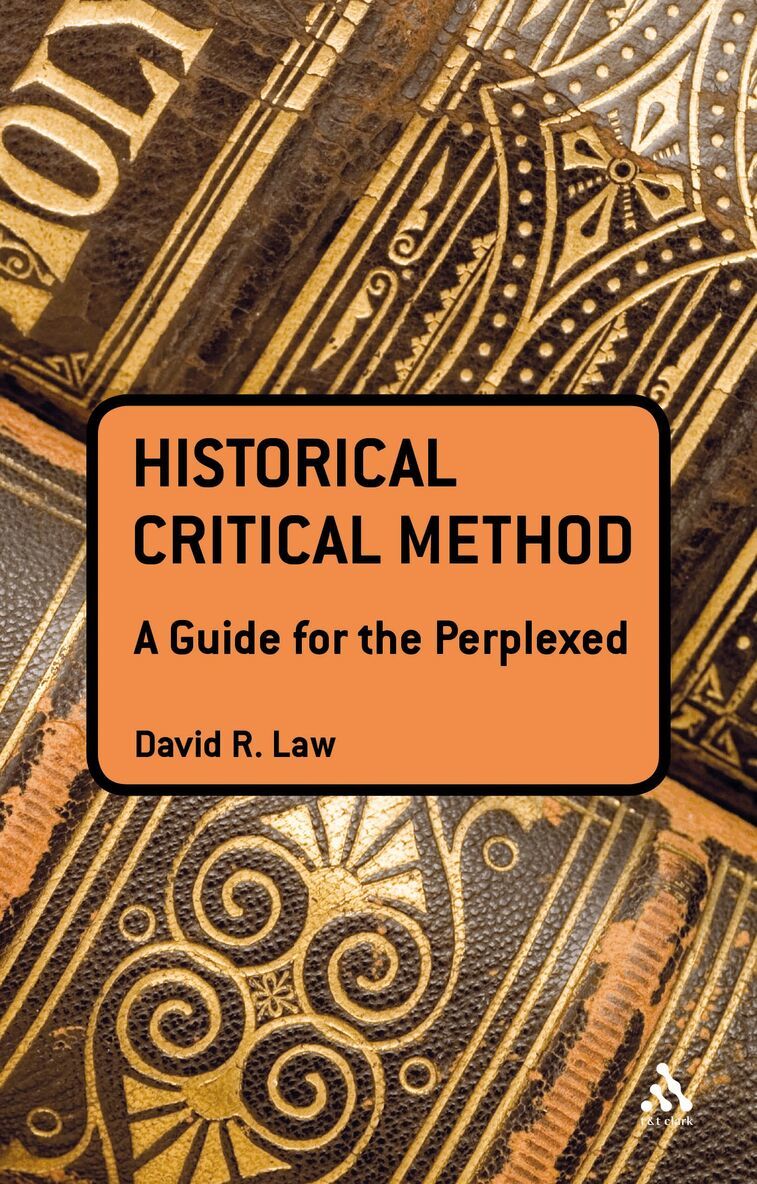
This title offers an introduction to one of the core methods of approaching biblical texts. "Historical Critical Analysis" is the main way in which the Bible (both the Hebrew Bible/Old Testament and the New Testament) has been examined and read by scholars in the last century. The term refers to a range of methodologies which examine the origins of biblical texts, in relation to other contemporaneous texts, to form critical approaches and to questions of authorship, audience and authenticity. The aim is to get as close to the 'original text' and its 'original meaning' as possible. For many years 'Historical Critical Method' has been the cornerstone upon which biblical scholarship is built, even as modern studies examine other theoretical approaches to reading the text in history, tradition, and from different audience perspectives "The Historical Critical Method" still presents the crucial starting point for students and scholars. "Continuum's Guides for the Perplexed" are clear, concise and accessible introductions to thinkers, writers and subjects that students and readers can find especially challenging - or indeed downright bewildering.Concentrating specifically on what it is that makes the subject difficult to grasp, these books explain and explore key themes and ideas, guiding the reader towards a thorough understanding of demanding material.
1 975 kr
Skickas inom 5-8 vardagar
This book is concerned with Kierkegaard's `apophaticism', i.e. with those elements of Kierkegaard's thought which emphasize the incapacity of human reason and the hiddenness of God. Apophaticism is an important underlying strand in Kierkegaard's thought and colours many of his key concepts. Despite its importance, however, it has until now been largely ignored by Kierkegaardian scholarship. The book argues that apophatic elements can be detected in every aspect of Kierkegaard's thought and that, despite proceeding from different presuppositions, he can therefore be regarded as a negative theologian. Indeed, the book concludes by arguing that Kierkegaard's refusal to make the transition from the via negativa to the via mystica means that he is more apophatic than the negative theologians themselves.
1 670 kr
Skickas inom 5-8 vardagar
The orthodox doctrine of the incarnation affirms that Christ is both truly divine and truly human. This, however, raises the question of how these two natures can co-exist in the one, united person of Christ without undermining the integrity of either nature. Kenotic theologians address this problem by arguing that Christ 'emptied' himself of his divine attributes or prerogatives in order to become a human being. David R. Law contends that a type of kenotic Christology is present in Kierkegaard's works, developed independently of the Christologies of contemporary kenotic theologians. Like many of the classic kenotic theologians of the 19th century, Kierkegaard argues that Christ underwent limitation on becoming a human being. Where he differs from his contemporaries is in emphasizing the radical nature of this limitation and in bringing out its existential consequences. The aim of Kierkegaard's Christology is not to provide a rationally satisfying theory of the incarnation, but to highlight the existential challenge with which Christ confronts each human being. Kierkegaard advances 'existential kenoticism', a form of kenotic Christology which extends the notion of the kenosis of Christ to the Christian believer, who is called upon to live a life of kenotic discipleship in which the believer follows Christ's example of lowly, humble, and suffering service. Kierkegaard thus shifts the problem of kenosis from the intellectual problem of working out how divinity and humanity can be united in Christ's Person to the existential problem of discipleship.
1 331 kr
Kommande
455 kr
Kommande
1 719 kr
Skickas inom 5-8 vardagar
This title offers an introduction to one of the core methods of approaching biblical texts. "Historical Critical Analysis" is the main way in which the Bible (both the Hebrew Bible/Old Testament and the New Testament) has been examined and read by scholars in the last century. The term refers to a range of methodologies which examine the origins of biblical texts, in relation to other contemporaneous texts, to form critical approaches and to questions of authorship, audience and authenticity. The aim is to get as close to the 'original text' and its 'original meaning' as possible. For many years "Historical Critical Method" has been the cornerstone upon which biblical scholarship is built, even as modern studies examine other theoretical approaches to reading the text in history, tradition, and from different audience perspectives "The Historical Critical Method" still presents the crucial starting point for students and scholars. "Continuum's Guides for the Perplexed" are clear, concise and accessible introductions to thinkers, writers and subjects that students and readers can find especially challenging - or indeed downright bewildering.Concentrating specifically on what it is that makes the subject difficult to grasp, these books explain and explore key themes and ideas, guiding the reader towards a thorough understanding of demanding material.
541 kr
Skickas inom 10-15 vardagar
Law develops his theory of inspiration starting with texts as varied as Virgil's Aeneid and Shakespeare's plays before focusing on the Bible. Following Karl Jaspers, Law views all human knowledge as having limits beyond which there exists the Transcendent. He believes that there are symbols, signs and characters-or ciphers-that inhabit religion and art and which point beyond these horizons. Perceiving these is at the heart of inspiration and the knowledge of God. For Law, the key to the question of inspiration and the Bible lies with understanding the reader's encounter with these ciphers, the supreme of which is Christ.