David Sheehan - Böcker
Visar alla böcker från författaren David Sheehan. Handla med fri frakt och snabb leverans.
5 produkter
5 produkter
859 kr
Skickas inom 7-10 vardagar
"As will be seen, there is not much missing here. I thought that the sections were well balanced, with rarely too much or too little on a given topic...This is a text to be welcomed by both teachers and students." BIOCHEMISTRY & MOLECULAR BIOLOGY EDUCATION (on the first edition) The second edition of this successful textbook explains the basic principles behind the key techniques currently used in the modern biochemical laboratory and describes the pros and cons of each technique and compares one to another. It is non-mathematical, comprehensive and approachable for students who are not physical chemists. A major update of this comprehensive, accessible introduction to physical biochemistry.Includes two new chapters on proteomics and bioinformatics.Introduces experimental approaches with a minimum of mathematics and numerous practical examples.Provides a bibliography at the end of each chapter.Written by an author with many years teaching and research experience, this text is a must-have for students of biochemistry, biophysics, molecular and life sciences and food science.
1 061 kr
Skickas inom 10-15 vardagar
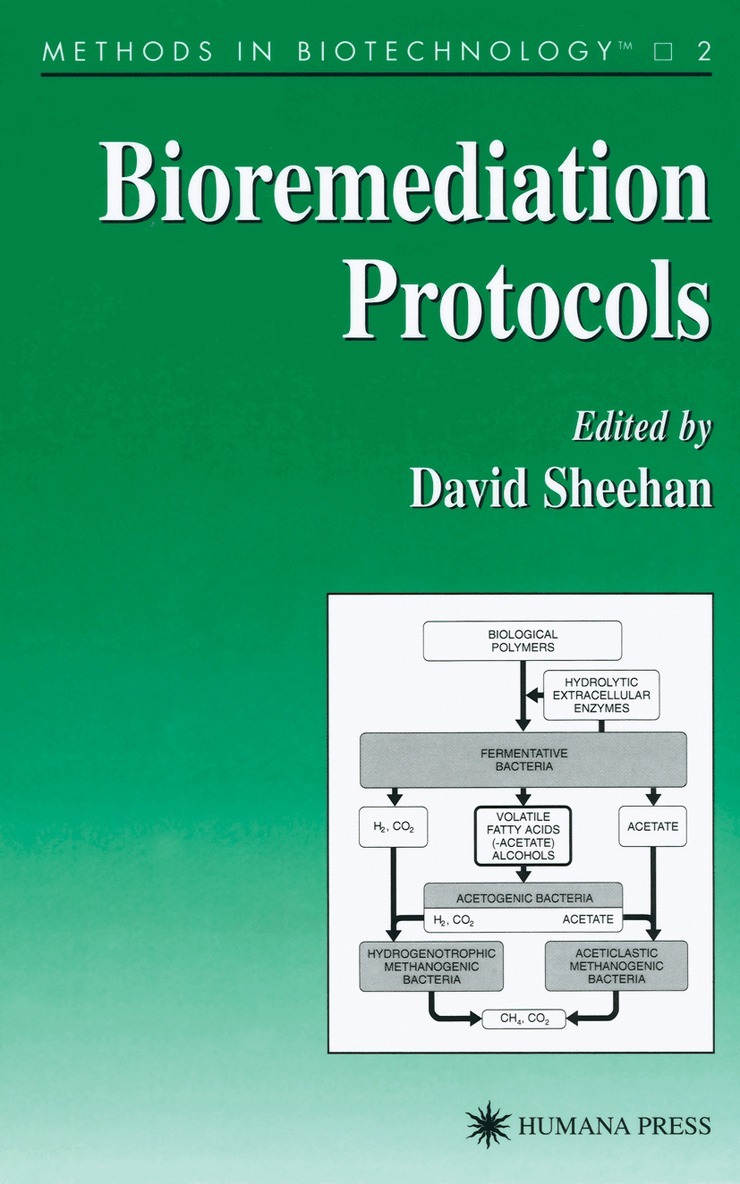
Leading researchers from around the world present their best genetic, chemical, and analytical techniques for studying specific pollutants and their remediation. Their expert procedures range widely from cell immobilization and screening to microbiological and analytical chemistry methods that are applied to such environmental pollutants as hydrocarbons, PAHs, PCBs, TBT, and heavy metals. These pathbreaking contributors have also included illuminating reviews and case studies intended to expand the useful range of the methods, and they discuss such major issues in bioremediation as the design and use of bioreactors, genetic manipulation, and the preparation and analysis of environmental samples.
1 061 kr
Skickas inom 10-15 vardagar
Leading researchers from around the world present their best genetic, chemical, and analytical techniques for studying specific pollutants and their remediation. Their expert procedures range widely from cell immobilization and screening to microbiological and analytical chemistry methods that are applied to such environmental pollutants as hydrocarbons, PAHs, PCBs, TBT, and heavy metals. These pathbreaking contributors have also included illuminating reviews and case studies intended to expand the useful range of the methods, and they discuss such major issues in bioremediation as the design and use of bioreactors, genetic manipulation, and the preparation and analysis of environmental samples.
1 588 kr
Skickas inom 10-15 vardagar
The human genome and other large-scale genome sequencing projects have inevitably led to a focus on the proteins encoded by genes. The field of proteomics has grown enormously as a result and a number of high-throughput technologies have now been developed allowing discovery-led investigations of protein populations rather than more traditional hypothesis-led studies on single proteins. These high-throughput techno- gies include gene and protein microarrays, the yeast two-hybrid system, and various mass spectrometry methodologies. However, despite developments and improvements in these technologies, two-dimensional electrophoresis (2DE) remains one of the most widely used approaches. This technique was revolutionised by the development of immobilised pH gradient strips which are now commercially available. This has made possible highly reproducible separations of matched samples. Developments in staining, mass spectr- etry, and bioinformatics supported these developments and have led to a measure of standardisation in design, execution, and analysis of proteomics experiments. This book began life as a proposed update of the excellent volume 2DE Protocols edited by Andrew Link of the University of Washington at Seattle. However, we re- ised that 2DE has undergone major development in aspects of its technology in recent years and we were anxious to reflect these in the present volume. We are also conscious that many researchers have now begun to apply proteomics methodologies to a growing range of biological material and we were anxious to include contributions to reflect the challenges posed in sample preparation in less widely used organisms.
214 kr
Skickas
Just as Kawasaki was about to green-light the world’s first mass-produced across-the-frame four-cylinder motorcycle, Honda pulled the rug out from under the project by unveiling the CB750-4 at the Tokyo Show in 1968, and lighting the fuse for what was to become motorcycling’s most explosive decade.In never before published interviews with the men responsible for the bike, code-named ‘New York Steak,’ Dave Sheehan relates the story behind the Z1’s development; the secret US testing programme in which a team, including Imola-race winner Paul Smart, rode pre-production bikes disguised as Hondas coast-to-coast across America.The Kawasaki Z1 Story examines the myth, truth and legend surrounding the Z1’s first race win – of which even Kawasaki knew nothing. Here, too, is the full story of the epic three days at Florida’s legendary Daytona Speedway when a trio of Z1s broke more than 50 speed endurance records.