David Sherwyn – författare
2 961 kr
Läs direkt efter köp
2 961 kr
Läs direkt efter köp
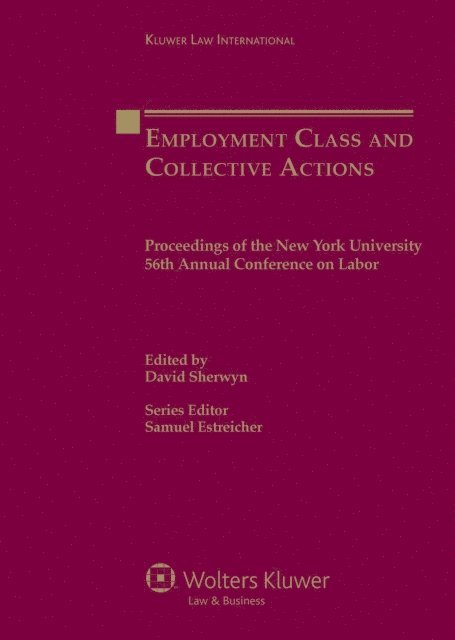
Long regarded as a powerful means to seek individual damages against a corporate defendant, class actions have become a staple of the U.S. litigation system. In recent years, however, several highly significant Supreme Court decisions have weakened the commonality claims of defendants, particularly in workplace discrimination actions. In light of this background, the trends and prospects of employment class actions were the theme of the 56th annual proceedings of the prestigious New York University Conference on Labor, held in May 2003. This important volume reprints the papers presented at that conference, as well as some additional contributions.
Among the considerable expertise brought to bear on this controversial subject, readers will find insightful analysis of such issues as the following:
Effect of class actions on losing companies;Importance of class actions to Title VII enforcement;Obstacles to class litigation;Compliance and internal enforcement challenges for large employers;Opt-in vs. opt-out alternatives for class members;Value and effectiveness of pattern or practice test cases;Legal limits of group identity;Shifting of the burden of proof;Authority of arbitrators to proceed on a classwide basis; andCountering statistical claims of expert witnesses.Because class actions are based on tension – that between commonality and individuation – they tend to accumulate precedent along a spectrum from disconnected disparity to meaningful resolution. In this deeply informed and thought-provoking book, lawyers and academics concerned with both the interests of employers and of employees will proceed with increased awareness as they work on reconciling the practical and theoretical constraints of class litigation.
7 043 kr
Läs direkt efter köp
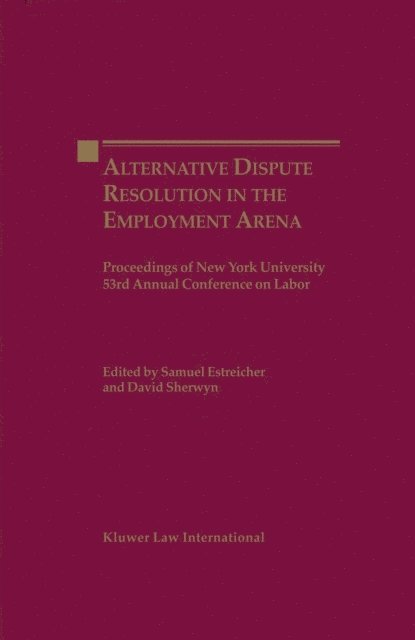
On the strength of the landmark 1991 Gilmer decision of the U.S. Supreme Court, which set a precedent precluding employees from litigation against their employers if they had signed a pre-dispute mandatory arbitration agreement, many U.S. companies have developed mandatory alternative dispute resolution (ADR) policies for employees. However, the issue is far from settled. A major segment of the U.S. labor and employment law community, including the powerful Equal Employment Opportunity Commission (EEOC) and numerous high-profile academics, contend that such agreements are unenforceable, and indeed should be unenforceable as a matter of policy.
This controversy was the theme of New York University''s 53rd Annual Conference on Labor. This long-standing, influential conference is the premier forum for bringing together legal practitioners, academics and researchers, government officials, representatives of companies and labor unions, and human resources specialists to explore solutions to problems in the American workplace. The Conference has recently been brought under the umbrella of the Center for Labor and Employment Law at the New York University School of Law, chaired by Professor Samuel Estreicher.
This valuable symposium addresses such provocative questions as the following:
• What is corporate America doing with respect to ADR?• How have in-house ADR programs fared?• Is ADR an economically efficient method to resolve disputes?• Do due process protocols affect outcomes?• Is post-dispute voluntary arbitration a viable alternative to pre-dispute mandatory arbitration?• Are Gilmer agreements possible in the union setting?• How does arbitration address class actions and injunctions?• Is mediation the better form of ADR?In addition to addressing the technical legal questions, this volume, which reprints the proceedings of the 53rd Annual Conference on Labor, features empirical work that provides data to answer many of the questions that form the basis of many of the policy arguments. This wide-ranging yet incisive survey of expert opinion and analysis in the field will be of great value to all professionals involved in the law and policy attendant on labor and employment in the United States.