David Strand - Böcker
Visar alla böcker från författaren David Strand. Handla med fri frakt och snabb leverans.
3 produkter
3 produkter
2 933 kr
Skickas inom 5-8 vardagar
This book, the result of a collaborative effort between scholars from Europe, Asia, and the US, argues that the central underlying theme of China's development trajectory in this century is `reconstruction' or jianshe, a keyword in twentieth-century Chinese political discourse. The impulse to reform and rebuild has erupted on a national scale every several years and include The May Fourth Movement, the Nanjing decade of 192737, The Yan'an reconsolidation and expansion of communism, the Great Leap Forward, the 1980 reforms, the Democracy Movement, and most recently, China's exploding economy. The contributions examine how a range of actorspolitical leaders, village reformers, government bureaucrats, entrepreneurs, women of child-bearing age, intellectuals, members of ethnic minorities, and local cadreshave reacted to these movements and transitions. They also highlight the importance of the state at the local and central level and discuss the prospects for the continuous search for a national identity balanced between powerful nationalist traditions and manifest cultural diversity. In examining these crucial aspects the contributors rely on new material in the form of original research and extensive fieldwork.
282 kr
Skickas inom 7-10 vardagar
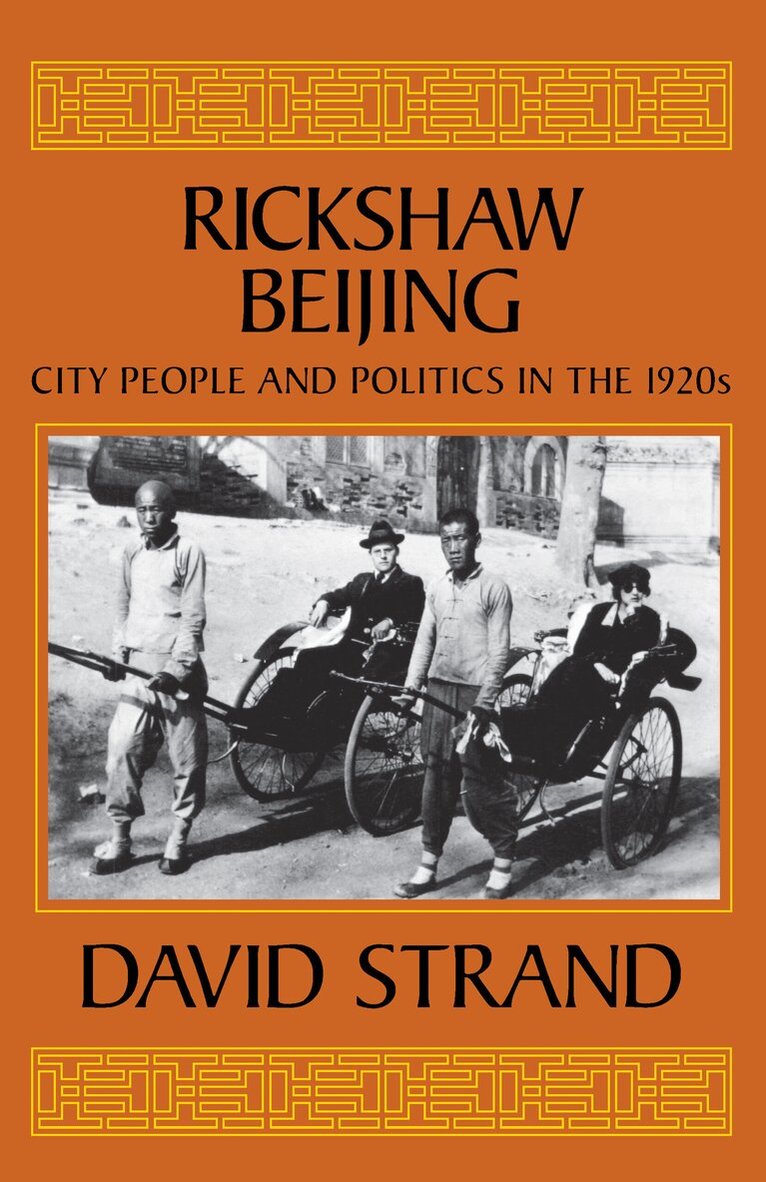
In the 1920s, revolution, war, and imperialist aggression brought chaos to China. Many of the dramatic events associated with this upheaval took place in or near China's cities. Bound together by rail, telegraph, and a shared urban mentality, cities like Guangzhou, Shanghai, and Beijing formed an arena in which the great issues of the day--the quest for social and civil peace, the defense of popular and national sovereignty, and the search for a distinctively modern Chinese society--were debated and fought over. People were drawn into this conflicts because they knew that the passage of armies, the marching of protesters, the pontificating of intellectual, and the opening and closing of factories could change their lives. David Strand offers a penetrating view of the old walled capital of Beijing during these years by examining how the residents coped with the changes wrought by itinerant soldiers and politicians and by the accelerating movement of ideas, capital, and technology.By looking at the political experiences of ordinary citizens, including rickshaw pullers, policemen, trade unionists, and Buddhist monks, Strand provides fascinating insights into how deeply these forces were felt. The resulting portrait of early twentieth-century Chinese urban society stresses the growing political sophistication of ordinary people educated by mass movements, group politics, and participation in a shared, urban culture that mixed opera and demonstrations, newspaper reading and teahouse socializing. Surprisingly, in the course of absorbing new ways of living, working, and doing politics, much of the old society was preserved--everything seemed to change and yet little of value was discarded. Through tumultuous times, Beijing rose from a base of local and popular politics to form a bridge linking a traditional world of guilds and gentry elites with the contemporary world of corporatism and cadres.
696 kr
Skickas inom 7-10 vardagar
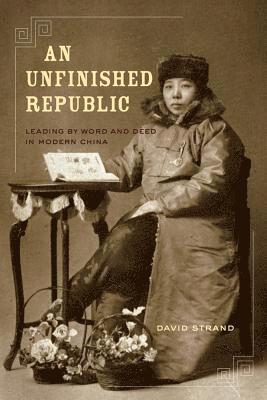
In this cogent and insightful reading of China's twentieth-century political culture, David Strand argues that the Chinese Revolution of 1911 engendered a new political life - one that began to free men and women from the inequality and hierarchy that formed the spine of China's social and cultural order. Chinese citizens confronted their leaders and each other face-to-face in a stance familiar to republics worldwide. This shift in political posture was accompanied by considerable trepidation as well as excitement. Profiling three prominent political actors of the time - suffragist Tang Qunying, diplomat Lu Zhengxiang, and revolutionary Sun Yatsen - Strand demonstrates how a sea change in political performance left leaders dependent on popular support and citizens enmeshed in a political process productive of both authority and dissent.