David Tall - Böcker
Visar alla böcker från författaren David Tall. Handla med fri frakt och snabb leverans.
11 produkter
11 produkter
377 kr
Skickas
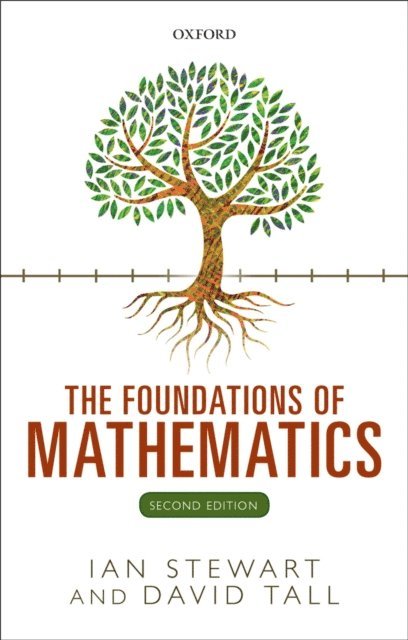
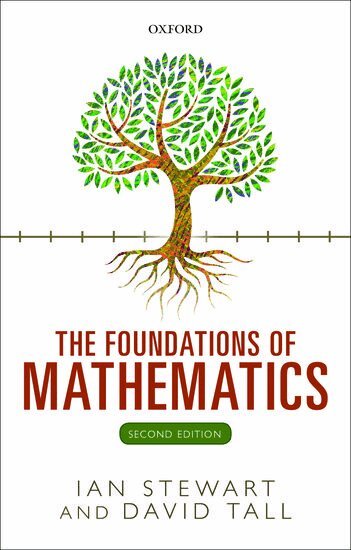
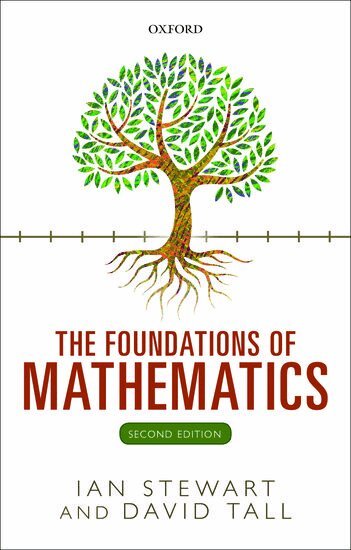
The transition from school mathematics to university mathematics is seldom straightforward. Students are faced with a disconnect between the algorithmic and informal attitude to mathematics at school, versus a new emphasis on proof, based on logic, and a more abstract development of general concepts, based on set theory. The authors have many years' experience of the potential difficulties involved, through teaching first-year undergraduates and researching the ways in which students and mathematicians think. The book explains the motivation behind abstract foundational material based on students' experiences of school mathematics, and explicitly suggests ways students can make sense of formal ideas.This second edition takes a significant step forward by not only making the transition from intuitive to formal methods, but also by reversing the process- using structure theorems to prove that formal systems have visual and symbolic interpretations that enhance mathematical thinking. This is exemplified by a new chapter on the theory of groups. While the first edition extended counting to infinite cardinal numbers, the second also extends the real numbers rigorously to larger ordered fields. This links intuitive ideas in calculus to the formal epsilon-delta methods of analysis. The approach here is not the conventional one of 'nonstandard analysis', but a simpler, graphically based treatment which makes the notion of an infinitesimal natural and straightforward. This allows a further vision of the wider world of mathematical thinking in which formal definitions and proof lead to amazing new ways of defining, proving, visualising and symbolising mathematics beyond previous expectations.
1 095 kr
Skickas inom 5-8 vardagar
The transition from school mathematics to university mathematics is seldom straightforward. Students are faced with a disconnect between the algorithmic and informal attitude to mathematics at school, versus a new emphasis on proof, based on logic, and a more abstract development of general concepts, based on set theory. The authors have many years' experience of the potential difficulties involved, through teaching first-year undergraduates and researching the ways in which students and mathematicians think. The book explains the motivation behind abstract foundational material based on students' experiences of school mathematics, and explicitly suggests ways students can make sense of formal ideas.This second edition takes a significant step forward by not only making the transition from intuitive to formal methods, but also by reversing the process- using structure theorems to prove that formal systems have visual and symbolic interpretations that enhance mathematical thinking. This is exemplified by a new chapter on the theory of groups. While the first edition extended counting to infinite cardinal numbers, the second also extends the real numbers rigorously to larger ordered fields. This links intuitive ideas in calculus to the formal epsilon-delta methods of analysis. The approach here is not the conventional one of 'nonstandard analysis', but a simpler, graphically based treatment which makes the notion of an infinitesimal natural and straightforward. This allows a further vision of the wider world of mathematical thinking in which formal definitions and proof lead to amazing new ways of defining, proving, visualising and symbolising mathematics beyond previous expectations.
1 161 kr
Skickas inom 5-8 vardagar
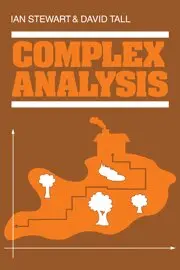
This is a very successful textbook for undergraduate students of pure mathematics. Students often find the subject of complex analysis very difficult. Here the authors, who are experienced and well-known expositors, avoid many of such difficulties by using two principles: (1) generalising concepts familiar from real analysis; (2) adopting an approach which exhibits and makes use of the rich geometrical structure of the subject. An opening chapter provides a brief history of complex analysis which sets it in context and provides motivation.
2 423 kr
Skickas inom 10-15 vardagar
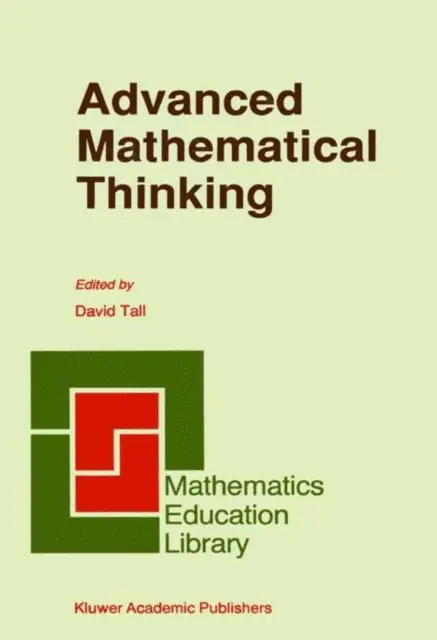
edited by David Tall Science Education Dept., University of Warwick, Coventry, UK Series: MATHEMATICS EDUCATION LIBRARY volume: 11. This book is the first major study of advanced mathematical thinking as performed by mathematicians and taught to students in senior high school and university. Its three main parts focus on the nature of advanced mathematical thinking, the theory of its cognitive development, and reviews of cognitive research. Topics covered include the psychology of advanced mathematical thinking, the processes involved, mathematical creativity, proof, the role of definitions, symbols, and reflective abstraction. The reviews of recent research concentrate on cognitive development and conceptual difficulties with the notions of functions, limits, infinity, analysis, proof, and the use of the computer. They provide a wide overview and an introduction to current thinking which is highly appropriate for the college professor in mathematics or the general mathematics educator. Kluwer Academic Publishers, Dordrecht. October 1991. 308 pp. Hardbound. Dfl.180.00. BrP.72.25. July 1994. 312 pp. Paperback. ISBN 0-7923-2812-4. Dfl.65.00. BrP.26.00.
2 948 kr
Skickas inom 10-15 vardagar
Advanced Mathematical Thinking has played a central role in the development of human civilization for over two millennia. Yet in all that time the serious study of the nature of advanced mathematical thinking – what it is, how it functions in the minds of expert mathematicians, how it can be encouraged and improved in the developing minds of students – has been limited to the reflections of a few significant individuals scattered throughout the history of mathematics. In the twentieth century the theory of mathematical education during the compulsory years of schooling to age 16 has developed its own body of empirical research, theory and practice. But the extensions of such theories to more advanced levels have only occurred in the last few years. In 1976 The International Group for the Psychology of Mathematics (known as PME) was formed and has met annually at different venues round the world to share research ideas. In 1985 a Working Group of PME was formed to focus on Advanced Mathematical Thinking with a major aim of producing this volume. The text begins with an introductory chapter on the psychology of advanced mathema- cal thinking, with the remaining chapters grouped under three headings: • the nature of advanced mathematical thinking, • cognitive theory, and • reviews of the progress of cognitive research into different areas of advanced mathematics.
2 170 kr
Skickas inom 10-15 vardagar
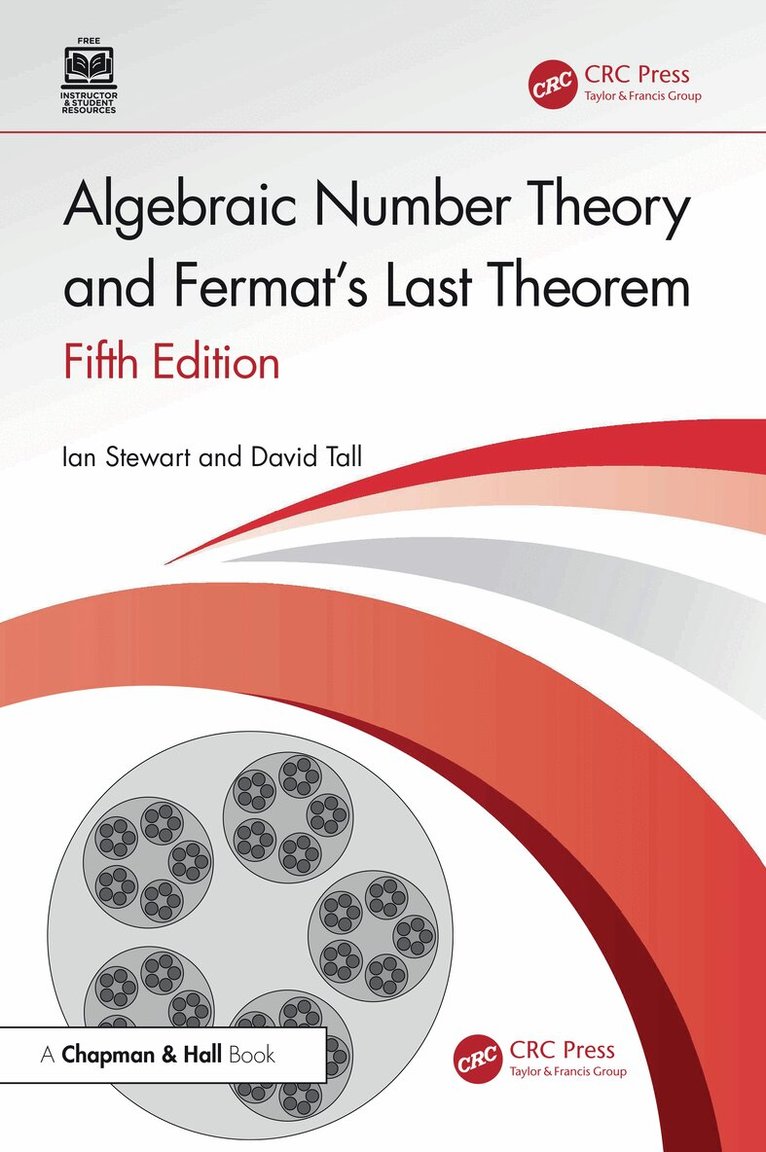
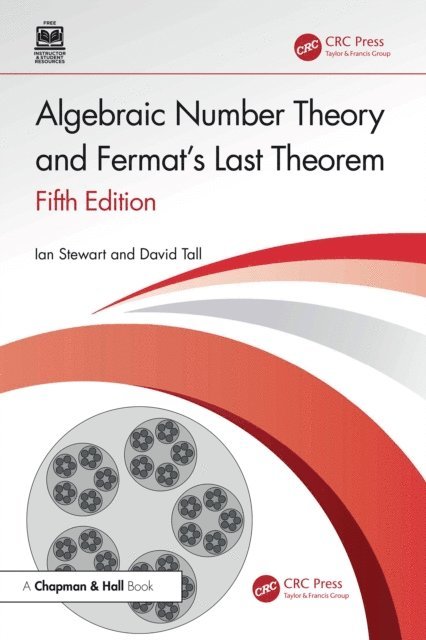
Updated to reflect current research and extended to cover more advanced topics as well as the basics, Algebraic Number Theory and Fermat’s Last Theorem, Fifth Edition introduces fundamental ideas of algebraic numbers and explores one of the most intriguing stories in the history of mathematics—the quest for a proof of Fermat’s Last Theorem. The authors use this celebrated theorem to motivate a general study of the theory of algebraic numbers, initially from a relatively concrete point of view. Students will see how Wiles’s proof of Fermat’s Last Theorem opened many new areas for future work. New to the Fifth EditionPell's Equation x^2-dy^2=1: all solutions can be obtained from a single `fundamental' solution, which can be found using continued fractions.Galois theory of number field extensions, relating the field structure to that of the group of automorphisms.More material on cyclotomic fields, and some results on cubic fields.Advanced properties of prime ideals, including the valuation of a fractional ideal relative to a prime ideal, localisation at a prime ideal, and discrete valuation rings.Ramification theory, which discusses how a prime ideal factorises when the number field is extended to a larger one.A short proof of the Quadratic Reciprocity Law based on properties of cyclotomic fields. ThisValuations and p-adic numbers. Topology of the p-adic integers.Written by preeminent mathematicians Ian Stewart and David Tall, this text continues to teach students how to extend properties of natural numbers to more general number structures, including algebraic number fields and their rings of algebraic integers. It also explains how basic notions from the theory of algebraic numbers can be used to solve problems in number theory.
730 kr
Skickas inom 10-15 vardagar
Updated to reflect current research and extended to cover more advanced topics as well as the basics, Algebraic Number Theory and Fermat’s Last Theorem, Fifth Edition introduces fundamental ideas of algebraic numbers and explores one of the most intriguing stories in the history of mathematics—the quest for a proof of Fermat’s Last Theorem. The authors use this celebrated theorem to motivate a general study of the theory of algebraic numbers, initially from a relatively concrete point of view. Students will see how Wiles’s proof of Fermat’s Last Theorem opened many new areas for future work. New to the Fifth EditionPell's Equation x^2-dy^2=1: all solutions can be obtained from a single `fundamental' solution, which can be found using continued fractions.Galois theory of number field extensions, relating the field structure to that of the group of automorphisms.More material on cyclotomic fields, and some results on cubic fields.Advanced properties of prime ideals, including the valuation of a fractional ideal relative to a prime ideal, localisation at a prime ideal, and discrete valuation rings.Ramification theory, which discusses how a prime ideal factorises when the number field is extended to a larger one.A short proof of the Quadratic Reciprocity Law based on properties of cyclotomic fields. ThisValuations and p-adic numbers. Topology of the p-adic integers.Written by preeminent mathematicians Ian Stewart and David Tall, this text continues to teach students how to extend properties of natural numbers to more general number structures, including algebraic number fields and their rings of algebraic integers. It also explains how basic notions from the theory of algebraic numbers can be used to solve problems in number theory.
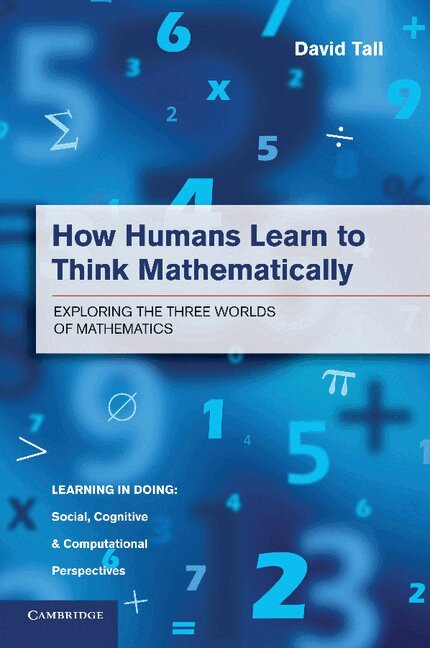
How Humans Learn to Think Mathematically
Exploring the Three Worlds of Mathematics
Inbunden, Engelska, 2013
1 232 kr
Skickas inom 7-10 vardagar
How Humans Learn to Think Mathematically describes the development of mathematical thinking from the young child to the sophisticated adult. Professor David Tall reveals the reasons why mathematical concepts that make sense in one context may become problematic in another. For example, a child's experience of whole number arithmetic successively affects subsequent understanding of fractions, negative numbers, algebra, and the introduction of definitions and proof. Tall's explanations for these developments are accessible to a general audience while encouraging specialists to relate their areas of expertise to the full range of mathematical thinking. The book offers a comprehensive framework for understanding mathematical growth, from practical beginnings through theoretical developments, to the continuing evolution of mathematical thinking at the highest level.
How Humans Learn to Think Mathematically
Exploring the Three Worlds of Mathematics
Häftad, Engelska, 2013
523 kr
Skickas inom 7-10 vardagar
How Humans Learn to Think Mathematically describes the development of mathematical thinking from the young child to the sophisticated adult. Professor David Tall reveals the reasons why mathematical concepts that make sense in one context may become problematic in another. For example, a child's experience of whole number arithmetic successively affects subsequent understanding of fractions, negative numbers, algebra, and the introduction of definitions and proof. Tall's explanations for these developments are accessible to a general audience while encouraging specialists to relate their areas of expertise to the full range of mathematical thinking. The book offers a comprehensive framework for understanding mathematical growth, from practical beginnings through theoretical developments, to the continuing evolution of mathematical thinking at the highest level.
474 kr
Skickas inom 7-10 vardagar
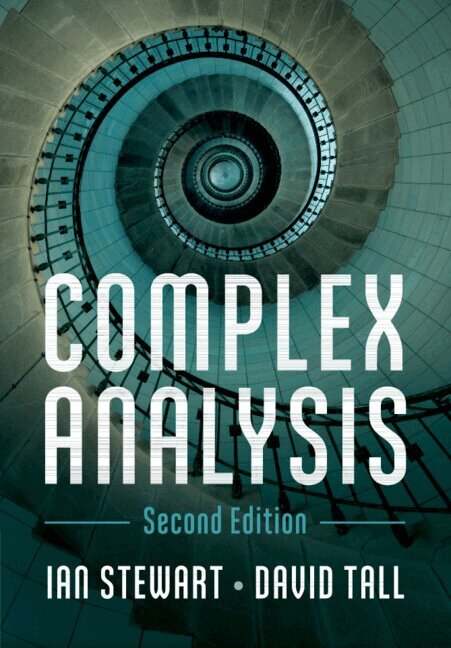
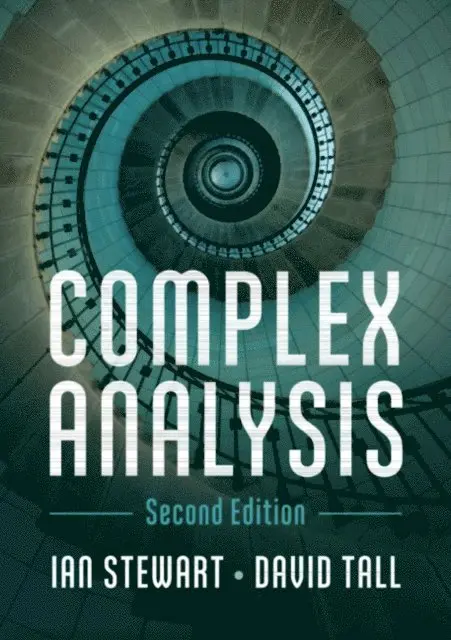
This new edition of a classic textbook develops complex analysis from the established theory of real analysis by emphasising the differences that arise as a result of the richer geometry of the complex plane. Key features of the authors' approach are to use simple topological ideas to translate visual intuition to rigorous proof, and, in this edition, to address the conceptual conflicts between pure and applied approaches head-on. Beyond the material of the clarified and corrected original edition, there are three new chapters: Chapter 15, on infinitesimals in real and complex analysis; Chapter 16, on homology versions of Cauchy's theorem and Cauchy's residue theorem, linking back to geometric intuition; and Chapter 17, outlines some more advanced directions in which complex analysis has developed, and continues to evolve into the future. With numerous worked examples and exercises, clear and direct proofs, and a view to the future of the subject, this is an invaluable companion for any modern complex analysis course.
785 kr
Tillfälligt slut
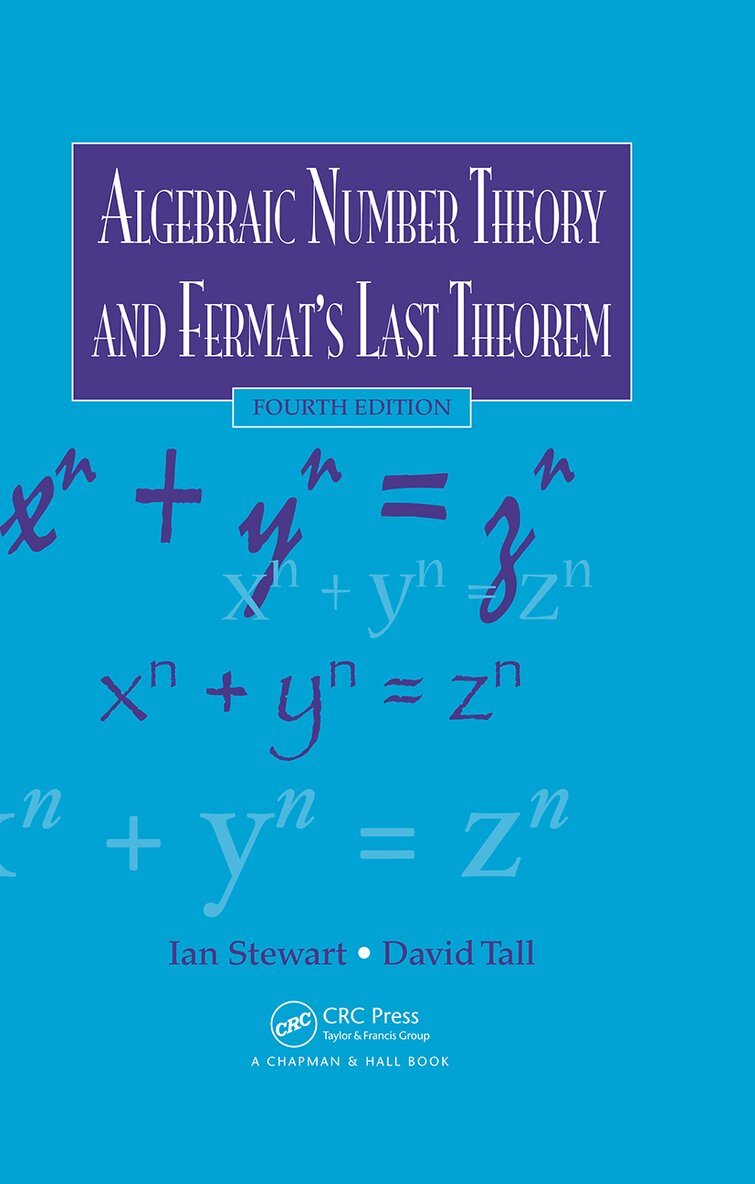
Updated to reflect current research, Algebraic Number Theory and Fermat’s Last Theorem, Fourth Edition introduces fundamental ideas of algebraic numbers and explores one of the most intriguing stories in the history of mathematics—the quest for a proof of Fermat’s Last Theorem. The authors use this celebrated theorem to motivate a general study of the theory of algebraic numbers from a relatively concrete point of view. Students will see how Wiles’s proof of Fermat’s Last Theorem opened many new areas for future work.New to the Fourth EditionProvides up-to-date information on unique prime factorization for real quadratic number fields, especially Harper’s proof that Z(√14) is EuclideanPresents an important new result: Mihăilescu’s proof of the Catalan conjecture of 1844Revises and expands one chapter into two, covering classical ideas about modular functions and highlighting the new ideas of Frey, Wiles, and others that led to the long-sought proof of Fermat’s Last TheoremImproves and updates the index, figures, bibliography, further reading list, and historical remarksWritten by preeminent mathematicians Ian Stewart and David Tall, this text continues to teach students how to extend properties of natural numbers to more general number structures, including algebraic number fields and their rings of algebraic integers. It also explains how basic notions from the theory of algebraic numbers can be used to solve problems in number theory.