D.C. Phillips - Böcker
Visar alla böcker från författaren D.C. Phillips. Handla med fri frakt och snabb leverans.
5 produkter
5 produkter
339 kr
Skickas inom 7-10 vardagar
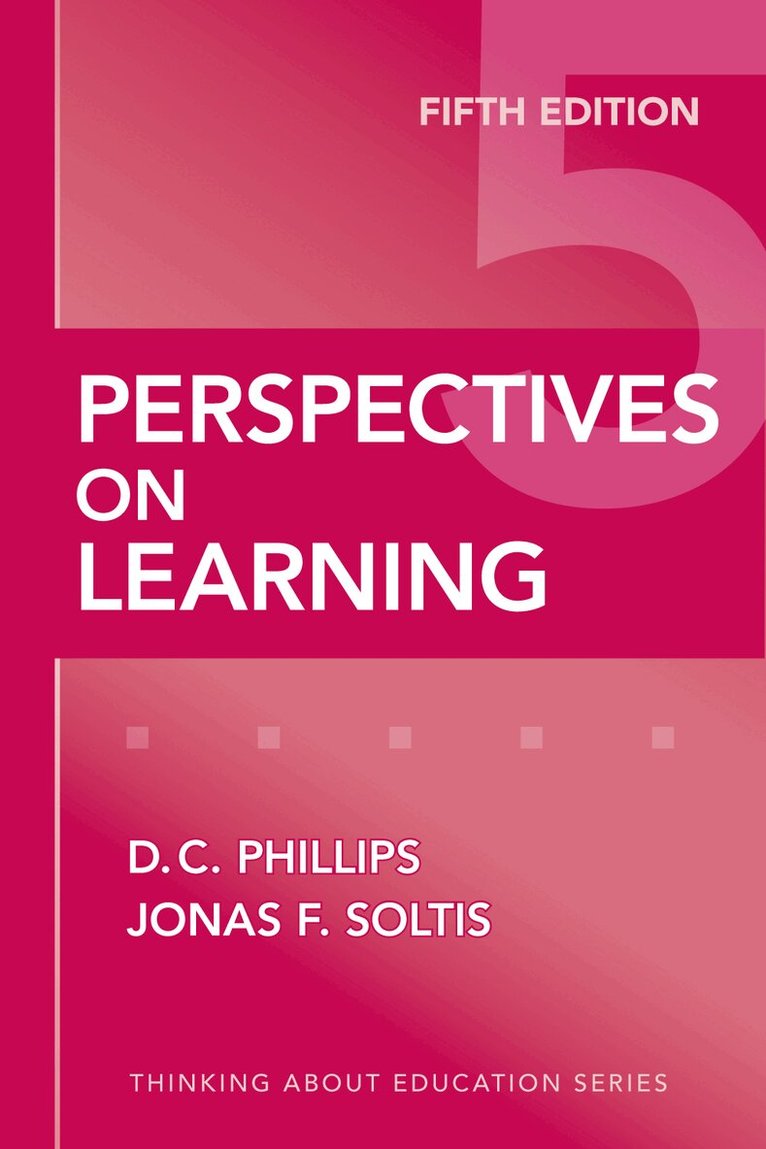
Rather than simply outlining the classical and modern theories of learning, this widely adopted text brings the material to life through case studies that engage students in debates about what really happens in classrooms. Students are encouraged to test the strengths and weaknesses of each theory so that, ultimately, they will learn to formulate their own philosophies of teaching and learning.The new Fifth Edition of Perspectives on Learning features:A discussion of common sense and learning theories.A new chapter on Transfer of Learning.Consideration of recent developments in brain science.A thoroughly updated list of Recommendations for Further Reading.Perspectives on Learning is one of the five books in the highly regarded Teachers College Press Thinking About Education Series, now in its Fifth Edition. All of the books in this series are designed to help pre- and in-service teachers bridge the gap between theory and practice.
319 kr
Skickas inom 5-8 vardagar
461 kr
Skickas inom 5-8 vardagar
Del 2 - Contemporary Philosophies and Theories in Education
Education, Culture and Epistemological Diversity
Mapping a Disputed Terrain
Inbunden, Engelska, 2011
1 381 kr
Skickas inom 10-15 vardagar
In the recent educational research literature, it has been asserted that ethnic or cultural groups have their own distinctive epistemologies, and that these have been given short shrift by the dominant social group. Educational research, then, is pursued within a framework that embodies assumptions about knowledge and knowledge production that reflect the interests and historical traditions of this dominant group. In such arguments, however, some relevant philosophical issues remain unresolved, such as what claims about culturally distinctive epistemologies mean, precisely, and how they relate to traditional epistemological distinctions between beliefs and knowledge. Furthermore, can these ways of establishing knowledge stand up to critical scrutiny? This volume marshals a variety of resources to pursue such open questions in a lively and accessible way: a critical literature review, analyses from philosophers of education who have different positions on the key issues, a roundtable discussion, and interactions between the two editors, who sometimes disagree. It also employs the work of prominent feminist epistemologists who have investigated parallel issues with sophistication. This volume does not settle the question of culturally distinctive epistemologies, but teases out the various philosophical, sociological and political aspects of the issue so that the debate can continue with greater clarity.
1 381 kr
Skickas inom 10-15 vardagar
In the recent educational research literature, it has been asserted that ethnic or cultural groups have their own distinctive epistemologies, and that these have been given short shrift by the dominant social group. Educational research, then, is pursued within a framework that embodies assumptions about knowledge and knowledge production that reflect the interests and historical traditions of this dominant group. In such arguments, however, some relevant philosophical issues remain unresolved, such as what claims about culturally distinctive epistemologies mean, precisely, and how they relate to traditional epistemological distinctions between beliefs and knowledge. Furthermore, can these ways of establishing knowledge stand up to critical scrutiny? This volume marshals a variety of resources to pursue such open questions in a lively and accessible way: a critical literature review, analyses from philosophers of education who have different positions on the key issues, a roundtable discussion, and interactions between the two editors, who sometimes disagree. It also employs the work of prominent feminist epistemologists who have investigated parallel issues with sophistication. This volume does not settle the question of culturally distinctive epistemologies, but teases out the various philosophical, sociological and political aspects of the issue so that the debate can continue with greater clarity.