D.C. Schindler – författare
Visar alla böcker från författaren D.C. Schindler. Handla med fri frakt och snabb leverans.
3 produkter
3 produkter
A Robert Spaemann Reader
Philosophical Essays on Nature, God, and the Human Person
Inbunden, Engelska, 2015
2 149 kr
Skickas inom 5-8 vardagar
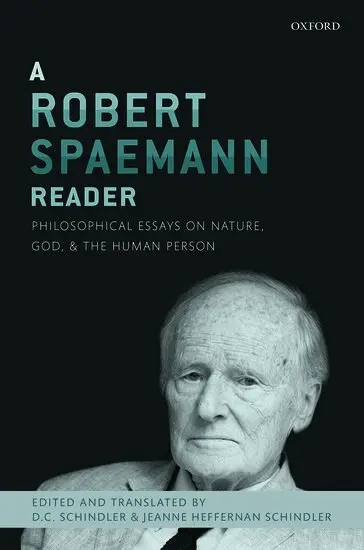
The German philosopher Robert Spaemann is one of the most important living thinkers in Europe today. This volume presents a selection of essays that span his career, from his first published academic essay on the origin of sociology (1953) to his more recent work in anthropology and the philosophy of religion. Spaemann is best known for his work on topical questions in ethics, politics, and education, but the light he casts on these questions derives from his more fundamental studies in metaphysics, the philosophy of nature, anthropology, and the philosophy of religion. At the core of the essays contained in this book is the concept of nature and the notion of the human person. Both are best understood, according to Spaemann, in light of the metaphysics and anthropology found in the classical and Christian tradition, which provides an account of the intelligibility and integrity of things and beings in the world that safeguards their value against the modern threat of reductionism and fragmentation. A Robert Spaemann Reader shows that Spaemann's profound intellectual formation in this tradition yields penetrating insights into a wide range of subjects, including God, education, art, human action, freedom, evolution, politics, and human dignity.
368 kr
Skickas inom 10-15 vardagar
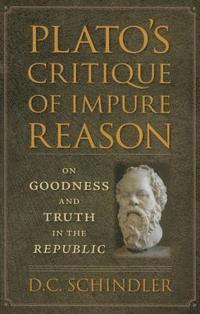
Plato’s Critique of Impure Reason offers a dramatic interpretation of the Republic, at the center of which lies a novel reading of the historical person of Socrates as the “real image” of the good. Schindler argues that a full response to the attack on reason introduced by Thrasymachus at the dialogue’s outset awaits the revelation of goodness as the cause of truth. This revelation is needed because the good is what enables the mind to know and makes things knowable. When we read Socrates’ display of the good against the horizon of the challenges posed by sophistry, otherwise disparate aspects of Plato’s masterpiece turn out to play essential roles in the production of an integrated whole.In this book, D. C. Schindler begins with a diagnosis of the crisis ofreason in contemporary culture as a background to the study of the Republic. He then sets out a philosophical interpretation of the dialogue in five chapters: an analysis of Book 1 that shows the inherent violence and dogmatism of skepticism; a reading of goodness as cause of both being and appearance; a discussion of the dramatic reversals in the images Socrates uses for the idea of the good; an exploration of the role of the person of Socrates in the Republic; and a confrontation between the “defenselessness” of philosophy and the violence of sophistry. Finally, in a substantial coda, the book presents a new interpretation of the old quarrel between philosophy and art through an analysis of Book 10.Though based on a close reading of the text, Plato’s Critique of Impure Reason always interprets the arguments with a view to fundamental human problems, and so will be valuable not only to Plato scholars but to any reader with general philosophical interests.
310 kr
Skickas inom 7-10 vardagar
Ferdinand Ulrich’s Homo Abyssus: The Drama of the Question of Being (Humanum, 2018), originally published in 1961, is one of the most groundbreaking works in Christian metaphysics from the 20th Century. But it is also a difficult book, posing unique challenges to the new reader because of its particular vocabulary, its unusual approach to traditional themes, and the philosophical background that it takes for granted. A Companion to Homo Abyssus is intended to offer readers initial assistance entering into the text and navigating their way once there. Rather than commenting on the text page by page, this book includes five relatively brief essays on basic themes in the original volume and a simplified “digest” of the work’s arguments as they appear in each section. Moreover, it provides a translation of a paper Ulrich delivered just after publishing Homo Abyssus, in which he presents the essential argument of that work in a more concise scope. A Companion to Homo Abyssus will be indispensable to those who are encountering Ulrich’s challenging but profoundly rewarding book for the first time, and beneficial for those who wish to deepen their understanding of the book’s broader implications.